
Final article: A wise decision
“As parents, we all want our children to get a good education. But my child's academic ability is limited; once they lack basic knowledge, they can't keep up with the studies anymore… Last year, they dropped out of school in the first semester. We encouraged them to come back and finish the school year. But this summer, they're dropping out again. At this point, we might as well let them quit altogether, learn a trade, and find a suitable job…” The story of Ms. Dinh Thi Phuong (Van Loi commune, Quy Hop district) made me ponder. Identifying the causes of student dropout and then developing appropriate, fundamental solutions is absolutely essential…
(Baonghean)“As parents, we all want our children to get a good education. But my child's academic ability is limited; once they lack basic knowledge, they can't keep up with the studies anymore… Last year, they dropped out of school in the first semester. We encouraged them to come back and finish the school year. But this summer, they're dropping out again. At this point, we might as well let them quit altogether, learn a trade, and find a suitable job…” The story of Ms. Dinh Thi Phuong (Van Loi commune, Quy Hop district) made me ponder. Identifying the causes of student dropout and then developing appropriate, fundamental solutions is absolutely essential…
>>Lesson 1: What are the causes of dropping out of school?
In a discussion about the issue of students dropping out of school, Mr. Le Duc Thuc, Principal of Nguyen Duc Mau High School (Quynh Luu), said: “The school is located in a disadvantaged area, and most of the students' families are fishermen, so they pay little attention to their children's education. Of the 32 students who dropped out, only a few cases were due to difficult circumstances; the rest were due to weak academic performance and a lack of interest in studying. For these students, the school had previously conducted counseling and opened charity classes to provide remedial instruction. However, they lacked the ability and could not keep up with the curriculum, leading to them repeating grades and dropping out. Once students are discouraged from studying, the school is powerless to do anything more…” Among the students who dropped out, five have registered to attend vocational schools. According to the principal, this is a “wise decision,” because when academically weak, it is necessary to find another path to establish oneself and build a career.
According to statistics, in the past school year, Quynh Luu district had the highest number of students dropping out in the province: 470 students, including 1 primary school student; 158 secondary and junior high school students; and 311 high school and senior high school students. According to Mr. Vo Minh Ky, Head of the District Education Department, these students need to be categorized and their reasons for dropping out analyzed in order to find appropriate solutions. For students who drop out due to difficult circumstances, all levels and sectors will be mobilized to help and create all conditions for them to return to school; for students with weak academic performance, guidance should be given to vocational training and finding suitable employment. It is not advisable to force students to attend school when they do not want to learn, as this will affect other students in the class, impact the quality of education, and waste resources and learning time…
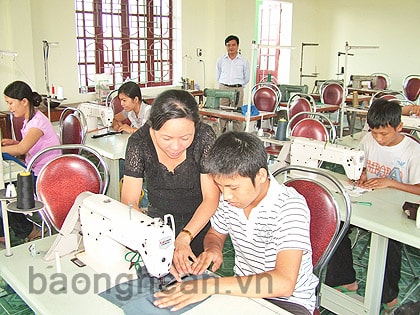
Instructions for learning tailoring skills at the Do Luong Humanitarian Center.
Photo: Huu Nghia
Clearly, career guidance, helping students choose the right path, is far more beneficial than trying to force them into school only to have them placed in the wrong classes. However, the current student streaming system still faces many obstacles. According to statistics from the Department of Education and Training, the average annual enrollment rate for 10th grade in high schools in the province is around 75% of the number of students graduating from junior high school. In the 2012-2013 school year alone, 34,462 students were admitted to 10th grade in high schools, accounting for 74.75% of the students graduating from junior high school in the 2011-2012 school year. The remaining students, however, only a small percentage attend vocational schools.
Currently, Nghe An province has 5 vocational secondary schools, but across all courses, only 157 students who graduated from junior high school enroll. Mr. Nguyen Manh Ha, Head of the Vocational Education Department of the Department of Education and Training, stated: “A significant number of students lack the ability to pursue higher education, but due to parental prejudice against skilled workers, they decide to send their children to secondary school at all costs. Upon reaching high school, many students are forced to repeat the year due to not being able to keep up with the curriculum, and some drop out midway, returning home without knowing what to do. Meanwhile, there is a great need for skilled labor, but parents pay little attention to vocational secondary schools, causing a huge waste for society.”
However, many students and families are able to assess their children's and their own academic abilities to determine a clear career path. This is the case of Nguyen Van Ty (Nghia Loc commune, Nghia Dan district), who decided to drop out of high school despite his parents' and teachers' attempts to dissuade him. “I know my own academic abilities. Even if I try my best, I can only finish high school and get a high school diploma without a profession, and I'll just end up working in the fields. It's better to quit early and find a way to make a living…” After dropping out, Ty researched various trades at the Western Nghe An Economic and Technical College (Thai Hoa town) and enrolled in a course in household electrical repair. In just over a year, while studying and working part-time at large repair shops in Thai Hoa town, Ty became a skilled technician. After finishing his studies, Ty returned to his hometown, rented a space in the center of the commune, and opened a kiosk repairing electrical appliances to serve people in the commune and neighboring communes, earning around 150-200 thousand dong per day.
At Mr. Nguyen Dinh Hoai's farm (My Thanh, Yen Thanh), which specializes in large-scale industrial pig farming, he employs up to 10 permanent workers, including 3 veterinary specialists, with salaries ranging from 2.5 to 3 million VND per month. “It was very difficult to find three graduates from a veterinary vocational school to work at the farm. There are plenty of unskilled laborers, easy to find and hire, but skilled and knowledgeable workers are very rare. These three are all from the district, graduated from a veterinary vocational school, and have expertise and skills, so they have contracts with multiple farms at once, while also running a livestock feed and veterinary medicine store and providing livestock treatment services…”
In the current context, with the country undergoing industrialization and modernization of agriculture and rural areas, the demand for skilled labor with scientific and technical knowledge is increasing. The national target program for building new rural areas, with its criteria of introducing mechanization into production, requires farmers to have basic knowledge of machinery, its use, maintenance, and repair. However, very few students after graduating from junior and senior high school pursue these professions. Furthermore, the implementation of specialized and extensive production zones, commodity production, and high-quality product manufacturing... all demand a highly skilled workforce with scientific and technical knowledge.
Analysis reveals that the most fundamental solution to effectively prevent school dropout is to identify the root causes of dropout and implement appropriate solutions. For primary school students, it's essential to encourage and motivate them to attend classes, ensuring they acquire a basic foundation of knowledge. For secondary and high school students, the reasons for dropping out must be clearly defined: those dropping out due to difficult circumstances should be helped to ensure they have the "three necessities" (food, clothing, and school supplies); while those dropping out due to academic shortcomings should receive clear career guidance. This requires schools to effectively guide students into appropriate career paths upon entering and after secondary school.
On the other hand, vocational schools and training centers must base their enrollment on the actual labor needs of each locality, selecting appropriate professions and linking training with job placement. In addition, the province needs mechanisms to support and encourage businesses and farm owners to employ skilled local workers. Local authorities, when assigning positions such as agricultural and forestry extension officers; Farmers' Association members; and village/hamlet agricultural extension workers, should pay attention to training students after graduating from lower secondary school to pursue vocational training, creating suitable and stable jobs for them.
Discussing this issue, Mr. Nguyen Trong Hoan, Deputy Chief of the Office of the Department of Education and Training, acknowledged: “When compiling statistics on the number of students dropping out, we have not yet analyzed and broken down the causes to accurately and clearly identify the reasons for each individual. Therefore, the current solution of the department is still to coordinate with all levels, sectors, authorities, and organizations to encourage students to return to school. Frankly, preventing students from dropping out is still ineffective and unsustainable. There are many cases where students drop out, are encouraged to return to school for a while, and then drop out again. In the future, the department will have specific solutions, clearly defining the reasons for student dropout to provide optimal solutions…”
THANH PHUC


