
Final article: Creating motivation for the poor and impoverished communities to rise up.
Supporting and assisting poor communes in western Nghe An province is an innovative and correct policy of the province, creating high consensus among officials, civil servants, and the people. This also serves as a driving force for the poor and impoverished communes to actively strive for socio-economic development, maintaining political stability and social order. Nghe An Newspaper had an interview with Comrade Le Xuan Dai - Member of the Provincial Party Standing Committee, Vice Chairman of the Provincial People's Committee, and Head of the Western Steering Committee of the province - on this issue.
(Baonghean)Supporting and assisting poor communes in western Nghe An province is an innovative and correct policy of the province, creating high consensus among officials, civil servants, and the people. This also serves as a driving force for the poor and impoverished communes to actively strive for socio-economic development, maintaining political stability and social order. Nghe An Newspaper had an interview with Comrade Le Xuan Dai - Member of the Provincial Party Standing Committee, Vice Chairman of the Provincial People's Committee, and Head of the Western Steering Committee of the province - on this issue.
>>Lesson 1: Acts of Sharing
PV:Comrade, after a year of implementing the campaign to encourage units, agencies, and businesses to support and assist poor communes in the western part of Nghe An province, how do you assess this work?
Comrade Le Xuan Dai:The overarching principle of the action program is to mobilize resources to support and assist poor communes in western Nghe An province in achieving rapid and sustainable poverty reduction, gradually increasing income, ensuring living conditions and quality of life for the poor, and helping them access and benefit from infrastructure, culture, education, health, and social security. Through monitoring 85 agencies and units in the area assisting 89 poor communes in western Nghe An, we have seen promising initial results.
That is, agencies and units have provided various forms of assistance and support to poor communes, such as: visiting and giving gifts to poor families and providing essential resources for commune operations; supporting and assisting communes in strengthening the grassroots political system and disseminating legal information; supporting and assisting in the construction of legal libraries; guiding commune People's Committees in the implementation of annual and phased planning; supporting the construction of housing for 34 poor households and policy beneficiary families; building 3 schools, 1 computer classroom, 3 health stations, and infrastructure projects including transportation, clean water, and boarding houses for ethnic minority students; supporting and assisting in training and transferring advanced scientific and technical knowledge in agricultural production, livestock development, and vocational training; supporting and assisting in building models and providing loans for economic development. In 2012, the units provided assistance to the People's Committees of communes to implement 37 high-yield livestock and crop farming models. Several units organized free medical examinations, treatment, and medication distribution. The results of mobilizing assistance for the poor and impoverished communes in the western part of the province in 2012 reached nearly 29 billion VND. Through this initiative, poverty reduction in the western region of the province has been achieved by 5-7% per year.
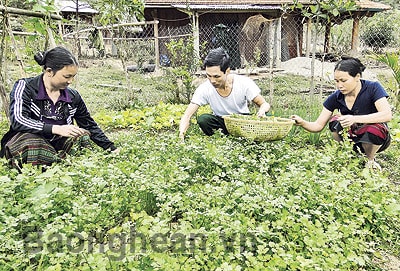
My Ly Border Guard Station encourages local people to grow green vegetables in their family gardens.
PV:In your opinion, what are the remaining limitations and shortcomings in providing assistance and support to poor communes in western Nghe An province?
Comrade Le Xuan Dai:Through our observations, we have found that during the process of assisting poor communes, many units have been merely going through the motions, failing to survey and understand the practical situation at the grassroots level. Furthermore, some units report their assistance to communes based on the performance of their relevant professional duties, rather than having a program or roadmap aimed at long-term support.
In reality, the implementation of the campaign to help the poor and impoverished communes in our province has not achieved the desired results due to the difficulties facing the global and domestic economies. The dissemination of policies and guidelines, and the raising of awareness among all levels, sectors, and people's organizations at the grassroots level, remain limited. Surveys and planning for step-by-step assistance to the poor and impoverished communes lack specific, long-term direction. The implementation of plans and projects in some localities is slow, not closely aligned with reality, and some units have not implemented the plans as set out. The assigned staff are part-time, meaning they have limited time to work in the field, and their understanding of the local customs and traditions is very limited. Supervision and monitoring of implementation have not been frequent or thorough.
During the survey, some agencies and sectors showed poor coordination. Furthermore, the infrastructure in the western mountainous communes still faces many difficulties, transportation is inconvenient, the capacity of key officials is limited, and the general level of education is low. The percentage of poor households in the communes receiving support remains high, the awareness of the people in the mountainous areas is generally backward, the mentality of dependence and reliance is still prevalent, and a segment of the population lacks full awareness and has not fully developed the spirit of self-improvement. Because this is a new policy, its implementation in agencies and units has sometimes been inconsistent; there is still confusion in coordinating the implementation of tasks.
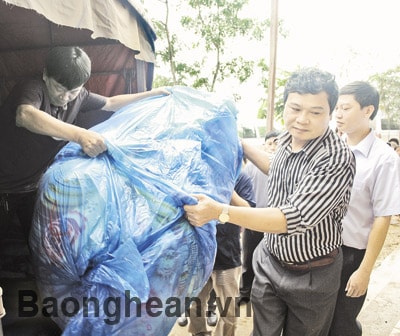
The Department of Construction presents gifts to Tay Son commune, Ky Son district (small photo).
PV:How to ensure that this assistance is truly meaningful and has long-term effectiveness is a matter of concern for both the giver and the receiver. Could you tell us what direction the Steering Committee will focus on in the coming period to make this initiative more practically effective?
Comrade Le Xuan Dai:The objectives of the action program to assist poor communes in 2013 and the following years are defined as continuing to support the building and strengthening of the political system at the grassroots level, organizing training to improve the skills of commune-level officials and civil servants, guiding the effective implementation of funding and support from agencies and units; focusing resources on supporting the construction of housing and infrastructure for the poor and poor communes in the western region of Nghe An province, contributing positively to the rapid and sustainable poverty reduction effort.
In this process, we also recognize that poverty eradication cannot be undertaken by a single organization or individual, but requires the collective efforts of the entire society. We must invest in infrastructure development while simultaneously integrating socio-economic development programs and projects such as Programs 134, 135, 30a, Program 167, and new rural development programs and projects, especially focusing on replicating successful models and applying scientific and technological advancements to production. At the same time, we must mobilize the community to help the poor, contributing to increased resources for impoverished communes.
Western Nghe An province accounts for 83.36% of the province's area and 36.5% of its population. This region is considered to have great potential in terms of land resources, forest resources, and mineral resources for the development and expansion of agricultural and forestry production, as well as large-scale mineral exploitation linked to processing industries. Under the direction of the Government, the Provincial Party Committee and the Provincial People's Committee have implemented many policies to support the development of Western Nghe An. The support of various departments, agencies, units, and businesses has been crucial in ensuring social welfare and creating stability for long-term development.
In the coming period, the province will focus more on directing, leading, and managing the western region more effectively and with higher priority. It will continue to implement programs and projects more effectively and synchronously. It will improve infrastructure development and agricultural and forestry development linked to sustainable poverty reduction. During this process, under the direction of the Provincial People's Committee, units, agencies, and businesses will continue to assist poor communes. The Provincial People's Committee will strengthen its efforts to urge all levels, sectors, and socio-political organizations to mobilize support for the poor and impoverished communes in the western region, creating consensus among all segments of the population, contributing to socio-economic development, and ensuring national defense and security.
The assistance provided to poor communes by assigned agencies and units needs to be more systematically organized, from planning and mobilizing officials and employees to coordinating with commune Party committees and authorities for implementation. During this process, units, agencies, and businesses need to mobilize resources and integrate programs and projects within their functional scope to organize assistance for the poor and poor communes as committed. The Provincial People's Committee will direct the western districts to continue to organize and supervise the People's Committees of the communes in receiving and using the donated funds purposefully and effectively; and to organize inspections, supervision, preliminary reviews, and final summaries to draw lessons from the Steering Committee's leadership and management of the plan to mobilize support for the poor and poor communes in western Nghe An.
PV:Thank you, comrade!
PVTS Group


