
Final article: Creating new impetus for development
(Baonghean)It can be said that the transformation of state-owned agricultural and forestry farms is a crucial "breakthrough" that creates momentum for innovation and development in these farms.
>>Lesson 3: New bottle... new wine?
Following the transition from Resolution 28, our province has actively reviewed and assessed the current state of state-owned agricultural and forestry farms, thereby identifying the specific tasks and roles of each farm to rationally adjust the management and use of land resources for optimal efficiency. Specifically, the system of state-owned agricultural and forestry farms in our province has been reorganized as follows: Agricultural companies now consist of 7 independent single-member limited liability companies (reducing the number of companies in the 19/5 Nghe An Fruit and Vegetable Company). Of these, the Nghe An Tea Development Limited Liability Company has 8 member units with accounting records, and the Nghe An Rubber and Coffee Investment and Import-Export Limited Liability Company has 6 member units with accounting records. Forestry companies now consist of 5 independent single-member limited liability companies, of which the Song Hieu Forestry Limited Liability Company has 6 member units with accounting records. There are 14 management boards for protection forests and special-use forests, including 9 boards converted from state-owned forestry companies and forest farms, 4 protection forest management boards, and the newly established Pù Huống Nature Reserve Management Board.
Previously, the agricultural and forestry farm system managed large areas of land but did not utilize it effectively. After the transformation and implementation of a new management method, the potential of the land has been exploited. Areas of unused land, land used for the wrong purpose, or land used for the wrong purposes have been clearly identified and transferred to farmers for production in accordance with the law. After the transformation, agricultural and forestry farms returned 93,308.67 hectares of land to local authorities; currently, 542,874 hectares remain; of which 54,013.11 hectares are managed under various forms of contracting; 7,592.89 hectares are contracted under Decree 01/CP, and 36,810 hectares are contracted under Decree 135/ND-CP. Regarding labor restructuring, as of now, there are 24,438 workers, including 6,764 social insurance contributors, 5,429 contract workers, 5,516 retired contract workers, and 6,702 local contract workers. The surplus workforce has been addressed according to Decrees 41/ND-CP, 155/ND-CP, and 110/ND-CP, totaling 998 workers. The support funds disbursed amounted to 37.37 billion VND, with the State contributing 34.66 billion VND and the companies involved in the restructuring contributing 2.71 billion VND.
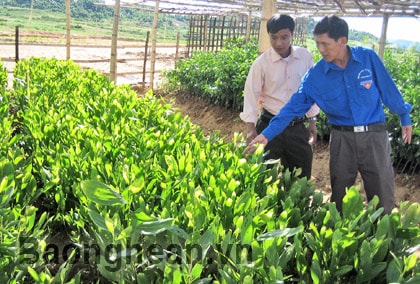
The hybrid acacia nursery of Con Cuong One-Member Limited Liability Forestry Company.
Most agricultural and forestry farms have developed effective production and business plans, boldly applying scientific and technological advancements. Production is organized with increased investment in processing and the planning of concentrated, high-quality raw material areas. For example, Xuan Thanh Agricultural Company Limited has planned to plant over 650 hectares of various orange varieties, introducing new varieties such as disease-free oranges and late-ripening oranges (V6), bringing high economic value. The Fruit Tree Company Limited has planned to plant over 900 hectares of rubber trees, introducing high-yield rubber varieties. Forestry companies have introduced the production of raw material tree varieties such as acacia hybrid cuttings and acacia mangium; successfully propagated and introduced several mangrove tree varieties such as Avicennia marina, Sonneratia caseolaris, and Rhizophora apiculata for planting coastal mangrove protection forests. Thanks to the application of science and technology and intensive cultivation of new varieties, crop yields have increased by 20-50%. Specifically, late-ripening oranges for Tet (Lunar New Year) yield 150-160 quintals/hectare, generating revenue of 500-600 million VND/hectare/year; rubber trees increase by 0.2 tons of dry latex/year, equivalent to 15-20 million VND/hectare/year; sugarcane yields increase by 30-40 tons of sugarcane/hectare/year; and grafted acacia trees and Acacia mangium trees reach 150 m3/ha after 6-7 years, increasing revenue by 25-30 million VND.
Financially, the units allocated capital generally utilized and preserved their capital. All companies operated efficiently; pre-conversion revenue in 2010 was VND 501,393 million, averaging VND 41,782.75 million per unit, while post-conversion revenue in 2011 was VND 579,094.00 million, averaging VND 48,257.83 million per unit. Pre-conversion profit was VND 7,600.00 million, averaging VND 633.33 million per unit, while post-conversion profit was VND 15,031.00 million, averaging VND 1,252.58 million. Average income before conversion was VND 2,390,000 per person per month, while post-conversion income was VND 2,870,000 per person per month.
Most agricultural and forestry companies perform well in supplying, consuming, and providing technical services for agricultural and forestry production in the region. They effectively implement forestry promotion projects, Project 661, Project 147, and the Vietnam-Germany Forestry Project, planting an average of 10,000 hectares of concentrated forest, contributing to the creation of raw materials for the processing industry and increasing forest cover from 45% in 2002 to 53.3% in 2011. The development of agricultural and forestry companies has contributed to local economic growth, creating jobs and increasing income for thousands of farming households through the cultivation, processing, and consumption of agricultural and forestry products. In particular, it has contributed to the transformation of the agricultural and forestry economic structure in the region.
However, certain limitations remain, such as: Many units still maintain old contracting methods; some areas have not yet switched from the contracting method stipulated in Decree 01/CP to Decree 135/2005/ND-CP, thus the responsibility of the contractors has not been enhanced. The policy of leasing land for production and business units has not been fully implemented. Inventory and protection work is still limited, leading to inaccurate identification of disputed and encroached forest land. Support policies for agricultural and forestry farms that combine production and business with public service functions have not yet been specifically and appropriately defined.
To ensure the increasingly efficient development of state-owned agricultural and forestry enterprises, the Provincial People's Committee directs: Companies need to be proactive in production and business, especially in expanding their business activities to achieve the highest efficiency. Agricultural and forestry companies will be given favorable conditions to invest in and expand production, build processing and service facilities linked to production areas. For companies that meet the conditions, a pilot program of equitization will be implemented to gain experience, mainly focusing on orchards and planted forests linked to processing and service facilities. A pilot program will be organized to convert some single-member limited liability agricultural and forestry companies into joint-stock companies to gain experience, based on which the remaining companies will proceed. The State needs to invest funds to complete the surveying, allocation, leasing, boundary marking, and land planning for state-owned agricultural and forestry enterprises, clearly determining the value of assets on the land as a basis for allocating capital to the enterprises.
Photo credit: Van Truong


