
Final song: The beloved dialect of Nghe An
(Baonghean)Once, while standing on the deck of the HQ 571 ship, a naval officer proactively approached us to strike up a conversation. It turned out he'd heard our accent from Nghe An and guessed we were from the same province, so he came to introduce himself. In this way, the group of reporters from Nghe An Newspaper had the opportunity to get to know many people from Nghe An who are working and living in the Truong Sa archipelago. Overcoming their personal struggles, they are upholding the traditions of their homeland, contributing to building a strong and secure archipelago for the Fatherland.
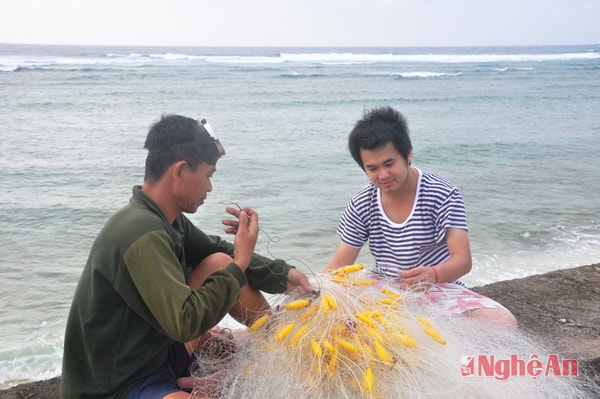 |
| A reporter from Nghe An Newspaper spoke with Mr. To Hoai in Truong Sa. |
| RELATED NEWS |
|---|
The story continues to revolve around the life of a soldier on a remote island. The names of the islands sound distant, like Truong Sa, Son Ca, Nam Yet, Len Dao, and finally, Da Tay. Wherever this experienced soldier has set foot, he has always excellently fulfilled his duties, worthy of his homeland's traditions. And just imagine, in eight years, that's nearly 3,000 long days, the amount of time he spent on the mainland, not to mention returning home to his family, is negligible. In those eight years, Toan spent six Tet holidays in Truong Sa, five of which were on continuous duty. And for the past four years, since getting married and having a two-year-old child, this year's Tet is the first time the whole family has been able to reunite and gather around the New Year's Eve dinner on the 30th of Tet. Toan's wife is now a teacher in Cam Khanh City (Khanh Hoa).
I asked, "With all your constant business trips, what gifts are you bringing home for your family for Tet?" He laughed heartily, patted his chest, and jokingly said, "Here are the gifts! The biggest gift is me, and the rest are a few cans of canned meat and some seashells. That's all we soldiers on the island have." Through his story, we understood that for soldiers in general, and especially those on the islands, the home front plays an extremely important role in their spiritual lives. Being far from family for so long, the longing, the sharing of joys and sorrows, and the difficulties of life can only be expressed through phone calls. But like Toan's family, his kind and hardworking wife is always a solid support and source of confidence for him. His parents back home are a great source of encouragement for their son serving on the front lines. Toan's father has visited him twice on the island as part of the annual family visit program, once when he was stationed on Len Dao Island and again this year on Da Tay Island.
The night sea was pitch black, the wind howled, and the crew announced that the ship would remain anchored until the sea calmed before continuing its journey. In room C10 on the ship, his story about life as a soldier on the island continued to captivate the reporters. Suddenly, the phone rang. He winked mischievously and quickly said, "My wife's calling again. We've all bought tickets for the ship, and we'll be boarding the 'Nghe An to An' ship on the 22nd of the lunar month. This year, the family will have a chance to reunite so the children can see what their ancestral homeland looks like. But I can't stay long on my two-month leave to go back to my paternal hometown; I have to go to Cam Ranh early so my wife can go to teach." With that, he quickly said goodbye to everyone in the room and went out onto the deck to answer the phone. After this leave, he would once again be on the ships heading to take up his duties in the sacred archipelago of the Fatherland. And we believe that, even though the mainland is still waiting for thousands of days for his return, they will wholeheartedly support and stand alongside the soldiers on the island, giving them strength and resilience in carrying out their duties.
Being far from family and lacking the affection of loved ones is a common situation for soldiers on the Truong Sa Islands. On our visit to Point B, Da Tay Island, it was thanks to his distinctly Nghe An accent that we quickly recognized and befriended Lieutenant Chu Van Hung, originally from Nghi Phuong commune, Nghi Loc district (Nghe An province). He has dedicated his military career and has three years of experience working on several islands in the Truong Sa archipelago. Speaking in his resounding Nghe An accent, he volunteered to guide us on a tour of the unit's infrastructure. Over there was the sports and cultural center; over there, in carefully sheltered small wooden pots, was a lush green vegetable garden of spinach and cabbage. "Truong Sa only has two seasons: the dry season from March to September each year, and the rest of the time is the rainy season, with rough seas and constant salty winds, so to have fresh vegetables, you have to put in a lot of effort," he shared, speaking with the voice of someone familiar with Truong Sa.
Along the sturdy concrete bridges connecting three concrete houses standing majestically amidst the vast ocean, in the story about his homeland and family, we learned that his wife and children now live in Da Nang. Due to the nature of his duties, he rarely gets to be home, and this year's Lunar New Year is no exception; he will still be working alongside his comrades to protect the homeland's seas and islands. Before parting ways, Lieutenant Hung saw us off to the water's edge of the shallow beach on the island and said goodbye: "Please send New Year's greetings from the soldiers of Truong Sa to the mainland! As for me, I send my best wishes for a fulfilling new year to my family and friends back home, and for Nghe An to become increasingly prosperous and beautiful. As a son of Nghe An, I will always uphold the traditions of my homeland and strive to excellently fulfill my duties in this remote island." The ship sailed away, but Lieutenant Hung and his comrades still stood there, waving goodbye to the delegation as if wanting to convey many heartfelt feelings to the mainland.
Besides the many officers and soldiers of Nghe An origin serving in the Truong Sa archipelago, we were fortunate to meet a very special Nghe An resident. He is Mr. To Hoai, a citizen of Truong Sa town, originally from Dien Bich commune, Dien Chau district (Nghe An province). Upon meeting him, with his Dien Chau coastal accent, he greeted us warmly as if we were family. In his spacious house, already filled with the festive atmosphere of Tet (Lunar New Year), he shared his life's connection with the Truong Sa archipelago. In 1989, he enlisted and joined the navy, taking up duty on Thuyen Chai Island in the Truong Sa archipelago. Having a natural seafaring background, after leaving the army, Mr. Hoai decided to settle in Cam Ranh (Khanh Hoa province) and married a charming and graceful woman named Doan Thi Thinh.
Every day, he works at sea, and his wife works at a seafood company. But then, the harsh yet generous land of Truong Sa seemed to hold a strange allure for a strong, adventurous personality like his. The whole family decided to move to Truong Sa to start a new life, and now they have become veteran citizens of this picturesque town. On the island, he continues his profession as a fisherman and actively participates in the militia; his wife stays at home, taking care of the children and helping him with his work. Their pretty 7-year-old daughter, To Phuong Linh, is in first grade at Truong Sa Primary School. "Life on the island will certainly lack many things compared to the mainland, but the work is more convenient because the Truong Sa fishing grounds are very rich in seafood resources," Mr. Hoai affirmed in his strong Nghe An accent, even though he has been away from his hometown for more than 20 years. As soon as he finished speaking, Ms. Thinh, sitting beside him, added: "And the commander and the soldiers on the island have created many favorable conditions and provided a lot of help to the people! Every family has formed a close relationship with one or two units on the island, so their spiritual life is rich, their economy is stable, and the people feel very secure in staying and establishing their lives in Truong Sa."
And, there were many more people from Nghe An that we met in Truong Sa. They could be soldiers, civilians, doctors… but their Nghe An accent is unmistakable. That accent may be rough and simple, but hidden behind it is the character of the people of Nghe An: affectionate, hardworking, resilient, and courageous in facing challenges. It is in this place at the forefront of the waves that the sons and daughters of Nghe An are representing their homeland's traditions and making worthy contributions to the construction, protection, and development of the Truong Sa archipelago.
Thanh Duy - Dao Tuan


