
Lessons from the case of the "tycoon" who defrauded the bank.
(Baonghean)Taking advantage of loopholes in the loan application and land appraisal process by credit officers, Nguyen Chu Ngoc established two companies and forged numerous land ownership certificates and documents to embezzle funds from the bank. Only when the "tycoon" defaulted and fled did the bank realize it had been deceived all along.
Setting up a company and forging land ownership certificates to defraud banks.
In late June 2013, the People's Court of Nghe An province tried the case of fraud and appropriation of property against Nguyen Chu Ngoc (born in 1977), residing in Ha Tinh City. Attending the trial, in addition to some citizens and family members of the defendant, were many officials and employees of the Eximbank Vinh branch. Two former credit officers of the branch, NVH and NQT, also stood trial for the crime of "Negligence causing serious consequences." After two days of trial, the court sentenced Nguyen Chu Ngoc to 16 years in prison, while the two former credit officers, H. and T., received sentences of 36 months and 18 months respectively, suspended.
Nguyen Chu Ngoc is a well-known "tycoon" in Ha Tinh, famous for his high-end restaurant called Dai Duong (Ocean) and nicknamed Ngoc Dai Duong (Ocean Ngoc). In late 2008, Ngoc wanted to expand his business into the Nghe An market. In April 2009, Ngoc, along with Mr. Nguyen Sy Quang and Ms. Doan Thi Phuong Loan, established Thai Binh Duong Company, renting prime land near the Nghe An Labor Culture House, building a stilt house, and opening a restaurant. Nominally, Mr. Quang was the director, but he was not present at the company's headquarters on Ho Tung Mau Street, Vinh City. This "nominal director" only appeared to sign documents when Ngoc requested.
To obtain working capital, Ngoc Dai Duong instructed his subordinates to apply for loans from the Vinh branch of Eximbank. From December 2009 to January 2011, Thai Binh Duong Company borrowed 15.6 billion VND from the aforementioned bank branch. Seeing how easy it was to obtain bank loans, in April 2010, Ngoc established Hoang Phu An Limited Company, with his wife as director, primarily engaged in the automobile business. This time, Ngoc again borrowed nearly 12.4 billion VND from the Vinh branch of Eximbank.
Ngoc used all the borrowed money to invest in real estate. In 2011, when the real estate bubble burst in Vinh City and surrounding areas, Ngoc went bankrupt and fled. At the end of September 2011, Ngoc was arrested by the Economic Police Department of Nghe An Province while hiding in Hanoi. It was then that Nguyen Chu Ngoc's fraudulent scheme of creating fake land ownership certificates and using them as collateral was exposed.
During the loan process with Eximbank Vinh Branch, Ngoc consistently used land ownership certificates and prime land plots in Ha Tinh province as collateral. Specifically, when using Thai Binh Duong Company to secure loans, Ngoc used five land use right certificates for five different plots of land in Ky Anh district, Cam Xuyen district, and Ha Tinh city as collateral.
According to investigators, Ngoc forged two land ownership certificates. The first was forged by taking a genuine certificate in the name of a relative to Ho Chi Minh City and having someone create a new certificate in Ngoc's name. The second was a direct forgery of an original certificate in the name of her parents. Ngoc then used the "genuine" certificate to borrow 3.5 billion VND from the Investment and Development Bank of Vietnam, North Nghe An branch. The "forged" certificate was used to borrow 1.86 billion VND from the Eximbank Vinh branch. At Hoang Phu An Company, Ngoc created six sets of documents, including forged land ownership certificates and fraudulent registration documents, to embezzle 10.1 billion VND.
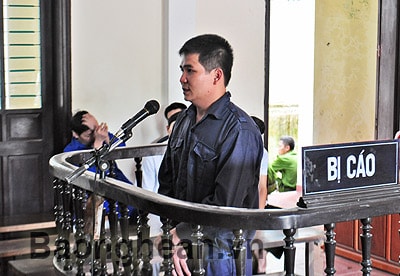
Nguyen Chu Ngoc at the trial.
Who aided the tycoon?
The reason Nguyen Chu Ngoc was able to easily use forged documents and fake land ownership certificates to borrow money was because of the complicity of bank credit officers.
According to the investigation, since 2001, the Governor of the State Bank of Vietnam has issued regulations on lending by credit institutions to customers. Subsequently, the Board of Directors and the General Director of Eximbank also issued Decision No. 19/EIB/ dated March 29, 2002, on guiding the implementation of Decision No. 1627 on lending regulations of the State Bank of Vietnam; Decision No. 155/EIB - TGĐ dated April 19, 2004, promulgating credit operation procedures; and Decision No. 1308/2007, promulgating real estate valuation procedures. Accordingly, after receiving the application from the customer, the credit officer will have to assess the customer's financial potential, income sources, ability to repay the debt, legal capacity, and collateral. They must also register the secured transaction with the customer and draft the necessary documents and contracts in the loan application file to advise management on whether or not to grant the loan.
However, during their work at the bank branch, both credit officers failed to perform their duties properly, neglecting the prescribed procedures for appraising assets, skipping the step of verifying the origin and ownership of the land with the local authorities and the commune's land registry where Ngoc mortgaged the land. In particular, both credit officers did not directly sign the collateral transactions at the Land Use Rights Registration Office, instead delegating the entire process to Nguyen Chu Ngoc. This laxness on the part of NVH allowed Nguyen Chu Ngoc to use 7 sets of forged documents, defrauding Eximbank of over 10 billion VND. NQT, on the other hand, facilitated Nguyen Chu Ngoc's use of 2 sets of forged documents, resulting in the embezzlement of over 2.2 billion VND…
Judge Vi Van Chatt, Deputy Chief Judge of the Criminal Court of the People's Court of Nghe An Province, presiding over the trial, affirmed: The case of Nguyen Chu Ngoc defrauding the Eximbank Vinh Branch is a major lesson about the laxness in credit management of banks and financial institutions. When the case occurred, those responsible at the Eximbank Vinh Branch at that time were well aware that both Pacific and Hoang Phu An companies were opened and operated by Nguyen Chu Ngoc.
Ngoc lacked real financial resources, a stable income, and the ability to repay debts, yet both companies easily borrowed large sums of money from the aforementioned bank branch. Besides the laxness in the collateral appraisal process, the bank officials were also extremely incompetent in evaluating the documents, failing to distinguish between genuine and fake land titles, leading to Nguyen Chu Ngoc's deception. This case serves as a timely warning to bank branches, credit institutions, and anyone intending to make money and get rich through fraudulent and illegal schemes.
Text and photos: Nguyen Khoa


