
Lessons learned about production linked to product distribution.
(Baonghean) - One day in mid-August, we visited Hung Xa, where chili fields were ripening to a vibrant red during the harvest season. Mr. Vo Trong Hai said: This is the second year he has received land from the commune to grow chili peppers for Asia Company.
Two years ago, Asia Company came to the commune to find land to experiment with a model of growing chili peppers in the winter for export. At that time, the commune also had a policy of developing winter crop models to increase farmers' income. The commune and the company met to discuss the idea, and the model was born. After two years of cultivation, Mr. Hai concluded that chili peppers are the most profitable crop in the floodplains of Hung Nguyen. This year, Mr. Hai's family planted 15 sao (approximately 1000 square meters) of chili peppers, 5 sao of stevia, and a few sao of beans and other vegetables. The chili peppers were planted on October 18th (Lunar Calendar) and harvested after 3 months. This season, they expect to yield 15 tons, with an average selling price of 7,000 VND/kg. The income from one sao of chili peppers is 7 million VND. Thus, one hectare of chili peppers yields 140 million VND, which is the actual income from Mr. Hai's farm. According to calculations, the investment cost for one sao (approximately 1000 square meters) of chili peppers per cycle is 1 million VND/sao - the farmer earns a profit of 6 million VND.
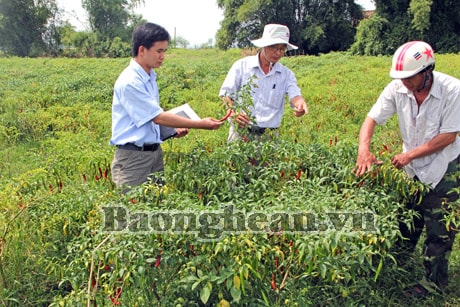
Officials from the Hung Nguyen District Department of Agriculture inspect a chili pepper cultivation model.
in Hung Xa.
Based on the results of two years of trial planting, this winter the commune decided to expand the model to approximately 10 hectares of chili peppers and 10 hectares of carrots for export. Not only Hung Xa, but also Hung Lam, Hung Nhan, Hung Loi… communes with alluvial land, each commune is establishing 1-2 models this winter, each model covering about 10 hectares of high-yield chili peppers and carrots for export. Mr. Cao Dinh Tuyen, Head of the Agriculture Department of Hung Nhan commune, said: Implementing the district's conversion project, based on the practical results of the model, the commune is determined to convert some areas to cultivate cash crops for export. Initially, due to old farming practices, some households were hesitant. To facilitate the conversion, the commune mobilized the entire political system to promote and encourage people to try the trial planting. The plan is that if this winter crop is successful, the model will be expanded to the entire alluvial land area of the commune in the following years.
According to Mr. Hoang Van An, Deputy Head of the District's Agriculture Department, Hung Nguyen district has 1,231 hectares of alluvial land along the Lam River, of which 750 hectares are dryland crops. This winter season and in subsequent years, the district is determined to convert this area to high-income crops to maximize the potential of the alluvial land. This winter season, approximately 100 hectares will be converted to high-yield chili peppers and 50 hectares to carrots. To ensure product sales, the district has signed a product purchase contract with Asia Pacific Company. Under this contract, the company is responsible for providing seeds, fertilizers, technical support for production, and purchasing the products. To ensure farmers' peace of mind, the company has deposited funds in a bank.
According to Mr. An, producing chili peppers for the Chinese market requires a planting schedule that ensures products are available for export during the coldest months of winter. Therefore, a late winter crop season has been established. Winter crops are usually sown in September, but in floodplains, September is often subject to flooding. To avoid flooding, the planting schedule is shifted to October. This shift in production schedule ensures products meet market demands and prevents inventory buildup, a new feature of this year's winter crop production in Hung Nguyen. In addition to the converted land for export crops, the district's Department of Agriculture has also developed several new crop rotation formulas that yield high economic efficiency, such as: winter-spring chili peppers - spring-summer beans; winter corn - spring peanuts - mung beans; carrots - spring peanuts - sesame... for localities to choose from.
To ensure the success of the above methods, in addition to introducing advancements in crop varieties and techniques, a top priority is irrigation. Currently, the district is focusing all its resources on improving the irrigation system in the floodplain area, proactively managing irrigation and drainage. Several irrigation solutions for the floodplain area have been proposed for local authorities to choose from, such as constructing concrete canals, supplying water through plastic pipes, and drip irrigation. Currently, a highly feasible solution being applied in some areas of the floodplain is using groundwater from drilled wells to irrigate crops. This is an effective and inexpensive method, requiring only investment in power lines to the fields.
Speaking with Mr. Nguyen Cong Vuong, Head of Raw Material Development at Asia Company, he stated: As a company specializing in the production and export of agricultural products, Asia Company has developed a project to participate in crop conversion in Nghe An province. The project has been approved, and the company is gradually implementing it alongside farmers, committed to sharing profits. Specifically, for chili peppers, the company ensures a guaranteed income of 150 million VND/hectare when purchasing from farmers, and 100 million VND/hectare for carrots. This guaranteed income has fostered empathy and trust among farmers. The company's motto is: Businesses work alongside farmers to establish principles of conduct.
Developing winter crops in the Hung Nguyen floodplain is considered a breakthrough. Aimed at bringing benefits to the people in the floodplain, it provides a boost and momentum for changing the mindset and practices of a locality previously considered underdeveloped in winter crop cultivation. The key element in this "transformation revolution" is clearly the implementation of production plans linked to businesses that guarantee product purchase. The production schedule must be harmoniously arranged to create favorable conditions for the product market.
Mr. Tuan


