
The Prime Minister's speech on challenges to peace and security.
One of the events that received significant attention and high praise from leading German and European scholars and researchers during Prime Minister Nguyen Tan Dung's visit to the Federal Republic of Germany was the Vietnamese Prime Minister's speech on the afternoon of October 15th at the Koerber Institute in Berlin, concerning challenges to peace, security, and development in the Asia-Pacific region and the development of the Vietnam-Germany Strategic Partnership within the overall context of Asia-Europe relations.
We are pleased to present the full text of this speech by Prime Minister Nguyen Tan Dung:
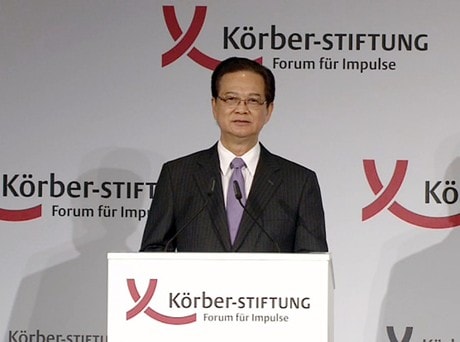 |
| The Prime Minister speaks at the Koerber Institute. Photo source: Koerber Institute |
Thưa Ngài Tiến sỹ Vê-mai-hờ, Phó Chủ tịch Viện Koerber.
Thưa các vị Đại sứ,
Ladies and gentlemen,
Trước hết, tôi xin cảm ơn Viện Koerber đã dành cho tôi cơ hội trao đổi với Quý vị - những chính khách, các nhà nghiên cứu hàng đầu của nước Đức - về những vấn đề, thách thức đối với hòa bình, an ninh, phát triển ở châu Á – Thái Bình Dương và phát triển quan hệ Đối tác chiến lược Việt - Đức trong tổng thể quan hệ Á - Âu. Cuộc trao đổi của chúng ta diễn ra trong không gian của những sáng kiến, ý tưởng, triết lý về đối thoại vì hòa bình, hợp tác và hiểu biết lẫn nhau như Ngài Koerber đã mong muốn khi sáng lập ra Viện.
Ladies and gentlemen,
Hòa bình, hợp tác và phát triển vẫn là xu thế lớn. Kinh tế thế giới đã vượt qua khủng hoảng và đang đi vào giai đoạn phục hồi hướng tới phát triển bền vững. Song thế giới vẫn đứng trước nhiều mối lo ngại, thách thức cùng với những diễn biến nhanh chóng, phức tạp và rất khó lường. Các nguy cơ từ xung đột vũ trang, tranh chấp lãnh thổ, sử dụng vũ lực và đe dọa sử dụng vũ lực, sự trỗi dậy của chủ nghĩa khủng bố, cũng như những thách thức về an ninh phi truyền thống như biến đổi khí hậu, dịch bệnh, an ninh nguồn nước... ngày càng nổi lên gay gắt.
Trong những năm gần đây, khu vực châu Á - Thái Bình Dương nổi lên là động lực tăng trưởng và liên kết của kinh tế thế giới, đưa khu vực này trở thành một trung tâm quyền lực mới, một trung tâm kinh tế lớn chiếm gần 55% GDP toàn cầu và có vai trò rất quan trọng trong tiến trình hình thành trật tự thế giới trong tương lai.
Tuy nhiên, khu vực này đang còn tồn tại nhiều vấn đề; nổi lên là diễn biến phức tạp của các điểm nóng như bán đảo Triều Tiên, các tranh chấp chủ quyền lãnh thổ, đặc biệt là ở Biển Đông và Biển Hoa Đông... và đáng lo ngại là sự thiếu hụt lòng tin - nhân tố chủ yếu khiến cho hòa bình, ổn định ở đây chưa thực sự bền vững. Nếu môi trường hòa bình, an ninh, phát triển của châu Á - Thái Bình Dương bị xấu đi thì sẽ gây tác động rất tiêu cực và hệ lụy khôn lường đối với cả khu vực và toàn thế giới - còn ngược lại sẽ là niềm vui, niềm hạnh phúc to lớn của tất cả chúng ta.
Những nguy cơ, thách thức trên đây đòi hỏi tinh thần trách nhiệm, sự hợp tác và nỗ lực rất cao của mỗi quốc gia, cả khu vực và toàn thế giới. Và không một quốc gia nào, kể cả những cường quốc hàng đầu, có thể một mình đủ sức giải quyết được. Để duy trì hòa bình, ổn định một cách bền vững ở khu vực, chúng tôi cho rằng cần có thiện chí và cộng đồng trách nhiệm của tất cả các nước.
Mỗi quốc gia, dù lớn, hay nhỏ, bên cạnh việc chăm lo lợi ích của riêng mình, đều phải quan tâm đến các vấn đề chung của thế giới và lợi ích chính đáng của các nước khác. Đây là nền tảng nhận thức cơ bản để các quốc gia tăng cường quan hệ hữu nghị, thúc đẩy các cơ chế hợp tác, xây dựng lòng tin, giải quyết bất đồng bằng biện pháp hòa bình, phù hợp với Hiến chương Liên hợp quốc và luật pháp quốc tế.
Các nước cần đề cao hơn nữa vai trò của các thể chế đa phương và cùng chung tay góp sức xây dựng một cấu trúc và thể chế của khu vực ổn định và bền vững; vừa làm cơ sở và động lực chính cho sự hợp tác, vừa có khả năng ứng phó hiệu quả với các nguy cơ, thách thức.
Ladies and gentlemen,
Chúng tôi luôn nhận thức sâu sắc rằng hòa bình và phát triển của Việt Nam gắn chặt với hòa bình và thịnh vượng chung của cả khu vực. Ưu tiên hàng đầu của Việt Nam là giữ vững môi trường hòa bình ổn định để tập trung phát triển đất nước và cải thiện đời sống của người dân. Đồng thời đóng góp có trách nhiệm vào việc giải quyết các vấn đề, các thách thức chung của khu vực và thế giới.
After nearly 30 years of Doi Moi (Renovation), Vietnam has successfully transformed its centrally planned, subsidized economy into a socialist-oriented market economy. From a poor, underdeveloped country heavily devastated by wars of aggression, Vietnam has risen to become a middle-income developing nation.
Over 25 years (1986-2010), we achieved an average annual GDP growth rate of 7%. During the global financial crisis and economic recession, Vietnam still maintained a GDP growth rate of 5.6% for three years (2011-2013). In 2014, GDP increased by approximately 6%, and per capita income reached over US$2,000.
With stable socio-political and macroeconomic conditions, guaranteed social security, and the achievement of many of the United Nations Millennium Development Goals (MDGs) ahead of schedule, Vietnam is perfecting the rule of law, strongly promoting the democratic rights of its people, and continuing to urgently develop a comprehensive market economy; accelerating economic restructuring, innovating the growth model, improving productivity, efficiency, and competitiveness, aiming for sustainable development with an average GDP growth target of 6-7% per year during the 2016-2020 period.
Vietnam is actively integrating deeply with the region and the world, with economic integration being the focus and main driving force. Vietnam became a member of the World Trade Organization (WTO) in 2007. To date, we have participated in eight free trade agreements and are actively contributing to the building of the ASEAN Economic Community 2015.
We are also negotiating six high-standard free trade agreements, the most important of which are the Trans-Pacific Economic Partnership Agreement (TPP) and the Vietnam-EU Free Trade Agreement (EVFTA). International integration, alongside its difficulties and challenges, has opened up many favorable opportunities for Vietnam to accelerate development, reform, and participate more effectively in global production and value chains.
Vietnam is an active and constructive member, making responsible contributions to the activities of many multilateral organizations and forums such as the United Nations, ASEAN, APEC, ASEM, WTO... We have participated in UN peacekeeping operations (PKO) and are striving to assume important responsibilities in several key mechanisms and forums such as the UN Human Rights Council and the Board of Governors of the International Atomic Energy Agency (IAEA)... The current situation and conditions have allowed us to shift from a mindset of "active participation" to "proactively contributing to building and shaping common rules of the game," more clearly demonstrating our responsibility towards regional and global issues and challenges.
We consistently pursue an independent, self-reliant, diversified, and multilateral foreign policy. Vietnam is a friend and a reliable partner of all nations for peace and development. We continuously strive to build good friendly relations and strengthen mutually beneficial cooperation with all partners, especially neighboring countries, ASEAN countries, strategic partners, comprehensive partners, and traditional partners.
Vietnam's consistent policy is not to ally with one country against another. We are steadfast in defending our legitimate interests, while sincerely wishing to work with other countries to build strategic trust – a sustainable and long-lasting mutual trust – based on the United Nations Charter and international law; respecting each other's independence, sovereignty, and territorial integrity; resolving disputes through peaceful means; cooperating on an equal and mutually beneficial basis; and making positive contributions to peace, stability, cooperation, and development in the region and the world.
Vietnam welcomes all policies of major powers towards the Asia-Pacific region if those policies respect international law and regional institutions, do not impose coercion, do not infringe upon the independence and sovereignty of nations, promote equal and mutually beneficial cooperation, and make positive contributions to peace, security, and development in the region.
As an active member of the ASEAN Community to be formed in 2015, Vietnam is deeply concerned about the future of the regional structure and ASEAN's central role. The current structure is still in a formative and transitional phase, with many multi-layered mechanisms and forums such as the East Asia Summit (EAS), the ASEAN Regional Forum (ARF), and the ASEAN Defence Ministers' Meeting Plus (ADMM+). To ensure peace, security, and development in the region, the Asia-Pacific needs a sustainable structure with a system of feasible principles and institutions consistent with international law. Within that structure, ASEAN needs to continue to affirm its central, leading, and closely connected role, building strategic trust among all relevant partners.
One issue currently receiving much attention is the complex situation in the South China Sea. Peace, stability, security, safety, and freedom of navigation and overflight in the South China Sea are common interests of countries both within and outside the region. This is where international shipping lanes are located, carrying approximately 50% of global seaborne cargo – a large portion of which flows between Europe and East Asia.
Recent instability and tensions have clearly shown that this benefit can only be guaranteed when all countries, especially those with direct sovereignty claims in the South China Sea, seriously abide by international law, the 1982 United Nations Convention on the Law of the Sea, refrain from unilateral actions that further complicate the situation, do not use force or threaten to use force, fully and effectively implement the Declaration on the Conduct of Parties in the South China Sea (DOC), and promptly develop a Code of Conduct (COC).
With its tradition of peaceful coexistence and consistent foreign policy, Vietnam has always steadfastly advocated for resolving disputes through peaceful means, based on respect for international law and regional norms of conduct. While affirming and resolutely defending the sacred territorial sovereignty of the country in accordance with international law, we always proactively act appropriately and seize every opportunity to reduce tensions, restore trust, promote friendly cooperation, and strive for dialogue to find a fundamental and long-term solution to the East Sea issue.
Over the past period, public opinion worldwide, the governments of many countries, international organizations, the United Nations, the European Union (EU), the G7 group of countries, the ASEAN Community, etc., have strongly voiced their support for Vietnam's just stance – consistent with international law – on the East Sea issue. On this occasion, we would like to sincerely thank our friends around the world – in Europe, in Germany – for their positive, objective voices and practical contributions to peace and security in the region.
Ladies and gentlemen,
Having weathered the ups and downs of the economic and political landscape in Europe and the world, Germany has affirmed its increasingly prominent position at both continental and global levels. Germany has not only proven to be a leading economic engine pulling Europe out of crisis and recession, but also plays a crucial role and has a significant voice in major political, security, and peacekeeping issues in Europe and the world. Vietnam supports a strong Germany with an active and responsible role in global peace, security, and development.
Although geographically distant and possessing different histories and socio-economic characteristics, Vietnam and Germany have both strived to overcome numerous difficulties to enjoy peace, development, and a good friendship today. The German people have supported Vietnam throughout its struggle for national independence, reunification, and development.
The relationship between the two countries has made solid progress and is developing very favorably, especially since the establishment of the Strategic Partnership in 2011. In 2015, we will celebrate the 40th anniversary of the establishment of diplomatic relations between Vietnam and Germany (1975-2015). The scale and depth of the strategic partnership are clearly demonstrated through high-level visits, dialogue mechanisms at all levels, and effective cooperation in the fields of economics, trade, investment, development cooperation, politics, diplomacy, defense, security, culture, education, people-to-people exchanges... and active coordination at important multilateral forums such as the United Nations, ASEM, and ASEAN-EU.
Germany is currently Vietnam's largest trading partner in Europe, with bilateral trade reaching nearly US$8 billion, accounting for over 20% of Vietnam's total trade with the EU. Germany is also one of the largest Official Development Assistance (ODA) donors to Vietnam. We welcome the influx of investment capital from Germany, with many high-quality FDI projects featuring modern, environmentally friendly technologies, including many renowned German corporations and companies such as Siemens, Mercedes-Benz, Braun, Bosch, etc.
German universities are currently hosting over 4,000 Vietnamese students and researchers. A community of over 100,000 Vietnamese people live, study, and work in Germany, along with over 100,000 German speakers in Vietnam, including many generations of students and researchers who have studied in Germany. These communities have made significant contributions to the prosperity of both countries and fostered friendly and cooperative relations between Vietnam and Germany.
Today, Chancellor Angela Merkel and I had a very successful meeting, agreeing on many important strategic cooperation directions linked to specific action plans to deepen and strengthen the strategic partnership between our two countries. This focuses on five key areas: strategic political cooperation; trade and investment; justice and law; development and environmental protection; and education, science and technology, culture, media, and social affairs.
Vietnam will work with Germany to elevate bilateral dialogue mechanisms, striving to strengthen cooperation for sustainable development, especially in sectors where both sides have strengths and needs, such as energy development, green and clean technologies, manufacturing, public transport, finance and banking, consumer goods, and agricultural and aquatic products.
2015, coinciding with the 40th anniversary of diplomatic relations between Vietnam and Germany, also marked the 20th anniversary of the signing of the Framework Agreement on Cooperation between Vietnam and the European Union. I am pleased to see that the Vietnam-Germany relationship has played a crucial role in every step of the development of Vietnam-EU relations.
Vietnam highly appreciates Germany's goodwill and positive efforts in the negotiation, signing, and ratification of the Vietnam-EU Comprehensive Partnership and Cooperation Agreement (PCA), and currently the negotiations for the Free Trade Agreement (EVFTA). On October 13, 2014, in Brussels, I and Mr. Manuel Durão Barroso, President of the European Commission, announced our agreement on the direction for concluding the Vietnam-EU Free Trade Agreement negotiations, with optimism that both sides will soon sign the Agreement in early 2015.
The 10th ASEM Summit, soon to open in Milan, Italy, will discuss many strategic cooperation issues between the two continents and globally. In this process, ASEAN-EU cooperation is the core and driving force of cooperation between the two continents. Our two countries, Vietnam – as an active member of ASEAN – and Germany – as a key member of the EU, need to strive for closer cooperation to jointly contribute to the strong development of ASEAN-EU cooperation and relations between the two continents, making a positive contribution to peace, stability, and prosperity in both continents. This development will, in turn, create a broader and more effective space for the Vietnam-Germany Strategic Partnership.
Ladies and gentlemen,
In early 2015, a photo contest organized by the German Academic Exchange Agency (DAAD) will feature an exhibition showcasing photographs of Vietnamese families with two or three generations who have lived, studied, and worked in Germany, along with touching stories of close friendships between Vietnamese and Germans.
Even while in Vietnam, people can visit the Goethe Institute in Hanoi and, soon, the German House in Ho Chi Minh City to learn German, explore German culture, or, for some, simply to relive memories of Germany, where they lived and experienced the warm hospitality of their German friends. These are vivid examples of the human connection between the ordinary, peace-loving people of our two nations. This is also the foundation for the ever-growing and enduring Vietnam-Germany Strategic Partnership.
Thank you, ladies and gentlemen.
According to VOV


