
Traditional remedies from the frangipani tree.
Plumeria trees are often planted in home gardens for shade and beautiful flowers. In addition, this species of tree also has medicinal uses.
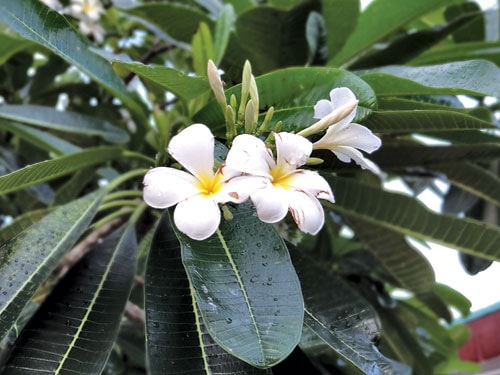 |
| White frangipani flowers with yellow centers and fresh frangipani leaves can be used in medicinal remedies - Photo: Minh Khoi |
It is important to note that the use of remedies derived from the frangipani plant should be under the guidance of a professional.
Multiple uses
According to herbalist Vu Quoc Trung, the frangipani tree is also known as the plumeria tree, mien chi, ke dam tu, etc. Plumeria belongs to the Oleander family. In traditional medicine, all parts of the frangipani tree can be used as medicine to treat diseases - from the bark of the trunk, the bark of the roots, the flowers, flower buds, fresh leaves, and sap.
The most commonly used part in traditional medicine is the frangipani flower. The entire frangipani plant contains the plant-based antibiotic fulvo plumierin, which inhibits the proliferation and growth of certain Mycobacterium tuberculosis bacteria.
Other parts of this plant have different uses; for example, the bark contains the glucoside agoniadin and a bitter substance called plumierit; the bark and roots are slightly toxic, bitter, and cooling, and are used in folk medicine as a laxative (8-15 grams), a laxative (3-5 grams), and to treat constipation...
People who are weak, elderly, pregnant women, or those with diarrhea should not use the bark, root bark, or sap of the frangipani tree – due to its strong laxative effect and slight toxicity. Folk medicine often uses the leaves of the frangipani tree to treat sprains, dislocations, and boils. The sap is also used as a laxative, but in much lower doses than the bark. The flowers, however, are used to expel phlegm, relieve coughs, and lower blood pressure.
In folk medicine, dried frangipani flowers are often used to treat coughs, dysentery, and other ailments. Dried flowers are more potent than fresh ones. They should be harvested when fully bloomed and dried for later use. In the 1960s, a domestic study also indicated that frangipani flowers have a blood pressure-lowering effect.
Practical applications of the remedy
According to herbalist Vu Quoc Trung, there are many species of frangipani (about 40 species) and they come in many colors, from white, yellow, pink, and red. Only the species with white petals and yellow spots have medicinal properties. Below are some effective remedies that utilize frangipani flowers:
- If you have a cough due to the weather, use 12 grams of dried frangipani flowers (use the type with white petals and a yellow center), boil them in water, and drink the resulting decoction throughout the day instead of tea.
- For people with high blood pressure, use 12-20 grams of dried frangipani flowers daily, boil them in water and drink the resulting decoction as a substitute for tea throughout the day.
- If you have a sprain, take some fresh frangipani leaves, wash them thoroughly, crush them into a paste, mix with a little salt, and apply it to the swollen or sprained area. Also, take some fresh leaves, wilt them over a fire, and apply them to the outside of the affected area, then bandage it in place. Apply this several times a day for several days.
- If you have boils, crush fresh frangipani leaves and apply them to the affected area.
- For toothaches with swelling, soak the bark of the frangipani root in alcohol (for a few days), then gargle with this alcohol (do not swallow). This is very effective.
Currently, some people collect dried frangipani flowers, possibly to sell them, because in Taiwan and Hong Kong, frangipani flowers are combined with other flowers to make a remedy that helps treat high blood pressure.
According to Alobacsi.vn


