
Version for lonely husbands
(Baonghean)After the media and local authorities intervened, people in the hotspots of human trafficking in Don Phuc, Con Cuong, became aware of the crimes of the "madams," and no one was tricked or sold anymore. However, dozens of women have yet to return, leaving behind much longing and sorrow for their loved ones, including their husbands...
One winter day, I received a call from Ms. Vi Thi May in Hong Dien village (Don Phuc - Con Cuong) inviting me to attend the "small wedding" of her nephew Ung the following day. Ung was one of three people who had escaped from human trafficking detention in China and returned home at the end of April 2012, as reported by Nghe An Newspaper.
True joy had arrived in Ung's thatched house. After the wedding, the husband had to live with his wife's family until the groom's family had prepared all the necessary dowry items before a "big" wedding could be held, officially making them husband and wife. The "small wedding" was organized by the groom's family, who slaughtered a small pig, prepared over ten kilograms of sticky rice, and a dozen bottles of wine. That was all, but it was warm and cozy, as if everyone were one big family.
The warm atmosphere easily sparked conversation. May whispered to me, "After you and the journalist went to write the article, the police arrested several human traffickers, and no one in the village believes their promises anymore. But there are still dozens of people who were tricked and haven't returned. Their husbands miss them day and night, and they have to raise their children alone; their suffering is immeasurable!"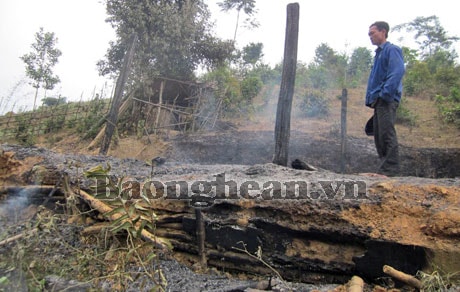
The house of single father Lo Van Tam is now just a pile of ashes.
Before human trafficking, people in the mountainous regions rarely saw men raising children alone, except in unfortunate cases where the wife passed away and the husband was left to raise his children alone. But now, in Hong Dien village, that has become commonplace. When mentioning lonely husbands in the village, people think of Lo Van Tam, 30 years old. His wife was tricked and sold to China when their child was still breastfeeding.
After Ung's small wedding, I expressed my desire to visit that lonely man. May showed me the way, guiding me across a small stream to Lo Van Tam's house. Upon arrival, I saw that the house was nothing but a pile of smoldering ashes. A woman from the neighboring house poked her head out and said, "His house burned down this morning. He's not home anymore. Please come in and have some water; I'll send my child to call Mr. Tam back."
Then the woman named Huong recounted: "Uncle Tam has always been kind and hardworking since he was a child, even though his parents didn't have much wealth to give him. Many young people in the village get involved with drugs and become addicted, so it's hard to find someone who is dedicated to working hard. Even though Tam has a cleft palate and difficulty speaking, many girls from the surrounding villages liked him. Five years ago, he married a girl from the same village who was eight years younger than him. His wife's parents overlooked their prejudice about his disability and happily accepted him as their son-in-law. The wedding was simple and modest because the family was poor, but joyful."
Shortly after their marriage, Tam's parents built them a small hut on the edge of the village. We Thai people have a custom of letting our sons move out to live independently after marriage. After two years of living separately, the young couple remained poor, but without a single conflict. People still saw Tam going to the forest every day, and his wife planting rice and tilling the fields. The poverty of Tam and his wife was truly a common situation for many households in Hong Dien village. The husband was illiterate. The wife only studied up to the second grade, knowing how to sign her name before staying home to wait until she was old enough to get married. The poverty discouraged her. She heard that in China, women lived in luxury, never having to lift a finger to work, like the beautiful women in the homes of feudal lords in the old stories the elders used to tell. The smooth talk and alluring appearance of the "madams" captivated this simple young woman.
Lo Van Tam had returned. He sat beside me by the fire. After a few words of conversation, he recounted: One day during the rainy season, more than two years ago, he and a group of friends went on a long trip to the forest. He told his wife, "Don't let the little girl go to the stream and fall into the water! I'll be back in three days." After returning from the trip, he was tired and hungry. It was pitch dark, but the small house was dark and the ashes were cold. He ran around the village asking for directions and learned that his wife had left. His daughter was thirsty for milk, and his wife had left her with his parents for a while, crying for her mother. That's when Tam learned that his wife, with whom he had shared both joys and sorrows, had been tricked and sold. Unable to read or write, he couldn't file a complaint against the human traffickers. Thinking his wife might only be gone for a few days or weeks, he held his child and waited. His daughter was thirsty for milk, so he carried her around the villages, begging for milk. Mothers with young children, out of compassion, couldn't refuse the poor father and daughter. After some time, he decided to wean his child, who was almost two years old. Once his child could play with friends in the neighborhood, Mr. Tam's workload eased, and he had more time to tend to his fields and gardens, go into the forest to trap squirrels, and work as a construction laborer...
Then, one morning, he woke up early to check his traps, and the little boy also woke up to warm himself by the fire. A rope hung down from the stove, and with a matchstick in his hand, the boy lit the rope. The flames flared up, scaring the child, who ran out of the house crying. Neighbors heard and rushed over, but it was too late. The fire had engulfed the entire house and their few belongings. He was left with only the clothes he was wearing. The villagers who came to put out the fire could only save three sacks of rice.
My neighbor said that the villagers were discussing how some would contribute straw, others bamboo, to help Tam rebuild his house. Everyone felt sorry for the kind father and secretly blamed the mother for being so gullible. I turned to Tam and asked, "If she ever comes home, would you still accept her as your wife?" He replied, "She was just deceived; what fault does she have? I still hope she'll come back so our child can have a mother..."
In Hong Dien village, there's another young father raising his child alone. That's Luong Van Uc. His wife, Lu Thi Khay, left him more than a month ago, leaving the 26-year-old husband heartbroken. When I visited his house, tears still welled up in his eyes. With a guest, he said, "Excuse me," and went to the back to wash his face. As the conversation became more intimate, Mr. Uc shared that Ms. Khay was originally from Nga My (Tuong Duong). They married in 2006 and had a 5-year-old son. Being a fairly active young man in the village, Mr. Uc built a sturdy wooden house within a few years of moving out on his own. Then, one day, Ms. Khay met Vi Thi Ha (a human trafficker who had tricked many people in Don Phuc into being sold to China, a case previously reported by Nghe An Newspaper). Being distant relatives, they easily became close. Although she didn't dare show up in the village, Ha frequently called, telling her about her comfortable life and easy, high-paying job opportunities. These sweet words over the phone led Khay to abandon her husband and son and flee to China to "sell herself" to Ha.
When Khay first left, Uc couldn't believe that his beloved wife had fled to China, because she knew perfectly well that doing so would be tantamount to aiding human traffickers. Three days later, his wife called and saw the +86 area code, and he knew for sure that his wife was in China. She said she was just going to earn money to pay off a 20 million dong bank debt, but after verifying with several people who still called from across the border, Uc learned that his wife had remarried there. Betrayed by the woman he loved so much, Uc has been heartbroken and has been crying for a whole month. "I hate my wife so much, sir. Because I'm not addicted to drugs, I'm not lazy, I work hard to earn money to support our children and make my wife happy, but I'm still betrayed," Uc said, his voice choked with emotion.
According to police officer Luong Vinh Truyen of Hong Dien village, nearly twenty women from this small village are currently on the other side of the border. In previous years, they were often trafficked, but recently some have voluntarily sold themselves to human traffickers, lured by the prospect of a comfortable life promised by the pimps.
In my conversation with the villagers of Hong Dien, I also heard about a boy named Vi Thai Hung from Hong Thang village, right next door. Just last year, Hung's mother left home and fled to China because his father was seriously ill. In mid-2012, his father died, and his mother returned, taking her young daughter with her. Hung became an abandoned child and is now living with the village headman, who is also his uncle. Hung is currently in 10th grade.
The story of the mothers in Hong Dien village reminds me of my childhood. My mother cried so much when my siblings and I were in critical condition due to malaria and was willing to sell her last buffalo to pay for our treatment. And the young mother of Vi Thai Hung sold the last buffalo in their house to flee to China. For some reason, young mothers in the highlands have become more indifferent. Perhaps the husbands are also to blame in this story? Because in places where human trafficking is rampant, drug addiction is also a major problem. Although human trafficking has temporarily subsided, it's too early to say that Hong Dien village is truly peaceful...
Huu Vi


