
Are you providing your child with enough essential vitamins and minerals?
Breastfeeding, appropriate complementary feeding, and recommended nutritional requirements for Vietnamese children up to 9 years old.
Children are growing and developing, requiring a large daily supply of nutrients to build their bodies, ensure the proper functioning of life-sustaining processes, and support their play and learning. One of the most important food groups to eat daily is fruits and vegetables, a source of vitamins and nutrients.
Minerals are essential for health.
The role of fruits and vegetables in health
Fruits and vegetables play a particularly important role in nutrition. They contain many vitamins and minerals essential for the body. An important characteristic of fruits and vegetables is their ability to stimulate appetite and promote the secretion of digestive glands. Fruits and vegetables contain polyphenols (colors and flavors) and biolanoids, which have antioxidant properties, reducing the risk of cardiovascular disease and cancer. They also contain enzymes that aid digestion. Fruits and vegetables are rich in fiber, which stimulates bowel movements and prevents constipation.
Fruits and vegetables are the main sources of vitamin C and carotenoids (precursors of vitamin A) for the body. They also provide minerals such as potassium, calcium, and magnesium, which are essential for metabolism. Dark green leafy vegetables (such as spinach, water spinach, amaranth, and jute leaves) and yellow, red, and orange fruits (papaya, gac fruit, mango, and persimmon) contain high levels of beta-carotene, which plays an important role in the body, helping children grow, preventing dry eyes, and boosting immunity against respiratory infections and diarrhea. Fruits and vegetables also contain pectin, which absorbs toxins for excretion. Some herbs and spices are valuable sources of plant-based antibiotics with medicinal properties (onions, perilla, mint, chives, etc.).
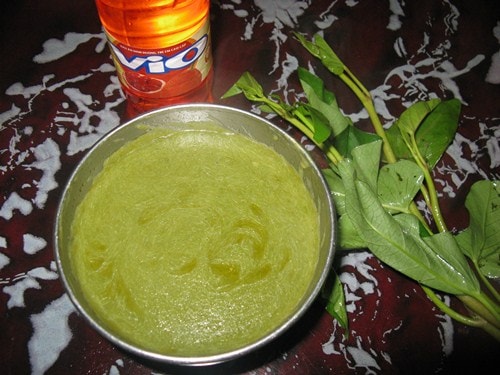 |
| Coloring the bowl of porridge correctly ensures children receive sufficient nutrients, vitamins, and minerals from green vegetables. |
Therefore, eating fruits and vegetables daily is extremely important for health. One of the sound nutritional recommendations is, "You should eat plenty of fruits and vegetables every day." Currently, according to nutritional survey data (2010), the consumption of green vegetables in Vietnamese meals is trending downwards, while meat consumption has increased 6-7 times compared to 10 years ago. According to the recommendations of the National Institute of Nutrition, adults should eat about 300g of green vegetables and 100g of ripe fruit daily. For children, the appropriate amount depends on age and needs.
What is the right way to feed children fruits and vegetables?
Fruits and vegetables should only be introduced to babies once they have started solid foods, ideally around 6 months old. Initially, squeeze juice from fruits like oranges, tangerines, and lemons (5-7 drops), then gradually increase to 2-3 teaspoons. Other fruits like bananas, papayas, and sapodillas should also be introduced gradually to help babies get used to them. Mothers usually start by giving their babies mashed bananas with a spoon, and mashed papayas and sapodillas. As with other foods, when introducing fruit, start slowly: begin with one or two teaspoons each day, then gradually increase the amount. For children aged 6-12 months, 60-100g of pureed fruit per day (1/3-1/2 banana or 1 sapodilla, 1 piece of papaya or mango) and 1/2 orange or 1 tangerine juice mixed with 5g of sugar (1 teaspoon of granulated sugar) can be given. For children aged 1-2 years, the daily intake should be around 100g. For children aged 3-5 years, the daily intake should be 150-200g.
According to suckhoevadoisong


