
By shooting down a Syrian bomber, the US could ignite a powder keg in the Middle East.
The act of shooting down the Syrian plane could turn the US into an enemy of many regional powers.
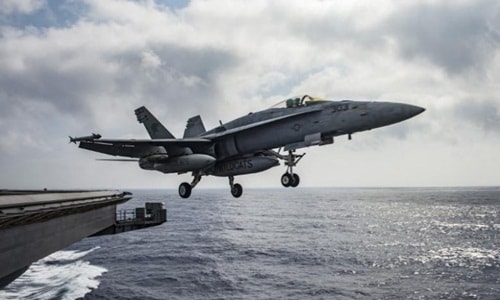 |
A US F/A-18E Super Hornet fighter jet takes off from an aircraft carrier. Photo: Reuters. |
The US fighter jet's downing of a Syrian bomber on June 18th to protect rebel forces in Raqqa has drawn strong reactions from Syria and Russia. Experts believe that the fierce reactions from all sides following this incident make the risk of a sudden conflict between major powers on the Syrian battlefield clearer than ever.according toWashington Post.
According to analysts, the situation in Syria is heating up following Russia's announcement.It suspended the agreement to avoid collisions with US-led coalition aircraft in Syrian airspace, and threatened to consider any aircraft operating in the western skies of the country as a "target".
The Syrian battlefield is heating up not only with the aggressive actions of the US and Russia.On June 18, Iran launched a series of medium-range missiles into territory controlled by the Islamic State (IS) in eastern Syria, marking the first time Tehran officially attacked an extremist group in its neighbor and sparking more aggressive military actions against regional adversaries.
The moment Iran launched missiles at rebels in Syria.
Pavel Baev, an expert on the Russian military at the Oslo Peace Research Institute, believes that Russia's response to the incident was "primarily a show of force" but "also carried a great deal of risk because there are many anxious fingers on dangerous buttons."
According to Baev, that "button" could be activated at any time if Syrian army or Russian air force aircraft continue bombing the Syrian Democratic Forces (SDF), an armed group backed by the US in terms of weapons and training.
The SDF is massing forces to encircle the ISIS stronghold of Raqqa in Syria, while the Syrian government army is also working to retake rebel-controlled territories. If a clash between the two forces breaks out, the US will have to intervene.Protecting allies comes with the risk of escalating tensions with Russian, Iranian, and Syrian forces in Raqqa.
If the situation spirals out of control from a serious incident, the U.S. could very well be drawn into a new conflict in Syria, where the goal of eliminating ISIS gives way to infighting between factions, Baev noted.
Gayle Tzemach Lemmon, a researcher at the Council on International Relations, stressed that the US action of shooting down the Syrian fighter jet was "a dangerous escalation in a war that Washington has no intention of participating in."
The U.S. military also appears to recognize this risk, stating that it has no intention of confronting Syrian or Russian government forces. Colonel Ryan Dillon, spokesman for the U.S.-led coalition, said that "appropriate groundwork" has been laid to help ensure military operations remain focused on combating ISIS.
"Engaging in this game of dare is not something the militaries on either side want; they are both political tools, but it is not wise at the moment, neither for Moscow nor Washington," Baev commented.
Meanwhile, many Russian officials believe the US is trying to send a clear message to Russia after shooting down a Syrian bomber. Frants Klintsevich, deputy chairman of the Russian Senate's Defense and Security Committee, called it an "aggressive and provocative" act.
"It seems that Donald Trump of America is the source of new dangers in both the Middle East and around the world," Klintsevich wrote on his personal Facebook page.
According to VNE
| RELATED NEWS |
|---|


