
Issuing guidelines for the diagnosis and treatment of bites from the green pit viper with a red tail.
On December 12th, Deputy Minister of Health Nguyen Thi Xuyen signed a Decision providing guidance on the diagnosis and treatment of bites from the green pit viper with a red tail.
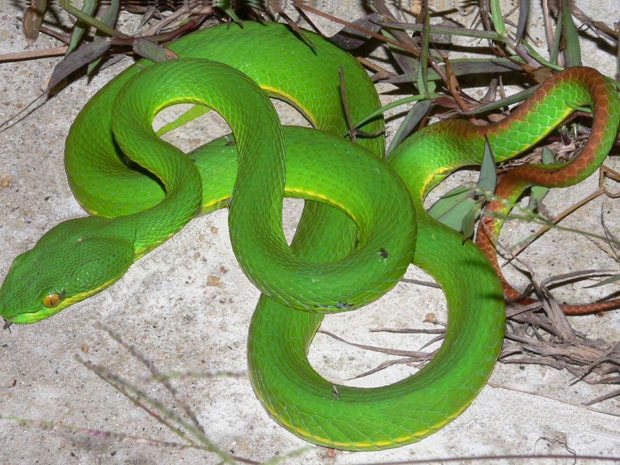 |
| Red-tailed pit viper. |
| RELATED NEWS |
|---|
Most patients are bitten on the hands and feet during work. The bite mark shows venomous fangs, with two tooth marks about 1 cm apart. Within minutes of being bitten, swelling and severe pain occur, accompanied by continuous bleeding at the bite site that does not stop spontaneously. After about 6 hours, the swelling spreads from the bite wound, potentially reaching the base of the limb, leading to overall swelling, pain, bruising, subcutaneous hemorrhage, and intramuscular hemorrhage. Blisters may form, with bleeding within the blisters. Local infection and compartment syndrome may also occur.
Patients may experience dizziness and anxiety; they may develop hemorrhagic shock such as hypotension, cold and clammy extremities, lethargy, oliguria, or anuria; anaphylactic shock due to snake venom may also occur. Patients may experience spontaneous bleeding at injection sites, bleeding gums; intramuscular bleeding, gastrointestinal bleeding, urinary bleeding, vaginal bleeding, pulmonary bleeding, and cerebral bleeding; acute renal failure may also develop.
The guidelines also clearly state the principles of diagnosis, clinical and paraclinical symptoms, differential diagnosis, definitive diagnosis, and treatment principles for patients bitten by the green pit viper with a red tail...
To prevent bites from the green pit viper with a red tail, it is necessary to clear overgrown bushes around the house, avoid building trellises or climbing plants in the front yard, and planting lemongrass or sprinkling sulfur powder around the house are measures that can repel snakes and should be applied, especially in areas with many snakes. When entering forests or places suspected of having green pit vipers, wear a wide-brimmed hat, long clothing, high-top shoes, and use a stick to scare away snakes...
The red-tailed green pit viper belongs to the viper family (Viperidae), genus Cryptelytrops. The viper family has many different genera and species, but they all share the common venom that causes blood clotting disorders and bleeding. Cryptelytrops albolabris (formerly known as Trimesurus albolabris), known in Vietnam as the red-tailed green pit viper, is distributed throughout the country and typically lives in trees.
According to Vietnam+


