
Issuing the Government's Rules of Procedure
Prime Minister Pham Minh Chinh has just signed Decree No. 39/2022/ND-CP promulgating the Government's working regulations. This decree clearly outlines six working principles of the Government.
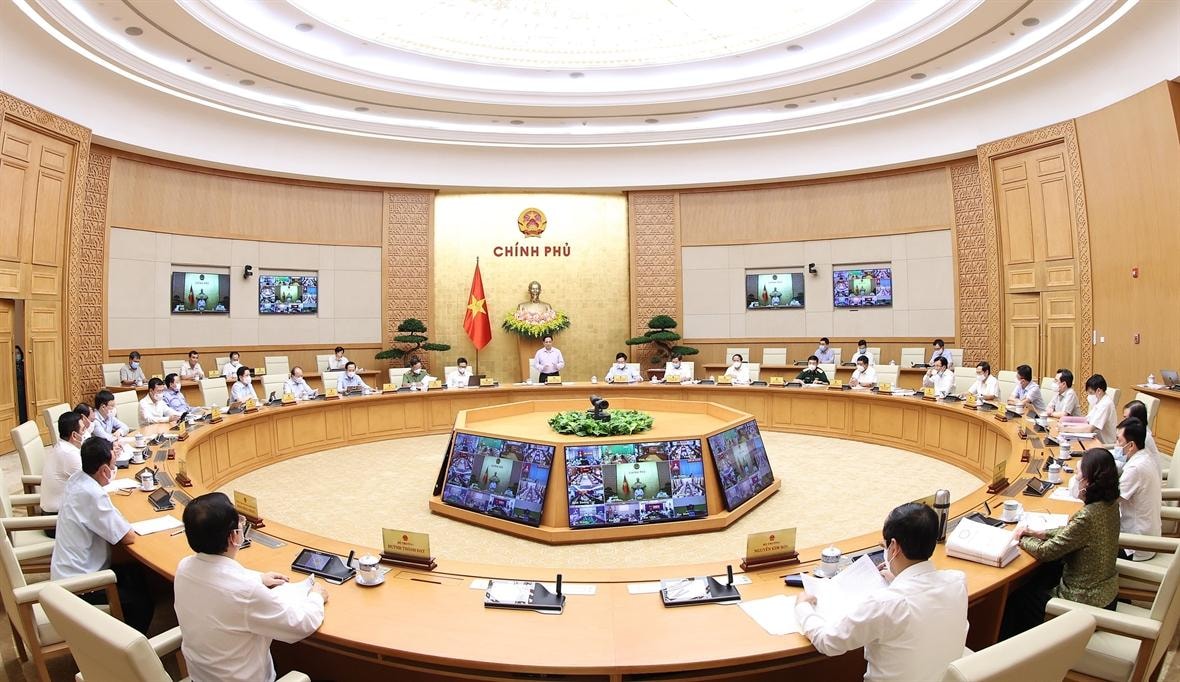 |
A view of the online meeting between the Government and local authorities. Photo: Duong Giang/TTXVN. |
Specifically, the Government operates on the following principles: All government activities must comply with the Constitution and laws, ensure the leadership of the Party, and implement the principle of democratic centralism. The Government operates under a system that combines the collective authority and responsibility of the Government with the individual authority and responsibility of the Prime Minister and each individual member of the Government. The Government makes decisions by majority vote on matters within its jurisdiction. It emphasizes individual responsibility and exemplary conduct of Government members, heads of ministries, agencies, and localities. Each task is assigned to only one person to preside over and be responsible for. In cases where a task is assigned to a ministry, agency, or provincial People's Committee, the Minister, head of the agency, or Chairman of the provincial People's Committee must bear responsibility. It proactively resolves issues according to the correct procedures, authority, and legal regulations, as well as the Government's working regulations. Ensuring coordination, information exchange, and promoting unity in the government's work.
Implement assignment, delegation, and authorization in accordance with the law, individualizing responsibilities while strengthening supervision, inspection, and control of power, ensuring centralized leadership and unified management in line with the Government's authority. Promote the initiative and creativity of heads of ministries, agencies, and localities. Strictly enforce administrative discipline and order; subordinates must obey and strictly comply with the leadership, direction, and assignments of superiors. Ensure transparency, openness, and innovation in the operations of the Government, ministries, ministerial-level agencies, government agencies, and state administrative agencies at all levels; implement a unified, seamless, continuous, democratic, modern, honest, effective, and efficient administration that serves the people and is subject to the people's inspection and supervision.
The responsibilities, scope, and methods of government work.
According to the Regulations, the Government uniformly manages the state administrative system from the central to local and grassroots levels; and fully performs the tasks and powers of the Government as stipulated in the Constitution and laws.
The government's method of handling affairs is through discussion and decision-making at government meetings. Decisions are also made by ballot among government members in cases where the government is not in session. Government decisions must be approved by more than half of the total number of government members. In case of a tie vote, the decision made by the Prime Minister will be implemented.
The Government assigns the Prime Minister to consider and decide on urgent issues requiring immediate attention within the Government's authority, or issues for which the Government has agreed on the principle. The Prime Minister reports or delegates to the Deputy Prime Minister, Minister, or Head of a ministerial-level agency to report on the decided issues at the nearest Government meeting.
The government implements decentralization and delegation of power to local authorities in accordance with the laws and resolutions of the National Assembly, and the ordinances and resolutions of the Standing Committee of the National Assembly.
The government implements decentralization and delegation of authority to local governments to decide on or carry out certain state management tasks within their respective sectors and fields, in accordance with the conditions and capabilities of the local governments, while simultaneously allocating resources rationally, improving the capacity and qualifications of officials, and strengthening inspection, supervision, and strict control of power.


