
Ban May remembers Uncle Ho
(Baonghean)From the beautiful country of Laos, crossing the Mekong River, we arrived in Nakhon Phanom province, home to Ban Mai, to hear stories about President Ho Chi Minh, visit his house, and see the familiar images of Lang Sen and Lang Tru villages right here in Thailand…
Nakhon Phanom is a province in northeastern Thailand, bordering the town of Thakhek in Laos.
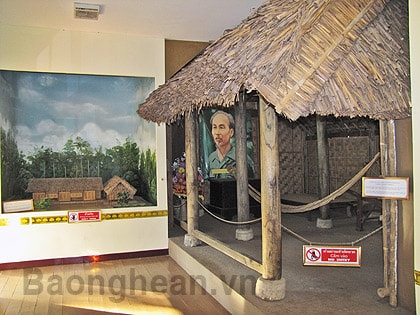
This image depicts a replica of Sen Village, President Ho Chi Minh's birthplace, within the Ho Chi Minh Memorial Site in Ban May.
Mr. Hoang Van Phuc, over 80 years old, one of the respected Vietnamese people in the community in Nakhon Phanom province, said: "From the moment they set foot on this land, the first Vietnamese people chose to live in areas with dense forests, because they feared being driven out by the local authorities. This land was called Na Chooc village by the Vietnamese (the 'wild dog' land, because in the early days, there were dense forests, wild fields, and many wolves). With the hard work and diligence of the Vietnamese people, this land gradually transformed and became the most important settlement of the Vietnamese community in Nakhon Phanom, a place that welcomed revolutionary cadres from Vietnam who came to Siam to carry out their activities."
In July 1928, under the pseudonym Thau Chin, leader Nguyen Ai Quoc arrived in Nakhon Phanom. There, Thau Chin proposed that the villagers change the name of their village from Na Chooc to May, meaning "new village," marking the renewal of the rural community established by the Vietnamese people. Initially, Thau Chin mobilized several young people in the village to cut wood and fire bricks to build a stilt house that served as a living and studying space, as well as a lodging place for revolutionary cadres from Vietnam. He called this the "cooperative house." The house faced the Noong Nhat lake; in front of it, Thau Chin planted a starfruit tree, two coconut trees, and a hibiscus hedge...
During this period, the Vietnamese in Siam didn't know much about Thau Chin, only seeing him as an approachable man who was very considerate of everyone. Every day, after work, Thau Chin and other young men would play football, teach the people how to grow rice and potatoes, and how to save money so they could be ready to return to their homeland and support the revolution. He urged the Vietnamese expatriates, no matter where they went or what they did, to always keep their homeland in mind.
Later, after the revolution succeeded, the people of Bản Mạy learned that Mr. Thầu Chín from years ago was none other than President Ho Chi Minh. Since then, everyone has cherished and treasured even the smallest mementos related to President Ho Chi Minh during his time in Bản Mạy. While there, President Ho Chi Minh guided the people in learning the Thai language to understand the customs and traditions of their neighboring country, but he also reminded them to preserve the Vietnamese language and customs because they were Vietnamese.
Today, President Ho Chi Minh's house in Mai village is preserved quite intact by the local people, with familiar items he used such as his Chinese-style hat, rubber sandals, wooden bed, rice storage shed, cooking stove, and fishing basket. The house is entrusted by the local authorities and community to Mr. Nguyen Trong Tieu's family for safekeeping, protection, and receiving guests, as well as for sharing stories about President Ho Chi Minh. For the past two years, since Mr. Tieu passed away, his children and grandchildren have continued his work. Occasionally, when visitors from Vietnam come to visit, Vietnamese people gather at President Ho Chi Minh's house to inquire about his health and the situation in Vietnam. For many, they simply come to hear Vietnamese spoken, to ease their homesickness. When speaking of President Ho Chi Minh, the people of Mai village are deeply moved and grateful. Many small stories about President Ho Chi Minh's time in Siam are also preserved and passed down to future generations by the villagers.
In Bản Mạy today, besides President Ho Chi Minh's stilt house, there is also the Vietnam-Thailand Friendship Village historical site and the Ho Chi Minh Memorial House. Here, the Vietnamese and Thai governments have jointly built models of President Ho Chi Minh's paternal and maternal hometowns in Sen village (Kim Liên – Nam Đàn), along with artifacts associated with his activities in Thailand. These are familiar destinations for Vietnamese people living, studying, and working in Thailand. Many Thais also come here to respectfully light incense at President Ho Chi Minh's altar.
Mr. Dao Trong Ly, Chairman of the Vietnamese Association in Nakhon Phanom Province, said: Currently, the Vietnamese community here numbers about 20,000 people, with approximately 300 households in Mai village alone. Every year, on President Ho Chi Minh's birthday, the Vietnamese community in Nakhon Phanom gathers at the Association's headquarters to offer incense and flowers, report their achievements to President Ho Chi Minh, and then travel together to Mai village to visit the stilt house, the Friendship Village, and the replicas of Sen and Hoang Tru villages in the Ho Chi Minh Memorial Area. "Although far from our homeland, the image of President Ho Chi Minh and the image of Vietnam always remain in the hearts of every Vietnamese person in Thailand. Mai village is an ideal place to educate about traditions, patriotism, and national pride for every Vietnamese person studying, working, and living in Thailand," Mr. Dao Trong Ly shared.
Text and photos: Nguyen Khoa


