
Violence erupted in the Swedish capital.
At least six cars were burned to ashes last night, May 23, in Stockholm, despite increased police presence aimed at preventing violence in the suburbs of the Swedish capital, an area with a large immigrant population.
According to AFP, this is the fourth consecutive night of violence, and police are ready to deploy forces to deal with the situation tonight.
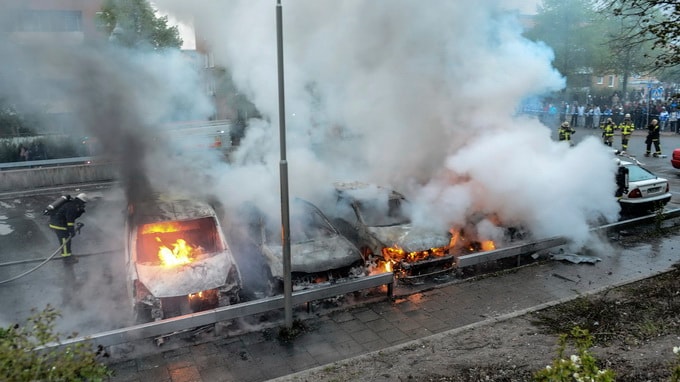
Burnt-out cars in the suburbs of Sweden. Photo: Reuters
The riots have tarnished the image of Sweden as a peaceful and egalitarian country and have led to controversy surrounding the immigrant community, which makes up about 15% of Sweden's population.
Police said they would increase their presence in other areas across the country to prevent the risk of violence spreading beyond Stockholm.
In Rinkeby, a predominantly immigrant area of Stockholm, around 300-500 people took to the streets, causing disturbances and setting six cars on fire.
A school in the Tensta suburb, which also has a large immigrant population, was also set on fire. However, firefighters managed to extinguish the blaze in time. Earlier, vandals had thrown stones at a police station in the Kista district as well as two other police stations in southern Stockholm.
In the Skogaas suburb, rioters vandalized a restaurant before setting it on fire. “We are gradually becoming like many other countries,” AFP quoted sociologist Aje Carlbom of Malmoe University as saying sadly.
The violence erupted after police shot and killed a 69-year-old man in Husby who was brandishing a knife in the street. The man then ran towards his apartment, but police opened fire. Police claimed they acted in self-defense.
The shooting ignited anger among young immigrant youths in the area, who had previously spoken out against police brutality. During the first night of the violence, many claimed police had called them derogatory names.
Expert Carlbom stated that Sweden's liberal immigration policy has attracted many immigrants from around the world. However, they face many difficulties here due to their lack of Swedish language skills and difficulty finding employment, despite numerous government support programs.
As a result, many immigrant communities become isolated from the outside Swedish society. "Life for young immigrants in these isolated areas is very difficult; they have no contact with Swedes and no understanding of Swedish society," expert Carlbom stated.
For example, the Husby area has 12,000 inhabitants, 80% of whom are immigrants. In the last decade, Sweden has welcomed hundreds of thousands of immigrants from Iraq, Afghanistan, Syria, Somalia, the Balkans, and other regions.
Integration Minister Erik Ullenhag acknowledged that the violence stemmed from high unemployment rates in immigrant communities. In Husby, the unemployment rate was 8.8%, compared to the Swedish average of 3.3%.
According to Tuoi Tre - DT


