
Warning: The sharp-finned, spine-like cleaner fish is spreading rapidly in the wild.
By some unknown means, the cleaner fish, an invasive species native to South America, escaped from a small family aquarium and is now proliferating in rivers and lakes from the South to the North, threatening the survival of other native species.
The buried fish didn't decompose and punctured the car tires.
Having worked as a trader buying seafood from local households for several decades, Mr. Pham Xuan Truong, from Hamlet 1, Vu Doai Commune, Vu Thu District (Thai Binh Province), had never seen so many aquarium cleaner fish appearing in ponds, lakes, and rivers in the area.
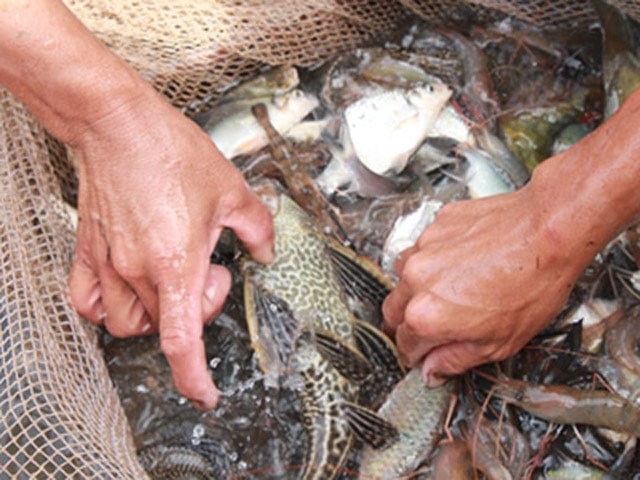 |
| Cleaner fish were caught among other aquatic species in a fisherman's net. |
"A few years ago, a single net might only yield a few fish, but now there are countless numbers. In some exceptional cases, a pond might yield 300 kilograms of fish, and 100 kilograms of that is cleaner fish. Many native aquatic species in the pond have disappeared," Mr. Truong said.
According to Mr. Truong, the characteristic of this fish species is its extremely sharp fins, "pointed and hard as nails; even burying them is ineffective, they can even puncture car tires, and some are as big as a kilogram, nothing short of monsters," Mr. Truong asserted. Furthermore, they can consume all the "nutrients" in ponds, leaving no place for other fish species to live.
Because they are difficult to dispose of, Mr. Truong said that most households, after collecting the fish and cleaning their tanks, simply dump them into the river. This unintentional act only contributes to the increasing proliferation of this fish species.
New external threat
Ms. Vu Thi Hong Nguyen, a staff member of the Center for Biodiversity and Aquatic Resources Research (Research Institute for Aquaculture I), affirmed that the cleaner fish is a new invasive threat, following many other invasive species that have had negative impacts on agricultural production in our country.
 |
| This invasive species poses a threat to other native aquatic species. |
Called aquarium cleaners or glass cleaners because they are omnivorous (eating waste from other fish, algae clinging to the tank walls, etc.), many experts are concerned that importing this species into Vietnam will cause ecological imbalance because, after being released into the environment, they easily adapt to river and water environments.
Cleaner fish can approach other fish and suck their mucus, hindering their growth. If other fish are less adaptable, they will die. More dangerously, because of their strong adaptability, they overwhelm native species, creating an ecological imbalance. After spreading into the wild, cleaner fish are now becoming an invasive species that threatens other fish in the same habitat.
"We conducted a survey in 14 provinces and cities across the country, from Cao Bang, Phu Tho, Yen Bai, Nam Dinh, Nghe An to Lam Dong, An Giang, Dong Thap,… and the reality shocked everyone because of the rapid spread of the aquarium cleaner fish," Ms. Nguyen said.
According to Ms. Nguyen, compared to the northern provinces, the reproduction rate of the aquarium cleaner fish in the Mekong Delta is much faster. Locals report that some net hauls contain up to 50% aquarium cleaner fish; these fish can tear nets if they are light, and can even destroy embankments because of their characteristic of eating algae and impurities in the water environment.
Regarding the harmful effects of this fish species, Ms. Nguyen stated that they will reduce biodiversity and aquatic resources. "In fact, through surveys, we have found that in areas with many cleaner fish, native aquatic species are very scarce. Another danger is that this species is very resilient, making it difficult to eradicate, while people's awareness is still low; when they catch them, they release them back into the natural environment," Ms. Nguyen said.
Answering a question about the nutritional value of this species, Ms. Nguyen affirmed: "It's very low, and to date, very few people dare to use it as food."
"In the proposed report, we also recommended that relevant agencies and localities take strong measures to prevent the spread of this invasive species. If timely action is not taken now, the danger will be unpredictable," Ms. Nguyen affirmed.
The glass cleaner fish, also known as the pleco (scientific name Hypostomus punctatus), is a freshwater fish native to South America, primarily living on the bottom of freshwater and brackish water bodies. Its main food source is algae and seaweed clinging to plant surfaces or the seabed. It is an omnivore, competing for food with other species, and reproduces rapidly when released into natural aquatic environments. The fish can breed year-round, with a survival rate of approximately 70% of fry, and can survive without food for up to a month. These fish are mainly imported into Vietnam from Hong Kong and Singapore as ornamental fish.


