
Alarm raised over illegal emigration.
(Baonghean) - In Tuong Duong district, more than 1,000 women have left their villages to work elsewhere, most of them illegally. Some voluntarily go to work as factory workers, while others are tricked and sold as wives to foreigners, but all of these situations carry unpredictable social consequences.
CWe arrived at Quang Phuc village, Tam Dinh commune, Tuong Duong district on a day at the end of March. The weather was mildly sunny, and the atmosphere of the Thai ethnic minority village was quite tranquil. At the foot of the ancient stilt houses, many women gathered in groups of five or seven, holding their children, chatting, pointing, and showing curiosity at the appearance of the strangers.
Visiting the home of Mr. Lo Van Tang, the head of Quang Phuc village, and inquiring about women leaving the village for work, Mr. Tang sighed wearily, saying that five women from the village had left. “We heard they went to China to work, but no one reported it to the village. We wanted to know the situation, but they wouldn’t provide any information,” Mr. Tang said. With the help of his son, currently the deputy secretary of the commune's youth union, we found Ms. Luong Thi Hien, 32 years old. Tall, with straight hair and hands adorned with black-dyed nails, scrolling through a large touchscreen phone, she stood out from the other women in the village.
According to the story, Ms. Hien had a husband and children and built a small house in the village, but later, her husband became addicted to drugs and was imprisoned. To cover her husband's debts, Ms. Hien had to borrow money from the bank and fell into financial difficulties, unable to repay. At the end of 2011, influenced by some people in the district, Ms. Hien left her children with her grandmother, sold all her valuables to borrow 10 million dong to give to a "broker," and then took a bus to Dien Chau intersection. From there, she was picked up by a passenger bus that went straight to Mong Cai and crossed the border into China.
Perhaps because of her age and lack of beauty, Hien didn't end up as someone's wife but instead found work as a factory worker in a flour mill, earning about 4 million VND per month. In early 2014, missing her children, Hien requested to return to Vietnam. When we spoke to her, Hien was reserved, not providing further information about the person who arranged her crossing the border or how she did it, only adding: "Many people who went there were taken to be wives instead of working as factory workers." When asked if she would go to China again, she said that life at home was too hard, and with no work available, she would continue to go.
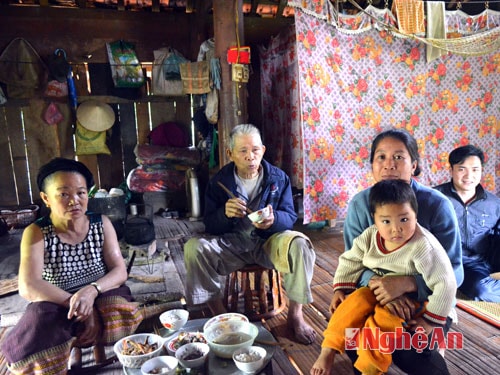 |
| The family of Mr. Lo Van Duong lives in Quang Phuc village, Tam Dinh commune. |
About 50 meters from Ms. Hien's house is the house of Mr. Lo Van Duong, Ms. Hien's cousin. The whole family was gathered around a late lunch. A chubby, fair-skinned 3-year-old boy seemed bewildered by the conversation in Thai being told by his relatives. Mr. Duong explained that the boy was his grandson. "He doesn't understand much Vietnamese yet, because he was born in China; he's Chinese." Mr. Duong added that four years ago, his daughter, Lo Thi Hai (born in 1987), was lured and sold to China by unscrupulous individuals and forced to marry a poor man with a speech impediment, resulting in the birth of the child.
After a long period without any news from their child, five months ago, Hai brought her son home, saying she wanted him raised by his maternal grandparents, then quickly left the village and went to China. Since then, Hai has not contacted home, and all the childcare has been handled by Mr. and Mrs. Duong. “We feel so sorry for our daughter and grandson. When she left, she was a girl, she was tricked and sold, and now she has a husband and children with a Chinese man. We don’t know how she’s living over there. We just hope she comes back to work and raise her grandson,” Mr. Duong sighed. The family has only named the child Nhat, but hasn’t registered his birth because they don’t know his father’s name, what he will become, or what nationality he will have when he grows up…
In Quang Thinh village, many women have left the area. According to Quang Van Hai, a police officer and deputy village head, the situation is worsening due to the large number of women leaving the village for unknown reasons, without registering their temporary residence or absence. In mid-March, the village committee held a meeting to request families with members who had left to report their departure. To date, according to data provided by the villagers, 37 women have left the area, 15 of whom went to China. "All of them left illegally, without notifying the village committee or local authorities," Hai confirmed.
Leaving Tam Dinh commune, we arrived at Tam Quang commune. Tam Bong village lies peacefully beside a stream during the dry season. Village head Tran Van Tien said that out of 200 households in the village, 103 are poor or near-poor. Historically, the villagers have relied on slash-and-burn agriculture, facing significant economic hardship. Many young people from the village leave to work elsewhere. After the Lunar New Year of the Horse, the number of people leaving the village to work increased significantly. Currently, there are about 30-40 people working outside the village, mostly women. The village management board doesn't know which country they've gone to or what professions they're pursuing. "We've tried to compile statistics and keep track of the situation, but all the families with members who have left the village want to keep the information secret. Some don't know where their children or relatives are or what they're doing," said Tran Van Tien. Mr. Lo Van Kham (81 years old) said: "For the past four months, my daughter-in-law, Luong Thi Luu (born in 1978), has also left her child, who is still in high school, to go work. Mr. Kham doesn't know where his daughter-in-law went."
His son has passed away. Despite his advanced age and frail health, Mr. Kham, out of love for his grandson, has to shoulder all the family responsibilities. According to Mr. Tran Van Quy, a permanent police officer in Tam Quang commune, the number of people leaving the village for illegal labor in China has recently surged. The commune police, in coordination with the local authorities, have been trying to persuade and educate people against this illegal migration, as it is dangerous, easy to be tricked and sold, and leaves them without any rights if something goes wrong. However, for various reasons, they still deliberately try to leave. In early 2014, after learning that some women were planning to leave the village for China, the commune authorities reported to the district and assigned commune police officers and permanent police officers to go door-to-door to persuade them not to go. At midnight, 17 women from the village secretly hired someone to take them by motorbike to Con Cuong district to catch a bus and leave. Currently, 63 people from Tam Quang commune have gone to China, and no one knows what professions they are engaged in or how they are living in that country.
According to investigations, the phenomenon of women in Tuong Duong leaving their villages to go to China, Laos, and Thailand has been occurring for about 2-3 years now. While people in communes such as Yen Na, Yen Hoa, Nga My, Yen Tinh, and Luu Kien often go to Thailand, many in communes like Tam Quang, Tam Dinh, and Tam Thai have gone to China. In 2013, the entire district had 1,558 people leaving to work abroad, mainly women and girls. Most of these people left illegally, without completing the procedures for temporary absence or residence permits, and without having their household registration or civil status cancelled. After the Lunar New Year of the Horse, the situation of women and girls leaving their villages continued. In response to this situation, at the end of March, the Tuong Duong District Police organized a survey and classification of those who had left the district to work abroad illegally. Currently, according to preliminary results, the entire district has 1,216 people leaving to work abroad. Of these, 476 went to China, 178 to Laos, over 60 to Thailand, and 464 went to work in other provinces. All of these people entered the country illegally.
Mr. Vi Tan Hoi, Vice Chairman of the People's Committee of Tuong Duong District, said that family tragedies have occurred when women leave home or are tricked and sold to China. Many women leave their husbands, and many other families do not know where their wives and children have gone. "This situation causes many difficulties in managing civil registration and household registration, disrupts security and order, and will certainly leave behind social consequences such as diseases, the spread of illegal religious activities, and the influx of obscene cultural products from abroad into peaceful villages," Mr. Vi Tan Hoi affirmed.
The main reasons women leave their villages to work abroad are limited legal awareness and difficult economic conditions. Meanwhile, human trafficking crimes are becoming increasingly sophisticated. While in the past traffickers would directly visit local communities to find victims, now they often use phones and social media to contact women in their villages and entice them. If they agree, they simply take a bus to National Highway 1A, then a passenger bus to the Mong Cai border gate, where someone will organize the illegal crossing. Many women believe that "Going to China is easier than going to the South."
Lieutenant Colonel Ho Trong Nam, Deputy Chief of Police of Tuong Duong District, said that to prevent women from being lured and deceived by criminals, the district police have coordinated with relevant agencies to implement many measures to disseminate information, educate, and popularize laws among the people, and established two women's clubs for preventing human trafficking in Nga My and Yen Hoa communes. In 2012, the district government, in coordination with the Border Guard and the Lang Son Provincial Police, successfully rescued a woman who had been trafficked to China to be a wife. Recently, the district police also coordinated the arrest of two individuals, Ngan Thi Thong (born in 1979) and Lo Thi Phuong Sa (born in 1992), in Tam Bong village, Tam Quang commune, for the crime of human trafficking. Mr. Vi Tan Hoi, Vice Chairman of the District People's Committee, said that in the coming time, the District People's Committee will continue to implement measures to improve the skills and awareness of management officials in communes and villages, especially in the management of civil registration, household registration, and labor management. Most importantly, it will educate women about the dangers of illegally going abroad and implement measures to gradually improve the economic and social lives of the people in order to gradually reduce the phenomenon of women leaving their villages.
Leaving the mountains and forests of Tuong Duong, we were worried thinking about the image of the bewildered Chinese child learning to speak Thai in the family of Mr. Lo Van Duong, and about the statistics on the number of women in the district who have left their villages. Behind those numbers lies a similar proportion of husbands losing their wives, children separated from their mothers, younger siblings separated from their older sisters, and families facing tragedy… leading to unimaginable consequences.
Nguyen Khoa


