
When will the new school be built?
(Baonghean) - Infrastructure for preschool education in particular, and all levels of education in general, is a major challenge for many disadvantaged localities today. With limited budgets, many preschools face the reality that both teachers and students are anxiously studying in dilapidated classrooms. When will the dream of a sturdy, well-built school become a reality?
The dilapidated, run-down classrooms of Dong Van 1 Kindergarten (Dong Van-Tan Ky), located near the center of the commune, have been the playground and learning space for over 300 children and teachers for many years. During the recent cold spell, the children's lunch had to be eaten on the small outdoor courtyard. Without any fire to warm them, the only way to protect them from the biting cold was for the teachers and students of Dong Van 1 Kindergarten to huddle together. Teacher Ho Thi Ha, who has taught at the school for 22 years, explained, as if justifying her decision: "It's cold, but we have no choice but to let the children eat outside for safety, because the classrooms are all in disrepair. If a roof tile were to fall..." She paused mid-sentence, a hint of guilt in her voice.
These dilapidated classrooms were formerly the commune's health station, handed over to the school when it moved to a new location. However, due to a lack of funding, the school hasn't been able to carry out many repairs since the move. Therefore, not only the general appearance but also the classrooms retain the structure of a medical facility. The floors are rough, cement-plastered, and the wooden pillars in the middle of the classrooms are already infested with termites. Most disheartening are the four walls; despite the teachers' efforts to decorate them with pictures and toys, they cannot hide the deterioration and stains. The 5-year-old group, due to a shortage of classrooms, has to split their rooms in two. The partitions are made of flimsy plastic sheets, seemingly ready to collapse at any moment. The roofing is also a problem; because the building was constructed so long ago, the entire rafters and purlins are dilapidated, with large holes in some places. Electrical wires are haphazardly strung between the classrooms…
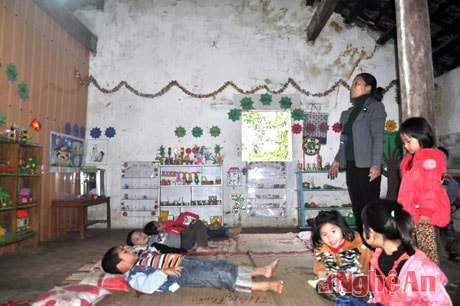 |
| Students are boarding in temporary classrooms renovated from the Dong Van Commune Health Station (Tan Ky). |
Speaking about the current facilities of Dong Van 1 Kindergarten, Principal Chu Thi Hoai Thu expressed her deep sadness. Firstly, she is concerned about the safety of the students. Furthermore, she is hesitant to mention any awards or commendations because with the school and classrooms not yet fully developed, even the best efforts of the teaching staff would be futile. In addition, the school is facing a severe shortage of classrooms. While the school has 13 classes, only 5 are located at the main campus, one of which is held at the village's community center. The remaining 8 classes are split between two branch schools, Ke Khieng and Dong Loong, located 6-7 kilometers from the main campus. The disadvantages for teachers at these branch schools are well-known, as they are far from the center, have difficult transportation, and lack opportunities for regular professional development. However, the students at these branch schools face even greater hardship because they don't receive half-day schooling, have playgrounds, or sufficient outdoor toys. The situation at the village cultural center is also difficult because the schedule depends on the village's activities. For example, when I visited, the 3-year-old class had to combine two classes because the cultural center was being used to collect motorbike parking fees. Because they share the cultural center, the teachers don't have the resources to decorate, draw, or display toys. "The village also finds it inconvenient because if we organize activities, the students have to miss school," lamented Mr. Nguyen Sy Hoi, head of Vinh Dong village.
Faced with this situation, the school has repeatedly requested funding from the commune government and the education department for upgrades. However, all requests have gone unanswered. The school has also considered fundraising, but Dong Van is a poor commune, with ethnic minorities accounting for 60% of the population, and a high poverty rate, making it difficult to mobilize and collect money from the people. It was with great difficulty that the school managed to persuade parents to contribute money to build a corrugated iron roof for the children's current eating area. The regular annual budget is only 25-30 million VND, requiring careful budgeting to cover teaching materials and regular expenses. For classroom decoration and toy making, the school encourages teachers to be creative.
Mr. Pham Cong Ly, Chairman of Dong Van Commune, lamented: "Currently, Dong Van Commune has 6 schools, from kindergarten to secondary school. Therefore, investing in all 6 schools at once is very difficult, as the commune's budget is limited. Currently, the commune spends 150-200 million VND each year on school repairs, but due to limited funds, we only focus on repairing one or two schools each year, prioritizing those in remote areas. Dong Van also doesn't have any schools that meet the required standards." With the rainy and cold season still ongoing, the dream of a sturdy classroom and a school with adequate facilities remains a distant one for the poor students here.
With heavy hearts, we left Dong Van Kindergarten and went to Nam Cuong Kindergarten (Nam Dan). Built long ago and ravaged by countless floods, despite annual efforts by the commune to mobilize social resources for repairs, Nam Cuong Kindergarten is now severely damaged and dilapidated. Many walls and roof tiles are rotten and cracked, and classrooms are constantly leaking during the rainy season, posing a constant threat to the lives of teachers and students. Since the beginning of the 2013-2014 school year, the school has had to close three times to avoid rain and floods. And each time heavy rain and flooding occur, the teachers have to rush to transport teaching materials and equipment to the neighboring primary school for safekeeping. Mr. Le Trung Sinh, Vice Chairman of the People's Committee of Nam Cuong commune, said: "In reality, the kindergarten here was built a long time ago. With a large number of children, the commune's budget is insufficient to build a proper school, only temporary structures. As a result, the children have had to miss school three times this school year, each time for 10-15 days. We earnestly hope that relevant departments, levels of government, and philanthropists will provide more funding and attention to build a new kindergarten so that the children can receive a stable education."
With a large student body of 280 children across 10 classes, the school only has 6 dilapidated classrooms, forcing it to borrow 4 additional rooms from the primary school. The school's management team shares an office with the security guard. Furthermore, teaching equipment, supplies, and toys are severely lacking. In addition, the school is short 7 teachers to meet the required standard of 1.5 teachers per class as stipulated by the Ministry of Education. Despite these numerous difficulties, the management team and teachers, driven by their love for the profession and dedication to education, have strived to excel in teaching and learning. As a result, the school's enrollment rate remains high, particularly in the kindergarten class, which has achieved 100% of its target. Ms. Tran Thi Hoa, Principal of Nam Cuong Kindergarten, shared: "Despite the difficulties, the unity within the school remains strong, with mutual support and affection among the staff and teachers. We have built a charity fund to help underprivileged children in the school."
Early childhood education plays a crucial role in shaping children's personalities and intellectual development, serving as the first training ground for future generations of the country. However, with the current poor and dilapidated infrastructure and shortage of personnel, how long will the efforts of the teachers and students at Nam Cuong Kindergarten and Dong Van 1 Kindergarten be able to sustain themselves? Meanwhile, in disadvantaged areas like Nam Cuong and Dong Van, investing in infrastructure using only local resources is very difficult.
Quynh Lam commune (Quynh Luu district), located not far from Cau Giat town (just over 2 km southwest), remains a disadvantaged commune to this day. Educational facilities are extremely rudimentary and makeshift. Quynh Lam A Primary School has 21 classrooms scattered across 3 locations, all of which are temporary, level 4 buildings. The main location, near the secondary school, has 9 classrooms built in the 1990s; the second location, in Hamlet 11, has 10 classrooms, about 5 km from the commune's People's Committee, built in the 1970s; and the third location, in Hamlet 16, has 2 classrooms that are now in serious disrepair. In 2013, due to the impact of Typhoon No. 10, the roof of one classroom at the Hamlet 11 location collapsed.
The reasons for this situation are that, for a long time, the commune has not paid sufficient attention to and invested adequate resources in education, resulting in a lack of a roadmap for repair and upgrading. Consequently, a series of schools, from preschool to primary and secondary levels, are currently in serious disrepair. Furthermore, due to the commune's large geographical area, spanning tens of kilometers, planning and allocation of resources are very difficult. Meanwhile, the average per capita income is low (less than 13 million VND/person/year), and the land is barren and prone to flooding, severely limiting the mobilization of community resources and other support.
Mr. Tran Ngoc Thu, Principal of Quynh Lam A Primary School, said: Compared to other localities, although the school facilities are poor, fortunately, the children of Quynh Lam still attend school regularly and seriously, with no dropouts; the student enrollment rate and primary education universalization always reach 100%. The school still maintains discipline and the "good teaching, good learning" emulation movement, and a "green, clean, and beautiful" campus... However, due to the extremely makeshift facilities and the distance between school locations, ensuring discipline is truly difficult. Moreover, none of the school locations have toilets or boundary walls, which is very inconvenient for teachers, especially female teachers...
Ms. Bui Thi Huong, Vice Chairman of the People's Committee of Quynh Lam commune, said: "Given the extremely poor state of school facilities, at the beginning of the 2010-2015 term, the commune's Party Committee set the goal of having all four schools meet national standards. However, more than half of the term has passed, and none of the schools have met the standards, and with the current conditions, it is very difficult to achieve the above target."
The freezing outdoor meals of teachers and students at Dong Van 1 Kindergarten (Tan Ky), the crumbling roofs and walls at Nam Cuong Kindergarten (Nam Dan), and Quynh Lam Primary School (Quynh Luu) are just three examples among many other heartbreaking images. For children to study in safe and secure schools, the involvement of all levels and sectors, the cooperation of the people, and the attention of local authorities are essential.
Reporters and Collaborators


