
When will the King Le Temple historical site be restored?
The King Le Temple, located in Hung Khanh commune, Hung Nguyen district, was built in the mid-15th century. It is one of the four largest and most famous ancient temples in Nghe An province, boasting unique architectural carvings not found in other temples. Through the vicissitudes of time, the King Le Temple was eventually destroyed; what remains in the grounds today are only a few stone foundations and a hollowed-out pillar. Originally a large temple with 23 chambers and 98 pillars, including 64 main pillars with a diameter of up to 60 cm.
(Baonghean)The King Le Temple, located in Hung Khanh commune, Hung Nguyen district, was built in the mid-15th century. It is one of the four largest and most famous ancient temples in Nghe An province, boasting unique architectural carvings not found in other temples. Through the vicissitudes of time, the King Le Temple was eventually destroyed; what remains in the grounds today are only a few stone foundations and a hollowed-out pillar. Originally a large temple with 23 chambers and 98 pillars, including 64 main pillars with a diameter of up to 60 cm.
The Le King Temple can be said to be one of the most outstanding architectural works of Nghe An. The carving art here has reached a masterful level, a harmonious combination of technique and artistry. Alongside this are ornate carvings with traditional themes such as dragons, unicorns, turtles, phoenixes, two dragons worshipping the moon, two dragons fighting for a pearl, and folk-style motifs such as images of female dancers, musicians, cranes, chess players, shepherds... with delicate and graceful carvings that make the carvings even more vibrant. This is one of the most beautiful wooden architectural works and bears the distinct mark of the typical architectural style of the 15th century.
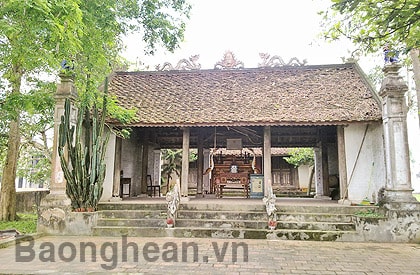
The temple dedicated to King Le has fallen into disrepair.
During the years 1930-1945, the King Le Temple served as a village meeting place and a meeting point for revolutionary cadres and party members to discuss their activities. In 1954, floods caused the collapse of two buildings, and in 1968, American bombing ripped off the roofs of the remaining buildings. After nearly four years of exposure to rain and sun without repair or upgrade, much of the wooden structure rotted until the village completely dismantled it in 1972. During that period, the usable wooden parts of the temple were used to build schools and warehouses, while some were lost, leaving the King Le Temple in ruins.
In 1986, in accordance with the wishes of the local people, Hung Khanh commune mobilized donations to restore the King Le Temple. However, even after restoration, the temple only partially met the needs of worship. Since its restoration, the temple has been celebrated annually on August 22nd in Hung Khanh commune. This is a characteristic festival of the people of Nghe An province. Another joy came to the people of Hung Khanh when, in 1998, the King Le Temple was classified as a National Historical and Cultural Monument by the Ministry of Culture. However, since its recognition as a National Historical and Cultural Monument, the King Le Temple seems to have been forgotten, receiving no attention for restoration, upgrading, or renovation. Therefore, the temple is currently showing signs of deterioration. Looking at the old, faded tiled roofs and the overgrown vegetation surrounding it, everyone feels saddened.
Mr. Hoang Van Ai, Vice Chairman of the People's Committee of Hung Khanh commune, added: After numerous requests from the locality, in 2012, the People's Committee of Nghe An province approved the detailed plan for the restoration and renovation of the King Le Temple relic, phase 1, including 19 items. These included the reconstruction of the central hall, lower hall, left wing, right wing, restoration of the upper hall, and the construction of several other auxiliary structures. The total cost of this project was over 9 billion VND.
However, after more than a year of waiting, the King Le Temple has only been renovated, and even then, only the gate and the front fence have been rebuilt at a cost of 200 million VND. Mr. Hoang Van Ai, Secretary of the Party Committee and Chairman of the People's Committee of Hung Khanh commune, suggested: "Since this project has been planned, it should be implemented soon. To ensure the King Le Temple has a scale worthy of a national-level historical and cultural relic, and since this relic is also included in the commune's cultural center plan, we hope that the construction will be implemented soon to meet the expectations of the Party Committee, the government, and all the people of the commune."
However, with the current slow pace of implementation, many people are wondering when the restoration and renovation project of the King Le Temple will finally be completed?
Hong Son (Hung Nguyen Radio Station)


