
When will the worries about temporary bridges end?
(Baonghean)Son Tien hamlet (Tho Hop commune, Quy Hop district) was formed by the merger of Dua village and Soi village. These two small villages are connected by a bamboo bridge. Called a bridge, it's actually just a few bamboo poles joined together. Yet, for decades, this bridge has served as the main route for transportation for the local people.
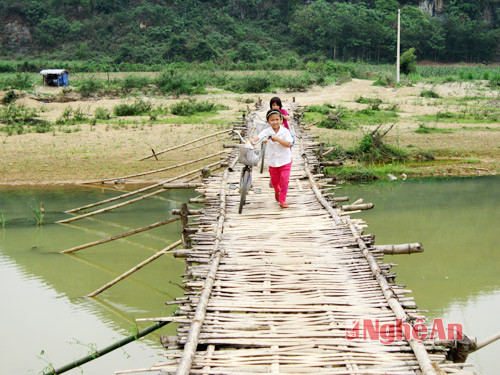 |
| They risked their lives to cross the temporary bridge. |
Truong Thi Yen Nhi, a student in class 1C at Tho Hop Primary School, said: “Every day, I have to cross this bridge four times. Knowing it's dangerous, I get off my bike and walk each time. About a year ago, my mother was carrying water home, and because there were many people carrying water that day, the bridge broke. Luckily, no one was injured!” Meanwhile, Truong Van Khoa (41 years old) said with a worried expression: “Every rainy season, the bridge washes away. When the water recedes, people find bamboo and reeds to build a temporary bridge to cross. There's no other way to get across.”
Khoa and Yen Nhi's worries are also the worries of the entire Son Tien hamlet. How could they not be worried when the bridge's main material is bamboo? The bridge deck is made of interwoven bamboo strips, with horizontal bamboo strips forming the supports. The "bridge's foundations" are bamboo stakes driven into the riverbed. Every meter or so, a longer bamboo stake is added to prevent the bridge from collapsing. In this way, the bamboo bridge, 70 meters long and 1.2 meters wide, has connected the shortest route (about 5 km) from Dua village to the center of Tho Son commune for decades. According to the locals, every year, many people, vehicles, and goods fall into the river. Whenever there's a funeral or wedding in Dua village, 3-4 people have to cross the bridge in turn.
Currently, the temporary bridge in Dua village has many rotten piles, and the bridge surface is riddled with holes, creating 40 cm wide gaps overlooking the river. Every day, the bridge serves not only hundreds of people from Dua village, but also from Soi Tren, Soi Duoi, and Do hamlets in Tho Hop commune. People from clusters C6 and C7 of the agricultural farm also choose to take this "shortcut" across the temporary bridge. When the bridge is washed away or severely damaged and not yet repaired, most families have to cross the river to leave their children there to ensure their education while waiting for a new bridge to be built. Mr. Truong Song Huong (63 years old, from Dua village) said: During the flood season last October, before the bridge was rebuilt, three parents and three children were rowing a raft across the river to school. Unexpectedly, in the middle of the river, due to the strong current, the raft capsized, leaving all six people adrift. Hearing the cries for help, all the villagers of Dũa rushed out to rescue them, and luckily they were saved. Thinking back, Mrs. Hương still feels scared.
Mr. Truong Xuan Thanh, Secretary of Son Tien hamlet, shared: "Dua village has over 50 households, mainly ethnic Tho people. The villagers are farmers, so their lives are still poor. But no matter how poor they are, building a temporary bridge is very necessary for the people. That's why, 7-8 times a year, the villagers of Dua mobilize all their labor and each household contributes 6 meters of bamboo and 1 small piece of wood for each new bridge, not to mention the repairs. Everyone has longed for a suspension bridge across the river for a very long time."
Mr. Nguyen Van Trung, Chairman of the Thọ Hợp Commune People's Committee, said: "We deeply understand the hardships of the people of Dũa village. The authorities are also worried about the people having to travel on such a bridge!" During the rainy season, the river water rises dangerously high, and the commune still has to widely advise the people of Dũa village and other villages not to arbitrarily paddle rafts or cross the river to the village. The biggest disadvantage is that the children cannot go to school?!
Thu Huong