
When will Vinh have a safe vegetable growing area?
(Baonghean) - In early 2015, Vietnam Television broadcast the program "Agriculture from the Heart," about two "miracle villages" producing clean vegetables in Japan (one in Japan, one in Da Lat). Seeing the images of farmers happily eating fresh vegetables right in the vast green fields, one hopes that one day, Vinh City will also have similar vegetable villages...
In Japan, the "miracle village" refers to Kawakami Village, located in Minamisaku District, Nagano Prefecture. Kawakami is a barren area, covered in snow for two-thirds of the year, resulting in extreme poverty and backwardness for its inhabitants. It was considered one of the poorest villages in Japan during the 1960s and 70s. To achieve this "miracle" transformation, around 1980, the village chief encouraged residents to produce vegetables according to a common standard; anyone who violated it would be banned from production. After 20 years of applying advanced technology to agricultural production, hundreds of households adopted a single farming technique, and the vegetables from Kawakami Village became so safe that they could be eaten fresh from the garden. As a result, the vegetables produced there became famous, in short supply, and the villagers became among the wealthiest in Japan, with an average income of over $250,000 per household per year, while working only four months a year.
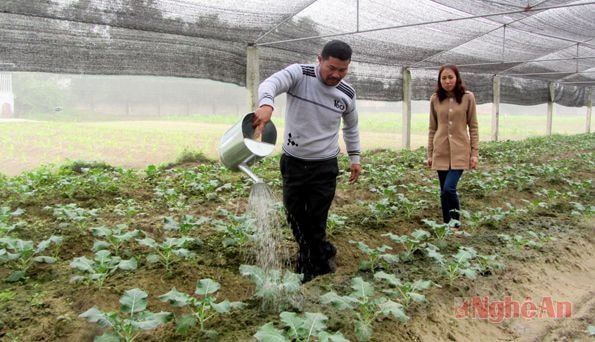 |
| Growing broccoli in greenhouses according to VietGAP standards in Hung Loc commune. |
"The 'Miracle Village' in Da Lat is the new name given to Da Nghit hamlet, Lat commune, Lac Duong district (Lam Dong province). According to a report by Vietnam Television, in 2012, Mr. Hironosi Tsuchiya, Director of Capital Investment and Cooperation Fund in Vietnam, after many visits to Da Lat, realized that the area was fertile land with a climate suitable for year-round vegetable cultivation, but the farmers had low incomes and worked quite hard. Mr. Hironosi Tsuchiya thought of Kawakami village and returned to encourage farmers there to come to Da Lat to grow vegetables. Two farmers, owners of Lacue Company in the village, Masahito and Takaya Hanaoka, decided to come to Da Lat to learn more. After surveying the area, these two Japanese farmers quickly collaborated with a local enterprise to establish the An Phu Lacue joint venture." Since the beginning of February 2014, An Phu Lacue Company has been conducting trial plantings of 13 vegetable varieties, with the main focus being the American lettuce variety commonly cultivated by the people of Kawakami village.
The production and distribution of vegetables has been successful and replicated among many local farmers. Vegetables from Da Nghit are primarily supplied to Japanese grocery stores, serving Japanese consumers. At the same time, they meet Japanese quality and safety standards for export back to Japan. Since the end of 2014, in addition to exporting vegetables to Japan, An Phu Lacue Company has also exported to Malaysia, Singapore, and expanded to other markets. The application of standards from seeds and pesticide-free cultivation techniques to harvesting and preservation processes has helped Da Nghit become the second "miracle village" of Japan in Vietnam.
That's the story about the "miracle villages" reported by Vietnam Television. Meanwhile, in Vinh City, the development of suburban agricultural production has long been considered extremely important, contributing to the daily supply of fresh food for the city's residents. Therefore, since the end of 2013, Vinh City leaders have approved the Sustainable Development Project for Safe Vegetable Growing Areas to simultaneously address both economic and social benefits. According to this project, priority will be given to the production, expansion, and development of safe vegetable growing areas according to VietGAP standards, striving to create a stable safe vegetable production area of at least 50 hectares in the communes of Nghi An, Nghi Lien, Hung Dong, Nghi Kim, etc., by mid-2017; with a smooth and efficient distribution system, widely accepted by consumers and consumed in the city market.
However, the implementation of the project is facing difficulties: Safe vegetables produced lack branding and are not yet known to consumers. According to the report on the implementation results of the safe vegetable project in Vinh City, by the end of 2014, the area of safe vegetable cultivation reached 7.9 hectares, with the main crop being chili peppers, and a small area of Chinese cabbage, Japanese pumpkin, and lettuce. In Hung Loc commune, 2,500 m2 of greenhouses were invested in to grow vegetables according to VietGAP standards.
According to Mr. Vo Van Chuong, residing in My Thuong hamlet, Hung Loc commune (one of the three households participating in receiving greenhouses for safe vegetable cultivation), after receiving training, vegetable seeds, and financial support for land preparation from the city's Agricultural Extension Station, his income from vegetables has been higher than from previous crops such as corn and peanuts. However, many shortcomings still hinder producers. These include inadequate infrastructure leading to frequent flooding of vegetables; overly thick netting affecting photosynthesis; and most importantly, a lack of attention to product promotion and sales.
Mr. Chuong said: "We sell all the vegetables we produce ourselves at the market. Although people really want to buy clean vegetables, at the market all the vegetables are the same, and the prices are the same too. This is a cause for concern because investing in safe vegetable production is much larger than producing conventional vegetables. We are the ones implementing the model, with support, but if we did it on a large scale, how could we make a profit? How could farmers feel secure investing in safe vegetable production...?"
According to some officials from the Economic Department of Vinh City, several businesses have invested in and guaranteed the purchase of products from producers, but they still face many difficulties due to issues of professional capacity and financial capability. Meanwhile, the people are still not diligent enough, not following proper farming techniques, maintaining a monoculture mindset, not actively and proactively combating drought and caring for crops, and still have a mentality of waiting and relying on others. In addition, local authorities lack attention in directing and not truly acting as a "support system" for the people and businesses...
Mr. Nguyen Van Chinh, Vice Chairman of the Vinh City People's Committee, stated: “The effectiveness of safe vegetable production has been initially confirmed, proving to be an essential direction in urban agricultural production. However, the implementation of the sustainable safe vegetable production project in Vinh City still faces difficulties. These include the fact that most agricultural workers are past working age, making it difficult for them to adopt new scientific and technical advancements, resulting in low labor efficiency; the infrastructure is still inadequate and makeshift, failing to cope with adverse weather conditions such as drought and floods; and the city's economy is still struggling, leading to a lack of commensurate investment… Therefore, the city government is aiming to attract financially strong and experienced agricultural enterprises to implement the city's safe vegetable project. The focus is on Japanese enterprises. Through the Japan-Vietnam Bridge Association, several Japanese enterprises possessing these qualities have expressed interest and are currently developing proposals.” investment project...
In Vinh City, many households, despite limited land area, still dedicate a small plot to growing clean vegetables; many families without land buy materials to grow vegetables on upper floors, balconies, or even in the corridors of traffic lanes. This shows that the need for clean vegetables in the daily lives of the people is extremely urgent. Visiting the areas implementing safe vegetable production in the communes of Nghi An, Hung Dong, Nghi Lien, Hung Loc... to see and hear about the shortcomings in production and product distribution brings to mind the image of the two "miracle vegetable villages," and I hope that one day Vinh City will also have similar vegetable villages.
According to our research, one of the Japanese companies interested in the agricultural sector of Vinh City, as mentioned by Mr. Nguyen Van Chinh - Vice Chairman of the Vinh City People's Committee, is Yabumae & Associates, headquartered in Tokyo, Japan. On August 26, 2014, Mr. Eiichi Yabumae - Director of Yabumae & Associates - sent a letter to the Director of the Department of Foreign Affairs proposing an agricultural project. In his letter, Eiichi Yabumae wrote: "...While in Vinh, I conceived the idea that exporting vegetables to Japan would be very promising, given the climate and human resources. A man whom I knew to be the village head of a suburban village (we met in the city hall) shared this same idea with us. I gathered any information I could find in Tokyo and analyzed it. As a result, I was convinced that this agricultural project was very feasible if implemented in this city. After that, I conducted more detailed research, and after about six months, a plan was formed. I am attaching to this letter a summary of the project, which can be considered the "Project Outline for the Development of a Farm for Export in the Suburbs of Vinh." It could be said that this project is still in its early stages. However, it shows the framework that the project should follow. This means that the types of vegetables to be produced, the agricultural techniques to be applied, the necessary scale of the farm, machinery and facilities, export prices of vegetables, farmers' income, annual production costs, transportation costs, technology, import costs and selling prices, initial investment capital, etc., are all clearly defined. ...If your agency supports it, naturally, the research and development company will open its doors to agricultural experts in your province, and advanced agricultural technology will become a shared asset of the province. Therefore, if you are interested in this project, if you believe the conditions are ripe, and if you have any questions, comments, or requests, please contact me. Currently, it is said that business opportunities are flowing from Japan to your country. So, if you are determined, investors will follow you..." After receiving Mr. Eiichi Yabumae's letter, the Department of Foreign Affairs requested the Vinh City People's Committee to consider the proposal. Subsequently, contact was established between the Vinh City government and Yabumae Company to open up a future cooperation relationship. |
Ha Giang


