
The museum does not prohibit touching the exhibits.
In Hoa Binh city, there is a museum where visitors can not only touch but also use the exhibits on display..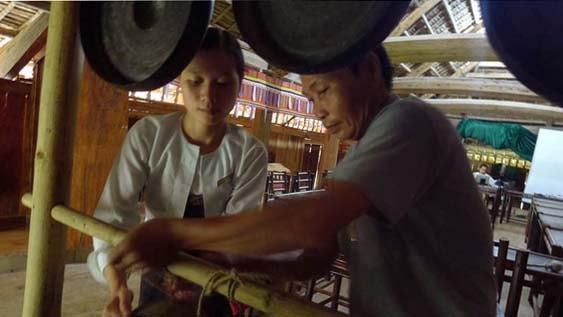
Mr. Ha Cong Yem demonstrates how to test the sound of the gong.
Living Culture Museum
Mr. Ha Cong Yem, a Muong man from Thai Binh ward, Hoa Binh city, Hoa Binh province, begins his workday at the Muong Cultural Space Museum by testing the sound of the gong set for an upcoming performance. While tapping and listening to the sound of each gong, Mr. Yem explains to visitors about the 12-gong set of the Muong people. This 54-year-old man is an artisan with a deep understanding of Muong ethnic culture.
He knows how to play the gong, sing folk songs, and make traditional items. Visitors to the museum can watch him whittling chopsticks, weaving baskets, or making gong hanging ropes. He explains to them how to use them and their role in the lives of the Muong people. Visitors can freely observe and even try using these items. There are no "Do not touch the artifacts" signs in the museum grounds, unlike what is commonly seen in other museums.
The Muong Cultural Space Museum, situated on two hills spanning 4 hectares, recreates the living space of a miniature Muong society with four houses representing the four social classes: the Lang house (the highest class in Muong society); the Au house (the class assisting the Lang); the Nooc house (the common people in Muong society); and the Nooc Troi house (the poorest class in Muong society). There are spaces for showcasing traditional crafts, spaces depicting the material, spiritual, and religious life of the Muong people, and spaces for recreation and festivals. There are also exhibition rooms displaying valuable artifacts and a medicinal garden featuring plants commonly used by the Muong people for healing.
At the Muong Cultural Space Museum, all the artifacts are handcrafted by the Muong people themselves. These items not only have display value but are also used in daily life. Their lives don't end in display cases; they continue as they do in the homes of the families. The baskets used for harvesting vegetables still bear traces of hillside soil. The chopsticks used in meals have a polished bamboo sheen. And the people who use them are nearly 20 Muong staff members who work alongside Mr. Yem at the museum. It is this team of staff members who keep the museum vibrant and lively.
Although they became salaried employees of the museum, their work was not much different from what they did at home. The women gardened, grew vegetables, cooked, and practiced singing and dancing. The men made household items, played gongs, and did other heavy work. The biggest difference was that they guided visitors on tours of the museum, introducing them to the life of their own ethnic community. Their life in the museum was like a warm family, helping visitors to some extent feel the pulse of life among the Muong people.
My dream is to become an "extended arm" (a metaphor for a supportive force).
The owner of the Muong Cultural Space Museum is Mr. Vu Duc Hieu, born in 1977, who is a genuine Kinh person. Initially, he devoted himself to collecting traditional Muong artifacts, from baskets, knives, scarves, shirts to gongs, driven by his passion for Muong culture. He was concerned to see these items gradually disappearing from Muong homes. When the number of artifacts became too large, coupled with suggestions from many people, Mr. Hieu established this museum in 2007.
Regarding the museum's goals, Mr. Hieu shared: "We hope that our work will create an impact in the community regarding the preservation and safeguarding of ethnic cultural identity, not only for the Muong people, but also for all ethnic groups in Vietnam. It's a form of extended arm. I alone cannot do everything; I only want to, with my small efforts, create an impact and awaken a sense of community among our people."
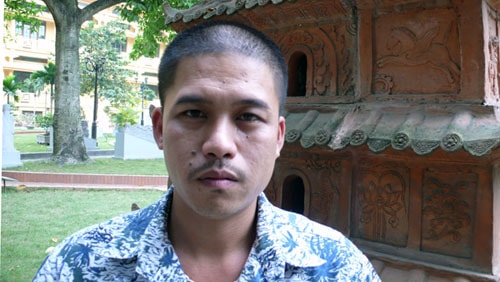
Artist Vu Duc Hieu hopes to convey a message about national culture.
through contemporary art forms
Originally an artist, Vu Duc Hieu hopes to convey messages about national culture to visitors through art forms such as painting and sculpture. He plans to create an artist's residence within the museum space. Artists will come here to create, drawing inspiration from the traditional culture of the Muong people in Hoa Binh province to convey messages about local ethnic culture.
The public can appreciate the beauty of local culture through new forms of language introduced by artists. In 2011, the museum held the exhibition "Muong Land" featuring works created right on the museum grounds, inspired by the beauty of traditional culture.
From October 17-27, the "Dat Muong 2" International Art Workshop and the 4th Asia Art Link event will be held at the museum, with the participation of approximately 80 Vietnamese and international artists.
According to (vov)-TN


