
Preserving and promoting the cultural values of the village.
(Baognhean) - Villages are repositories of tangible and intangible cultural values passed down through generations; they are elements that have been formed, supplemented, and developed alongside the nation's history, contributing to the diversity of Vietnamese culture. Currently, amidst the trend of integration and development, village culture is facing decline, a phenomenon occurring in many localities throughout the province.
(Baognhean) - Villages are repositories of tangible and intangible cultural values passed down through generations; they are elements that have been formed, supplemented, and developed alongside the nation's history, contributing to the diversity of Vietnamese culture. Currently, amidst the trend of integration and development, village culture is facing decline, a phenomenon occurring in many localities throughout the province.
The transformation of the countryside
Since the implementation of the national target program for building new rural areas in the period 2010-2020, the face of rural areas in the province has changed towards modernity, with many positive developments. However, the programs are currently focused on economic development and have not invested much in culture. During the planning process, rural spaces have been disrupted, and many tangible and intangible cultural values have not been properly planned for preservation and promotion. The cultural management team lacks practical experience and professional qualifications to meet the needs of local cultural activities. The direction and implementation of the new rural development program are still driven by a focus on achievements, thus the quality and effectiveness are not high. This situation has led to many changes in village and commune culture.
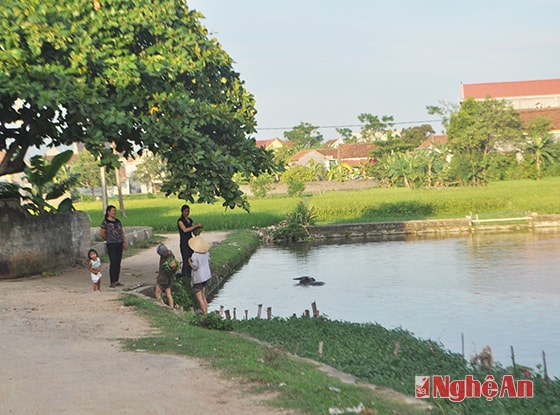 |
| A view of Bac Son Cultural Village, Van Dien commune (Nam Dan district). Photo: Thanh Thuy |
The characteristic traditional rural landscape—banyan trees, riverside docks, village communal houses—has almost completely shrunk. Agricultural land has also decreased, giving way to residential, commercial, and public works areas, blurring the previously distinct residential and production spaces in the countryside. New forms of settlement, new industrial zones, and new "village streets" concentrating people by occupation—such as households engaged in business, trade, services, or farming—are increasingly common in Dien Hong (Dien Chau), villages in Hung Dong and Hung Hoa (Vinh City), and villages in Nghi Tan and Nghi Huong (Cua Lo Town)...
The extensive construction and renovation of facilities such as cultural centers, markets, village gates, village roads, and alleys during the New Rural Development movement has given villages an urban appearance. The current village landscape is a blend of village and city, modernity and tradition, and agricultural and non-agricultural elements. Most villages in the province are moving towards an open economic structure combining production, trade, and services. Some villages still maintain traditional farming but incorporate industrial and commercial elements. However, the main economic activity remains subsistence agriculture, commodity production, and the current form of production is primarily household-based.
Economic changes have led to changes in lifestyles; many villages and hamlets are now developing independent lifestyles similar to urban ones. Simultaneously, an industrial lifestyle prioritizing speed and efficiency, and a market-oriented lifestyle emphasizing enjoyment and fairness, are becoming common phenomena in rural areas. Currently, investment in the restoration of historical sites is increasingly being promoted, but it is influenced by many factors such as the actual landscape, the current needs of the people, and the design of the sites, which have undergone changes in both the overall landscape and individual details. According to people's assessments of the current preservation of tangible cultural forms in the locality, 23.1% believe that a significant number of villages preserve their historical sites very well; 65.7% believe that a significant number of villages preserve their historical sites well, while 11.2% believe that villages with preserved historical sites are not well preserved. Villages with recognized historical and cultural sites tend to be better preserved.
Furthermore, the development of cultural institutions in new rural areas lacks synchronization between infrastructure and human resources. Infrastructure is built to a high standard, but its use is inefficient. Operating methods and mechanisms remain largely superficial. The utilization of cultural institutions is poor; many village cultural centers, built with hundreds of millions of dong, only serve for a few meetings. Due to a lack of engaging activities, people do not yet view these cultural centers as places for community activities, recreation, and entertainment.
Along with economic development towards the new rural development model, many problems have arisen in localities such as: Unemployment is a common phenomenon in rural Nghe An. The percentage of people living in rural areas is decreasing, and a significant portion of the population, although living in rural areas, is no longer considered farmers because they no longer have land to cultivate or even jobs; along with the transition to a market economy, the widening gap between rich and poor is also occurring strongly in rural Nghe An. Although the poverty rate for the entire province decreased to 12.5% (in 2013), this rate is higher in many rural areas; the good relationships of "community spirit" built by our ancestors for generations are being affected by the market economy.
The phenomenon of houses built close together, with high walls and locked gates; the busyness of economic activities leaves rural people with little time to interact with each other, causing neighborly relationships to fade. Currently, many commune officials lack specialized cultural training but are responsible for cultural affairs, thus negatively impacting the preservation and promotion of village cultural values in the new rural development program; the rapid influx of many external cultural influences has made the security situation in villages difficult to control. Social evils are increasing, making many rural areas no longer peaceful. During the new rural development process, many villages have become industrial zones, and rural land prices have risen rapidly, leading to internal conflicts that need to be thoroughly resolved.
Tradition and modernity
Effectively promoting the cultural values of villages in the construction of new rural areas is a requirement set by all levels, sectors, and localities. However, the fundamental solution lies within each village and hamlet. It requires enhancing the responsibility of the people in preserving and promoting village cultural values, as the people are both beneficiaries and creators of culture. Accordingly, Party committees and authorities at all levels need to intensify widespread propaganda among the people about building a cultural life, a cultured lifestyle, and establishing cultural institutions. In this process, it is necessary to replicate models of family culture, village cultural clubs, and clans characteristic of each region… The solutions need to be linked to specific activities in building cultural life in residential areas. To enhance the effectiveness and efficiency of state management in preserving and promoting traditional cultural values, with particular emphasis on building a team of cultural managers and promoting the role of the steering committee for the nationwide movement to build a cultured way of life.
Districts and communes need appropriate policies and mechanisms to maximize resource mobilization for building and organizing distinctive traditional cultural activities linked to progressive culture. They should develop and improve management mechanisms for implementing village cultural lifestyles in the new rural development program. Regarding the restoration and preservation of cultural heritage: Local leaders need to coordinate with the Nghe An Provincial Management Board of Historical Sites and Scenic Spots to reclassify and reassess historical sites in villages throughout the province. Based on this, they should develop plans for the restoration and reconstruction of these sites. Focus should be placed on building and improving basic cultural institutions to serve community cultural life. A comprehensive plan for village space based on the specific realities of each locality is necessary, as well as identifying truly suitable housing architectural models for modern rural areas.
Preserving and promoting the cultural values of villages in the context of building new rural areas is a necessary condition for every village in the province. The question is how to effectively promote the value of traditional village culture in the context of building new rural areas – a difficult problem for each village. This requires each village to select the best aspects of its culture, based on the principles of inheritance, exchange, and development. Accordingly, it is necessary to "separate the wheat from the chaff" to promote positive elements, discard limitations, and lay the foundation for practically absorbing new cultural values. Only in this way can the new rural development program be effectively implemented while preserving traditional village cultural values in the right direction.
Le Hieu


