
Conservation and development of biodiversity in coastal areas.
(Baonghean) - Biodiversity is an extremely valuable biological resource and crucial for human survival as it is the main source of food. Biodiversity plays a very important role in maintaining economic sectors, while creating stability, resilience for the economy, and opportunities to increase production, develop industries, and generate income for communities in the province. However, in recent years, the rapid and unplanned development of industries has seriously damaged the coastal marine biological resources of the province.
According to the survey results of the provincial-level scientific project "Research and Proposal of Solutions for Conservation and Development of Biodiversity on Ngư Island, Mắt Island and the Coastal Sea of Nghe An," Nghe An province has the advantage of a vast sea and island area of 4,230 nautical miles, including two islands: Ngư Island and Mắt Island. The sea area of Nghe An is home to many economically valuable marine species (such as grouper, sea snakes, various types of snails, and bivalve mollusks). Among these, marine fish and mollusks are two of the most diverse and abundant groups of aquatic animals.
Their resources are of great importance and bring high economic value to coastal communities, especially large marine fish and mollusks. Through investigation and data collection methods, the research team identified 54 species of phytoplankton belonging to 3 phyla: diatoms, dinoflagellates, and cyanobacteria, and 20 species of mangrove plants in the estuaries and coastal mangrove forests of Nghe An province. The fauna identified included 136 species of fish, belonging to 51 families, 16 orders, and 2 classes; 31 species of crustaceans, belonging to 10 families and 2 orders; 36 species of mollusks, belonging to 21 families, 10 orders, and 2 classes; 32 species of seaweed, belonging to 14 families, 10 orders, 5 classes, and 3 phyla; and 152 species of phytoplankton, belonging to 22 families, 9 orders, and 5 phyla.
The research results also identified diverse flora and fauna in the sea areas surrounding Ngư Island and Mắt Island in Nghệ An province. There are 152 species of benthic animals belonging to 51 families, 15 orders, and 4 phyla; 118 species belonging to 43 families and 15 orders were found in the sea area around Mắt Island; 99 species belonging to 41 families and 13 orders were found in the sea area around Ngư Island, and 100 species belonging to 30 families and 8 orders were found in the sea area around Mắt Island. The identified flora includes 77 species belonging to 41 families and 3 phyla. The fauna has been identified as comprising 56 species belonging to 22 families, 8 orders, 5 classes, and 144 economically valuable aquatic species, including 70 species of fish, 16 species of crustaceans, and 28 species of mollusks. Some species with high economic value include green mussels, blood cockles, hairy cockles, estuarine oysters, clams, oil clams, squid, cuttlefish, and mussels.
It is evident that the marine biological resources in the coastal waters of our province are vast, diverse, and abundant in both species and quantity. However, in recent years, these natural resources have been seriously threatened, declining in both area and structure. This is due to the increasing degradation of the marine environment, destructive fishing practices such as the use of explosives and poisons, and the increase in untreated pollution directly discharged into the water environment. Many plant and animal species are still being exploited through various methods, including the extermination of species using chemicals and explosives. The decline in biodiversity leads to a decrease in the number of economically valuable species. Furthermore, population pressure leads to overexploitation, further depleting natural resources and marine biodiversity.
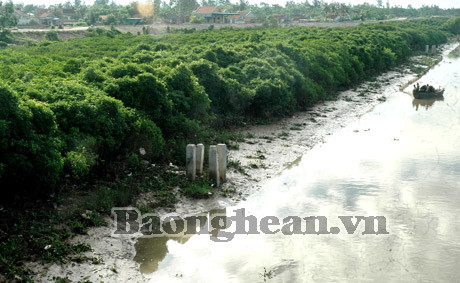
Mangrove forest in Dien Kim commune (Dien Chau).
Photo: Tran Canh Yen
To utilize and conserve biodiversity and protect the biological resources of our province's coastal areas, it is first necessary to delineate areas for rational exploitation and cultivation in order to protect and sustainably utilize aquatic resources. The challenge is to conserve and develop rare, specialty, and economically valuable species in conjunction with biodiversity conservation, preservation of indigenous knowledge, and the traditional cultural heritage of the people.
The proposed solutions include: strengthening the decentralization of state management in protecting aquatic resources, restoring rare aquatic species, protecting prohibited fishing areas and species; investing in infrastructure and equipment for facilities involved in research and development of genetic resources; strengthening public awareness campaigns through materials, films, and other means; enhancing international integration in the field of aquatic resource exploitation and protection to manage migratory species and monitor international wildlife trade; and, in science and technology, continuing research to develop maps of threatened species, studying aquatic species, and promoting technology transfer for efficient exploitation and protection of aquatic resources.
Conservation and development of marine resources means protecting marine ecosystems and maintaining marine biodiversity. Protecting marine flora and fauna, and preserving the marine landscape, forms the foundation for creating a rich variety of marine products such as seafood and marine environments. This allows businesses and communities in the province to utilize and develop the resources provided by the sea. Therefore, studying the biodiversity of the province's coastal areas is a necessary requirement today. This activity contributes to guiding the rational use of the province's coastal biological resources and contributes to the overall development of the province.
Thanh Hoa (Center for Information on Science and Technology)


