
The precarious life of a laborer
(baonghean) -The town of Anh Son is flourishing, and the lives of its people have improved significantly in all aspects. However, there is still a segment of the population that has almost no means of production and lives primarily by selling their labor.
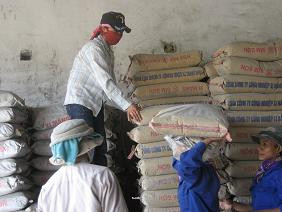 |
It's worth noting that the manual labor profession in the Ben Than area developed spontaneously, with each group consisting of about 8-10 people, and dozens of such groups in the region. Their daily work involves gathering at sand and gravel mining areas, cement factory warehouses, and construction material and supply businesses. Whenever a cargo owner needs goods loaded or unloaded, they enter into a "transportation contract." If it's sand and gravel, the price is calculated by volume (m³).3If the goods are packaged, the cost is calculated by weight. According to current rates, they receive 5,000-7,000 VND per ton of goods loaded and unloaded from trucks. On average, each person transports 10-15 tons per day (equivalent to about 200 bags of cement), earning 30,000-40,000 VND per person. However, there are about 5-10 days each month without income, partly due to unfavorable weather and partly due to unpredictable market demand. Therefore, the lives of these manual laborers are quite precarious, living from day to day.
Speaking with Mr. Phan Van Ha, the leader of a group of porters, he said: "Our job is very hard and strenuous. We transport goods by carrying them on our heads, so at night our whole bodies ache, and our heads throb like a hammer." Most women in Block 1 work as porters, even while pregnant, but they have to stick with the daily work to make ends meet. Ms. Nguyen Thi Thanh (Mr. Ha's wife) said that even just days before giving birth, she still had to go with her colleagues to transport goods. About a month after giving birth, she resumed work because if she didn't, she wouldn't have any money to spend. Most porters over 40 years old show signs of declining health, symptoms of various diseases such as tuberculosis, stomach problems, and brain disorders.
Mr. Ha added: "About three months ago, Ms. Tran Thi Lan fell ill and passed away before she was 50 years old. Perhaps because she carried heavy loads on her head since childhood, it affected her brain, leading to complete paralysis." While I was talking to Mr. Ha's group of porters, a truck arrived to pick up the goods. One of the women said to me: "We have so much more to tell, but if we tell everything to the journalist, our children won't have anything to eat today." Then, everyone excitedly went to meet the owner of the goods to negotiate the "loading contract."
The people of Ben Than laborers' village all share a common dream: that the government, relevant agencies, and organizations will pay more attention to developing their trades, creating more jobs and stable incomes, and alleviating some of the difficulties and hardships in their daily lives.
Text and photos: Cong Kien