
Shortcomings and irregularities in land and forest allocation in Nghe An.
(Baonghean) - According to statistics, in Nghe An there are tOver 10,038 hectares of forest land have been illegally converted for other purposes, spread across many localities with complex circumstances.
Widespread violations
The public nationwide has not forgotten the distressing incident that occurred in Nam Son and Bac Son communes of Quy Hop district. In these two communes, from February to March 2017, there was a phenomenon of people illegally burning and clearing forests on land allocated by the State according to Government Decree 163/1999/ND-CP. Through investigation and verification by local authorities and relevant agencies, 55 families arbitrarily changed the purpose of forest land use illegally, with a total area of 142.46 hectares of forest burned and illegally planted with acacia trees (of which, 96.97 hectares were forested land and 45.49 hectares were non-forested land). The area of natural forest illegally burned and cleared was mainly regenerating natural forest, belonging to groups IIA and IIB; the total volume of timber illegally burned and exploited was 3,952.32 m3.
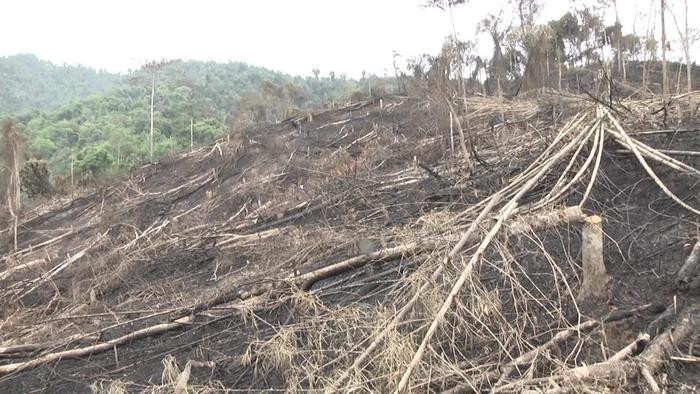 |
| The forest land in Nam Son was cleared by fire in early 2017. Photo: Lan - Tuan |
At the provincial People's Council meeting held from December 18, 2017, the Nghe An Provincial People's Council will question the implementation of land and forest allocation to organizations, households, individuals, and communities in the province. |
The above actions of the households were clarified when they arbitrarily converted the land use from natural production forest to timber plantation; meanwhile, this is natural forest land allocated by the State under Decree 163 for long-term stable use for forestry purposes. But what is particularly concerning is that these violations of the law were not only carried out by households to whom the State allocated forest land under Decree 163, but also involved the direct participation of local leaders, key officials, and a member of the District Party Committee Standing Committee.
The illegal transfer and conversion of forest land, followed by the destruction of natural forests to plant raw material forests, is occurring in districts implementing the policy of allocating land and forests to households according to Decree 163. This is particularly problematic in localities such as Tan Ky, Quy Chau, Que Phong, and Con Cuong districts.
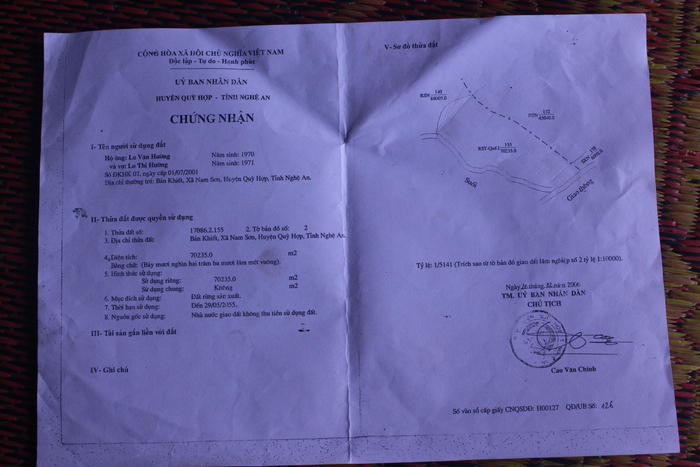 |
| The land use right certificate, issued under Decree 163, belongs to Mr. Lo Van Huong's household in Khiet village, Nam Son commune (Quy Hop district). Mr. Huong stated that the original certificate is currently mortgaged to a bank. |
Typically in Quy Chau district, the illegal buying, selling, and transfer of forest land, and the unauthorized conversion of forest land use purposes, have been discovered in the villages of Pa Co, Ke Ninh, Dinh Tien, and Ta Co in Chau Hanh commune. In these villages, dozens of households have sold or transferred forest land allocated to them by the State under Decree 163 to a single enterprise at extremely low prices. In Ke Ninh and Pa Co villages alone, authorities identified approximately 70 households transferring their forest land use right certificates to Nghe An Green Joint Stock Company. After collecting the forest land use right certificates, the enterprise deployed personnel and machinery to build roads into the forest areas, clearing forests and planting acacia trees on a large scale.
Quỳ Châu District directed functional forces to investigate and verify the situation, discovering that 11 out of 12 communes in the district had illegal buying, selling, and transferring of forest land, involving nearly 500 households; the area of forest land illegally transferred reached 3,433 hectares. To date, Quỳ Châu District has handled hundreds of cases of forest encroachment; including one case of illegal logging of nearly 2 hectares of forest in status 1c at Lot 1, Section 5, Sub-area 197 (Khe Đoọng, Nậm Bông, Châu Hạnh commune) involving a current official of the District People's Committee.
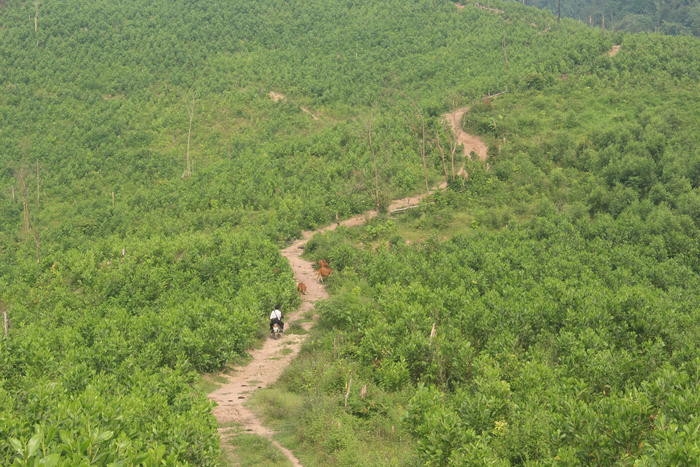 |
| A natural forest area in Nam Son commune (Quy Hop district) that was cleared by fire has been transformed into a plantation of acacia trees for timber. Photo: Lan - Tuan |
Along National Highway 7, the situation of illegal conversion and transfer of forest land in Con Cuong district is considered extremely complex. For example, in Don Phuc commune, out of 8,786.2 hectares of forest land, 3,969.9 hectares have been allocated to the people and granted land use right certificates according to Decree 163, but as many as 36 households have illegally transferred forest land to individuals inside and outside the district, totaling over 300 hectares.
In Binh Chuan commune, authorities have recorded 85 households illegally transferring 1,100.5 hectares of forest land; in Thach Ngan commune, 59 households illegally transferred 629.9 hectares of forest; in Mon Son commune, 133.5 hectares/25 households; in Luc Da, 148.9 hectares/32 households... In these communes, after receiving the land transfers, the individuals hired local people to burn the forests, cut down trees, and illegally exploit forest products, depleting the forests in order to plant acacia trees for raw materials.
In Tan Ky district, from late 2010 to early 2017, encroachment on protected forest land occurred in the border area between this district and Yen Thanh district. Many households in Tay Thanh and Quang Thanh communes (Yen Thanh district) secretly crossed into Ky Tan commune (Tan Ky district) to cultivate forest land. The encroached area was identified by authorities in plots 4, 5, 7, 8, and 9 of Sub-area 867. The total area of forest cleared and encroached upon amounted to over 100 hectares; of which 1.96 hectares occurred in 2017 alone; the type of forest damaged was regenerated forest. The violating households planted acacia trees on the encroached area and even built roads from Yen Thanh to Tan Ky to facilitate their illegal activities.
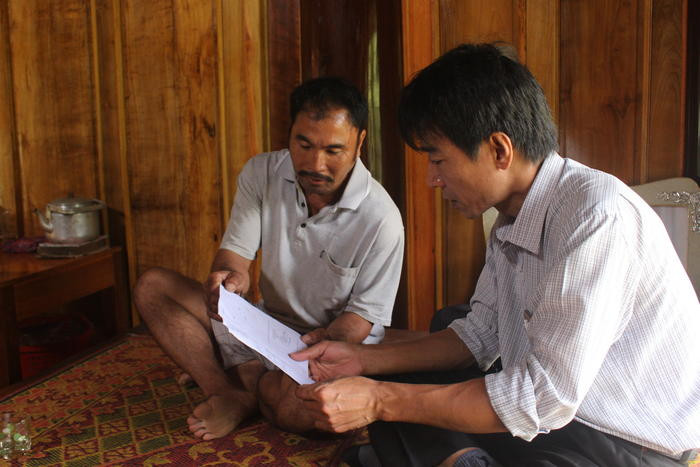 |
| Mr. Lo Van Huong, a resident of Khiet village, Nam Son commune, shared his thoughts with reporters about participating in the clearing and burning of forests for acacia plantations. Photo: Lan - Tuan |
According to Decision No. 1731/QD-UBND dated April 21, 2016, of the People's Committee of Nghe An province approving the results of the 2015 forest inventory in Nghe An province, the entire province has 1,236,259.31 hectares of forest and forestry land. Of this, over 240,000 hectares have been allocated to households and individuals for management under Decree No. 02/CP and Decree 163/1999/ND-CP; and approximately over 50.8% of the land has been granted Certificates of Forestry Land Use Rights.
A discrepancy between policy and reality?
| In early October 2017, due to severe damage to natural forests, the Provincial People's Committee issued Decision No. 4558/QD-UBND directing the Department of Agriculture and Rural Development to inspect the management, protection, and development of forests throughout the province. To date, according to investigations by the Department of Agriculture and Rural Development, illegal buying, selling, transferring, and misuse of forest land is occurring in almost all localities in the province and is becoming increasingly complex; the total area of forest land bought, sold, transferred, and misused is 10,038.497 hectares, of which 5,398.469 hectares have been illegally bought and transferred, and 4,640.029 hectares have been misused. |
Although the Department of Agriculture and Rural Development has provided fairly specific figures, confirming that violations in the illegal buying, selling, transferring, and converting of forest land are alarming, there are many reasons for this situation. Besides poor management and usage awareness among households, there is also the "incitement" from ringleaders... Furthermore, the inadequacies of overlapping legal regulations must also be considered. Many forestry officials have expressed concerns about this issue.
During the discussion, Mr. Nguyen Viet Khanh, Deputy Head of the Quy Chau District Forest Protection Department, stated that, based on the regulations of Decree 163 and the Law on Forest Protection and Development, people who are responsible for protecting and cultivating forests are allowed to harvest non-timber forest products such as bamboo shoots, bamboo, and rattan; they can harvest these to meet local needs and can also harvest dead trees or trees that have reached their harvesting cycle. However, it takes 50-70 years for a teak tree to reach its harvesting age, and 30 years for a chestnut tree.
For non-timber forest products such as bamboo, rattan, and reeds, if people want to harvest them, they must prepare documents, develop plans and designs, and then sequentially carry out the procedures. These plans must specify the area, location, quantity to be harvested, and the timeframe for harvesting. Next, they must obtain confirmation and approval from the commune, district, and relevant functional agencies. This process is impossible for the people to follow. Furthermore, a major reason is that most of the forests allocated under Decree 163 are degraded or regenerating forests, so people cannot make a living from non-timber forest products.
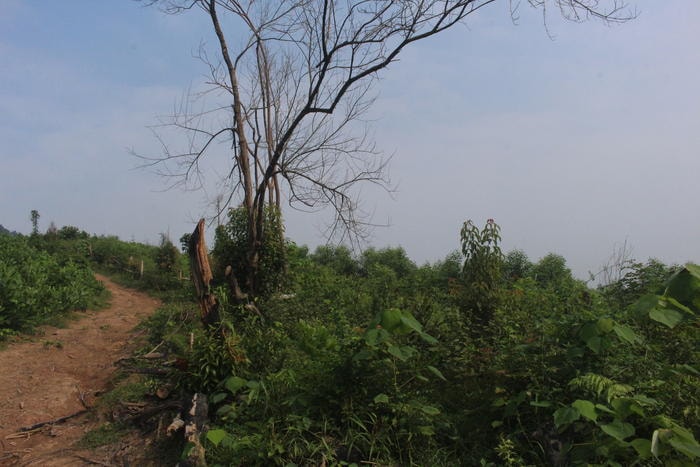 |
| These are the trees that remain after the forest was burned to plant acacia trees for timber. Photo: Dao Tuan. |
The most illogical and contradictory aspect of the policy for land allocation to households is that land is allocated to households without being linked to forest land. Ironically, under Decree 163, all land is confirmed as forest land. Whether it's degraded forest or regenerated forest, it remains essentially forestry land. Meanwhile, the issuance of land use right certificates under Decree 163 to households recognizes the land itself, not the assets on the land (the forest).
And here another contradiction arises: while the Law on Forest Protection and Development strictly prohibits all acts of illegal logging, destruction, exploitation, burning, conversion of land use, and transfer of forest land, the Land Law allows the transfer and change of ownership of land use rights. Although both involve land use right certificates, households allocated land under Decree 163 are not permitted to sell, transfer ownership, or assign land use rights.
In the long run, if the authorities do not definitively resolve these issues, it will lead to unpredictable consequences from the illegal transfer and conversion of forest land. Therefore, in addition to preventing and strictly handling cases of illegal buying, selling, transferring, and converting forest land, it is necessary to study and adjust legal regulations and policies to suit real-life situations.
| According to Mr. Nguyen Tien Lam, Deputy Director of the Department of Agriculture and Rural Development of Nghe An province: “The difference between the benefits of planting and protecting forests compared to converting forests is too high. One hectare converted from natural forest to acacia plantation yields an average of 20 m³/ha/year. At current prices, if sold at the factory for 1 million VND/m³, the profit would be 20 million VND. After deducting 50% of costs, people earn a profit of 10 million VND per hectare per year. Meanwhile, if natural forests are protected and not converted, the profit would only be 300,000 - 350,000 VND. This large disparity leads to the destruction of natural forests to plant acacia. This is the situation currently unfolding in Nghe An. Therefore, many households and some businesses intentionally impoverish natural forests to convert them to acacia plantations. This is a shortcoming arising from the policy...” |
Nhat Lan - Dao Tuan


