
Start with each individual.
(Baonghean) - There are many definitions of behavioral culture. Depending on the country, ethnic group, region, and even family or lineage, different cultural traits are formed, including behavioral culture. For Vietnamese people, everyday behavior is often expressed through sayings like, "Words cost nothing, so choose your words carefully to please others," "One act of forbearance leads to nine good things," or "Learn how to eat, how to speak, how to wrap, and how to unwrap"... Here, we will discuss behavioral culture in the current workplace environment.
(Baonghean) - There are many definitions of behavioral culture. Depending on the country, ethnic group, region, and even family or lineage, different cultural traits are formed, including behavioral culture. For Vietnamese people, everyday behavior is often expressed through sayings like, "Words cost nothing, so choose your words carefully to please others," "One act of forbearance leads to nine good things," or "Learn how to eat, how to speak, how to wrap, and how to unwrap"... Here, we will discuss behavioral culture in the current workplace environment.
The story of an old school friend.
Three market management officers from Market Management Team No. 4 of the Provincial Market Management Department were sentenced for bribery, including H (born in 1976, from Dien Chau), who received the highest sentence of 4 years in prison. Hearing this news, we involuntarily wondered: could his family have influenced H's character? Having studied together since elementary school, we were very familiar with H's family circumstances: his father served in the military and was stationed far away, his mother worked at a hospital and didn't have much time to care for her children. H's older sister got married before finishing high school because she was pregnant. From a young age, H always showed a carefree attitude, often talking privately and getting into fights with classmates. In middle school, H was a problematic student.
After graduating from high school, we were all worried about which university to apply to and what we would do after graduation, but H remained indifferent. Then we all went our separate ways, and several years later, we met again and found H working at the market management agency. When we met up, H generously paid for all our outings. No one knew exactly which school H attended; when asked, H just smiled dismissively. Seeing that H had a wife and children and was financially well-off, we were all happy for him… Then, suddenly, we heard that H had been arrested for corruption and bribery. Some friends sympathized, but many others commented: “He took too much and now his true colors are showing,” “That’s how he got rich so quickly,” “No wonder he was so generous…” H’s violation of the law while on duty is reprehensible, but could it be that his parents bear a significant part of the responsibility for today’s consequences? Do H’s parents realize this?
My friend's story is just one of many examples of cases that have been uncovered and clarified by law enforcement agencies in recent times, gradually restoring integrity to the public administration. There is also another "cultural" trend that is increasingly prevalent: the "envelope culture"—considered by many to be a chronic and incurable disease. Our ancestors used to say, "A betel quid is the beginning of a conversation," reflecting the traditional way of interacting where people would simply offer a betel quid, a small, delicate, and heartwarming gesture. The strong aroma of betel, the mellow spiciness of lime, and the sweetness of areca nut—how easily people could be brought together like that.
However, nowadays, with a level of "creativity" that has become "shameless," the culture of betel nut chewing has been replaced by the culture of envelopes. Teacher Nguyen Trong Be - Principal of Le Viet Thuat High School, said: "Wherever you go and whatever you do, you need an envelope to go with you. The envelope acts as a 'lubricant' to help us get things done more quickly and efficiently. Actually, the 'recipient' doesn't demand anything, but if the 'recipient' doesn't have 'something,' most things will be very difficult to get done smoothly: 'Just leave the documents here, I'll look at them;' 'I have a mountain of work lately;' 'This matter involves many steps...' and after many appointments, trips, and additional paperwork and procedures, the 'recipient' will eventually 'realize' and find a more flexible, proactive, and efficient way of 'working.' Many of us have wondered: Am I also being swept along in that cycle… and then, in the end, I just 'shrug it off' and continue to 'adjust' to fit in with society, with what the majority is 'accepting.'"
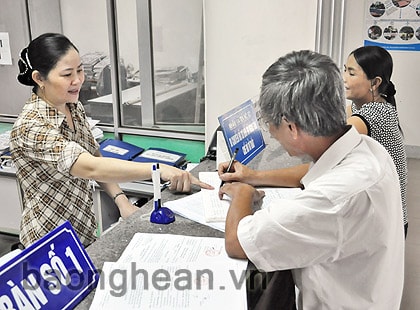
Instructions for citizens on how to complete procedures at the Social Insurance office in Vinh City.
Photo: Lam Yen
Civil servants now
Many people visiting government offices share the same observation: civil servants today have a great job: green, clean, and beautiful premises; air-conditioned offices; computerized note-taking, drafting of minutes, official documents, and reports; internet-assisted information exchange; and convenient and quick transportation for meetings, work assignments, and travel. However, the quality and quantity of work don't seem to increase much.
They even know how to "exploit" the strengths of technology in a negative way, such as the increasingly common practice of copying and pasting reports, which has become a valuable "experience" among office workers. Departments that interact with the public work carelessly, exhibiting irritable and uncivilized attitudes, closing their doors before closing time, not to mention the numerous officials who extort money from the public, engage in corruption, and abuse their power… Many officials still reek of alcohol during public service hours and working hours, and even though there are no-smoking signs in the office, they still openly smoke as if nothing happened…
Perhaps, in the past, government officials traveled everywhere on rickety bicycles, working underground, eating and sleeping among the people, thus understanding their needs and concerns, and achieving high efficiency in their work. Thanks to this, they were able to drive out two or three imperialist powers, liberate the country, and build a beautiful and prosperous homeland as it is today. A resident of Ben Thuy ward expressed frustration: "We are very reluctant to go to government offices. Even just going to the ward's 'one-stop' service center to get a notarized document is already a hassle."
The other day, I went to the "one-stop" service department of the ward to get my household registration and land title notarized. Looking at the clock, it was past 2 PM, but the staff hadn't done anything yet: some were on the phone, others were browsing the internet, while many other citizens were waiting. After more than 10 minutes with no sign of anything happening, I took a chance and asked: "Excuse me, sir, are you open today? It's past 2 PM." Only then did the young officer look up and ask: "What are you doing?" When I got home, I told my father-in-law about it, and he said: "Next time you want to get something notarized, ask me to go for you. I'm not familiar with the process, so it's difficult for you." Hearing him say that, I thought maybe the ward officials were more respectful because he was a veteran?
It's unclear why some officials and civil servants change so quickly. Is it due to the market mechanism, as some people say; or because these officials are indifferent or averse to the people; or because low salaries lead many to believe that "you get what you pay for," meaning that with such income, they can only work to a certain extent; or are these officials too busy scheming, worrying, and thinking about higher, more distant matters, forgetting their main duties...?
Workplace culture
However, alongside these "rotten apples," there are also many diligent, dedicated, and people-serving public officials and employees. Mr. Nguyen Xuan Do, Secretary of the Party Committee and Chairman of the People's Committee of Quang Trung Ward, believes that workplace culture must be implemented at all times, in all places, and for all individuals in the workplace. It's not only public officials and employees who have the obligation to perform their assigned duties well, but also those who come to work in the office must strictly abide by the internal rules and regulations of public authorities; in other words, they must also behave in a cultured manner.
For example, when a citizen comes to work, they must first comply with the agency's regulations, such as: getting out of their car at the gate and presenting their documents, parking in the correct spot, and then registering to work with this department, that office, or that individual... Quang Trung Ward is an example of building a "workplace culture" that has been highly appreciated by the public and citizens. Here, the ward has established regulations and rules on implementing "workplace culture" focusing on key contents such as: strictly adhering to working hours (ending the situation where a few people are late and the whole team has to wait); dressing seriously and politely, wearing personal identification badges; maintaining a proper and respectful attitude towards the public; explaining clearly and thoroughly until citizens understand before completing the task; Issues that can be resolved immediately should be addressed promptly, while those that cannot be resolved yet must be given a specific appointment date and time… From Monday to Friday afternoons, the ward leaders take turns on duty at the “one-stop” service center to sign notarized documents for the people, reducing waiting times.”
Visiting the One-Stop Service Center of the Quang Trung Ward People's Committee on a Thursday afternoon, we were surprised to find no chaos despite the large number of people conducting transactions. We asked Ms. Hoang Thi Hung, a resident of Block 10, and learned that since the establishment of the "one-stop service," it has been very convenient for people to get stamps at the ward office. After submitting documents, they only need to wait 10-15 minutes for the process to be completed. The service attitude is friendly, and any questions or concerns are answered immediately by the staff. Therefore, the "one-stop service" department of Quang Trung Ward has gained the trust of the people over time.
These stories, these specific situations—some sad, some happy, some filled with worries, anxieties, and even regrets—make us think. What should we do? How should we do it? How can we, in this world of modernity, convenience, abundance, dizzying integration and diversity of ideologies, ethnicities, and systems, still preserve the "Vietnamese soul" without feeling alienated, out of sync, different, or backward? Returning to the point mentioned at the beginning of the article, it's clear that the family environment serves as a starting point for shaping a person's character and qualities. However, the school environment plays a crucial role in cultivating thinking, intellect, knowledge, and life skills.
Finally, there is the social environment, class ideals, and the nature of the state that people serve. Therefore, we must build, nurture, and establish exemplary, happy families; a standard educational environment; and a civilized society. This depends greatly on parents, teachers, and leaders of each locality and unit. They must be exemplary role models, truly humane and intelligent. Only then can we multiply individuals and factors with sufficient qualities, abilities, courage, and knowledge to confidently say "no" to wrongdoing, indifference, evil, and wickedness. In other words, people with "cultured conduct."
I believe that each of us only needs to pay a little attention, think a little, and consider this: Why, in the past, when our society was poor and lacking, did people love, share, and empathize with each other, and why were officials effective and trusted and loved by the people? Today, however, even with improved living standards, the moral character and lifestyles of many have deteriorated, leading to bureaucracy, corruption, and blatant harassment of the people, causing them to lose faith and distance themselves from the regime. To make life better, to ensure that beauty increasingly prevails and pushes back evil, every official and civil servant needs to be confident, cultivate knowledge, reflect on themselves, correct shortcomings and weaknesses, and learn to listen to and understand the suffering and joys of the people.
President Ho Chi Minh was a shining example of cultural conduct. His loving, affectionate, and respectful attitude towards people was considered the central theme of his lofty humanist philosophy. Towards cadres, Party members, and the people, he was both kind and welcoming, yet warm and approachable. When mistakes occurred, he offered gentle reminders or timely, strict criticism, while still maintaining tolerance and magnanimity, moving and inspiring people. It was precisely this simplicity, subtlety, and strictness in his conduct that left a deep impression on everyone, regardless of their position or background, leaving them with respect, admiration, and reverence for him, due to the captivating influence of his morality, character, and cultured conduct. Because he deeply trusted and valued the people, President Ho Chi Minh always reminded cadres in their interactions with them: "Towards all people from all walks of life, we must have a flexible, skillful attitude, knowing how to compromise and respecting their individuality."
Thanh Hien


