
Disagreements over the $350 billion stimulus package cast a shadow over the US-South Korea summit?
US President Donald Trump arrived in South Korea today (October 29) to attend APEC events and hold bilateral talks. The visit comes amid significant disagreements between the two allies regarding a $350 billion investment package and their stances on North Korea.
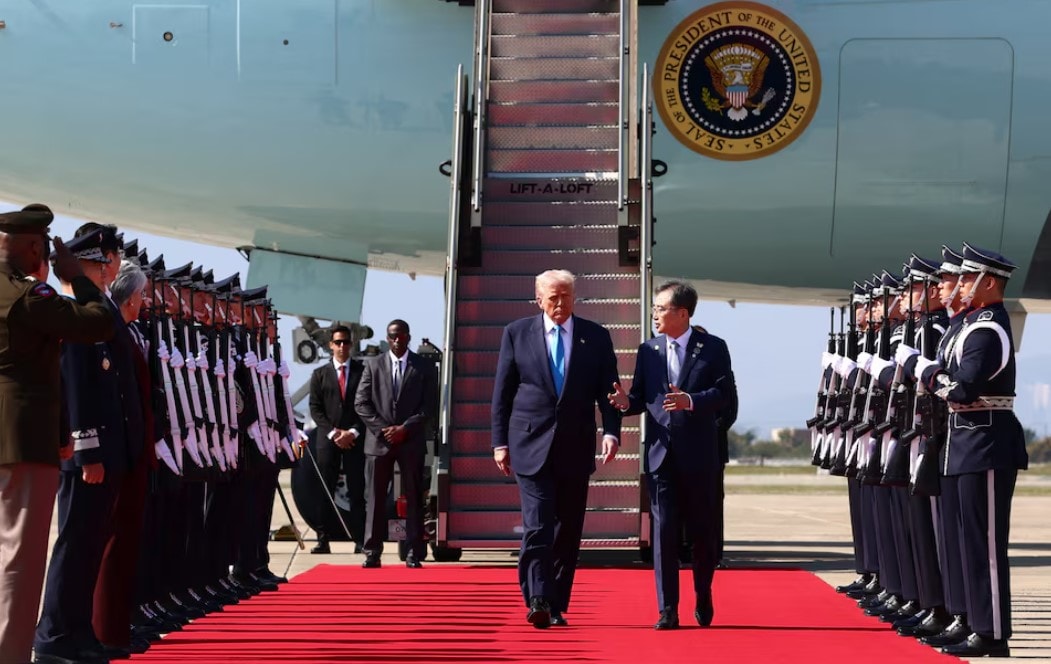
This is the next stop on President Trump's Asian tour, following trade and security agreements in Malaysia and Japan. According to international media, President Trump's two top priorities in South Korea are: pushing Seoul to finalize a $350 billion investment package in the US and arranging a follow-up summit with North Korean leader Kim Jong-un. However, analysts believe Trump's goals in Seoul may be more difficult to achieve than at previous stops.
Stalemate surrounding the $350 billion investment package.
The biggest obstacle currently is the negotiations over the $350 billion investment package. This is seen as a condition for the US to reduce tariffs on South Korean imports from 25% to 15%. The fundamental disagreement lies in the form of the investment package. On the US side, President Trump demands that Seoul pay the entire amount "upfront" in cash or equity. Meanwhile, on the South Korean side, President Lee Jae-myung's administration says that the majority of this money will be disbursed in the form of loans and loan guarantees for South Korean companies to establish new production and business facilities in the US.
South Korean President Lee Jae-myung warned that spending such a large amount of cash "upfront" could destabilize the domestic financial market. Kim Sang-woo, a former politician and current board member of the Kim Dae-jung Peace Foundation, pointed out that the $350 billion figure is equivalent to about 6.5% of South Korea's GDP, and that paying in cash could have a "very significant negative impact on financial stability."
Frictions in alliance relationships
Trump's visit comes amid some tensions in the US-South Korea alliance. Protests have taken place outside the US Embassy in Seoul over the past few days. Some in South Korea fear they are being pressured in trade deals and worry that Trump might once again raise the issue of withdrawing US troops if his demands are not met.
Furthermore, public opinion in South Korea remains outraged following the September raid by the U.S. Immigration and Customs Enforcement (ICE) on a Hyundai factory in Georgia, which resulted in the detention of over 300 South Korean workers before their deportation.
Professor Hyobin Lee of Sogang University (Seoul) told DW that under the Trump administration, "there was a widespread perception that the alliance was being exploited to achieve unilateral economic benefits." However, Lee also suggested that the current South Korean administration is expected to negotiate "more decisively and confidently," prioritizing economic interests and strategic autonomy.
The prospects for a US-North Korea summit remain open.
Besides economic issues, another focus of the visit is the possibility of resuming dialogue with North Korea. President Lee Jae-myung is expected to chair a bilateral summit with Mr. Trump on the sidelines of the Asia-Pacific Economic Cooperation (APEC) forum in Gyeongju.
On his way to Asia, President Trump has repeatedly and publicly expressed his desire to meet with North Korean leader Kim Jong-un, asserting that he is "ready" if Kim wants to. However, analysts remain cautious about the likelihood of a US-North Korea summit. The most recent meeting between the two leaders was in June 2019 at Panmunjom.
Experts point out that the current context has changed, especially after North Korea signed a military and trade alliance with Russia, which helped alleviate pressure from international sanctions. Kim Sang-woo analyzed that Trump seems to be "seeking to promote the visual image" of a meeting rather than offering substantive proposals. According to him, this "will not be enough to convince" the North Korean leader.
Reuters reported that on the morning of October 29, US President Donald Trump landed at Gimhae International Airport (Busan), beginning his official visit to South Korea and the final stop on his Asian tour. Trump arrived in Gyeongju from Tokyo (Japan), just hours after North Korea conducted a new cruise missile test. According to his schedule, he will deliver a speech at a CEO summit and hold talks with South Korean President Lee Jae-myung in Gyeongju. The main agenda item on October 29 is the unresolved US-South Korea bilateral trade agreement.
Speaking to reporters aboard Air Force One, President Trump said he was "completely focused" on his planned meeting with Chinese President Xi Jinping on October 30. Trump expressed optimism about the possibility of reaching a "trade truce" with Beijing. "The relationship with China is very good. So I think we're going to have a very good outcome for our country and for the world," Trump said. He also added that he plans to reduce U.S. tariffs on Chinese goods in exchange for Beijing's commitment to limiting exports of the precursor chemical fentanyl.


