
Bau Kien insisted on only doing things that were not prohibited by law.
In his response before the court, Mr. Kien presented arguments, citing specific provisions of the Enterprise Law and the Investment Law to prove that businesses are allowed to do anything that is not prohibited by law.
The chief accountant testified that everything was done according to the instructions of "boss" Kien.
This morning, February 21st, the second day of the first-instance trial of the case involving bầu Kiên and his accomplices entered its phase. The court began questioning defendant Nguyễn Thị Hải Yến, former Chief Accountant of ACB Hanoi Investment Joint Stock Company, regarding the charge of "Fraudulent appropriation of property".
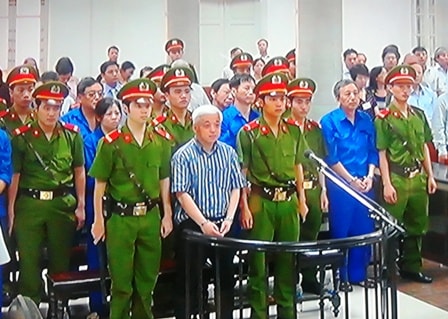 |
| Overview of the courtroom |
| RELATED NEWS |
|---|
The questioning revolved around the accusation that Nguyen Duc Kien, Tran Ngoc Thanh, and Nguyen Thi Hai Yen "fraudulently appropriated assets" in the case of ACBI Hanoi Company transferring 20 million shares out of a total of over 22 million shares of Hoa Phat Steel Joint Stock Company, equivalent to 264 billion VND. However, according to the indictment, these ACBI shares had been pledged to ACB Bank to secure the issuance of 800 billion VND in bonds.
The court's questions mainly focused on clarifying whether the actions of these three defendants, representing ACBI Company, in selling the pledged shares constituted a violation of the law.
"Did the defendant know that selling the mortgaged shares was illegal?" the court asked. "I only found out later," defendant Yen admitted. However, Ms. Yen argued that she only performed her assigned accounting duties and was unaware of the principles of the aforementioned transactions and transfers. Furthermore, Ms. Yen and her staff completely trusted the Chairman's (Mr. Kien's) decision.
Mr. Kien asserts that he did nothing illegal.
After defendant Nguyen Thi Hai Yen asserted that her actions were solely at the direction of Mr. Kien, the presiding judge requested the representative of Hoa Phat Steel Co., Ltd. to clarify further the fraudulent appropriation of assets. Accordingly, the transfer contract had not been executed, so ACBI Company returned the money. The reason was that Hoa Phat Steel had transferred the money, but ACBI Company did not transfer the shares. When signing the agreement to purchase 20 million shares, Hoa Phat Steel was unaware that these assets were mortgaged.
In court, responding to this matter, Mr. Tran Dinh Long - Chairman of the Board of Directors of Hoa Phat Group - stated: If Hoa Phat Steel had known that ACBI's shares were collateral, it would never have signed the purchase agreement. Mr. Nguyen Duc Kien and I have known each other since 2001, as we both share a passion for football. The representative from ACB Bank stated, "We knew that ACBI had pledged its shares to ACB. When pledged, ACBI is not allowed to buy, sell, or transfer them."
During his questioning, Mr. Kien answered very clearly and coherently. Mr. Kien affirmed that the share transfer was done with an agreement from Mr. Tran Dinh Long because Mr. Long wished to divest his stake in ACB Real Estate Company.
On the other hand, Mr. Kien also asserted that there was no way Mr. Long and Mr. Duong (representing Hoa Phat Steel) were unaware of the share transfer. According to Mr. Kien, everything was done in accordance with the company's principles and regulations, with the agreement and consent of all parties. "Mr. Duong and Mr. Long are close friends. We often eat meals together. It's impossible for them to have agreed to transfer shares without their knowledge," Mr. Kien said.
Regarding the allegations of fabricating meeting minutes, Mr. Kien stated that company regulations allow for meetings to be conducted through written documents.
This morning, the court also proceeded to question Mr. Kien about his illegal gold trading activities through Thien Nam Production and Import-Export Development Joint Stock Company. Mr. Kien asserted that it was not trading in gold futures but merely investing in gold prices before 2012, when the State Bank of Vietnam enacted a law that included trading in gold futures.
In his response before the court, Mr. Kien presented arguments, citing specific provisions of the Enterprise Law and the Investment Law to prove that businesses are allowed to do anything that is not prohibited by law. Mr. Kien asserted that he had not done anything illegal.
Responding to questioning from the panel of judges regarding B&B Company, Kien affirmed that he did not commit any illegal acts. The defendant Kien also confirmed that the issuance of 10 million bonds worth 1,000 billion VND to ACB Bank was as stated in the indictment.
According to the Transport Newspaper


