
Mother's treasure
(Baonghean) - Finally, my father returned. His face was somewhat wrinkled and darkened. Beside him was a thin, pale woman holding a tiny, red-faced baby. Her breasts were full, and milk was leaking out in patches, some dry, some wet, staining her clothes. She looked quite disheveled. He ordered the whole family not to upset her. As soon as Tham pouted, he slapped her across the face, and she ran away, sobbing. My mother's eyes showed a hint of anger.
To assert his authority, my father would occasionally point to the corner of the house where he kept a can of gasoline ready for use: "Anyone who disobeys, I'll set it on fire." That evening, my mother called the three of us sisters aside to the kitchen. Her voice was gentle: "We're all from the same family, you should be kind to the little boy. We have three daughters, so having a little brother would bring joy to the house." But even so, it was hard to feel any affection or joy when my mother, struggling to support three daughters, was already working hard selling goods at the market. Now, my father just sat around drinking, my aunt was recovering from childbirth, and we had a baby still in her arms.
Every morning, after feeding Giau (his name was my father's dream), my aunt would express about half a bowl of milk and cover it with a dirty pot lid. She told me to give him milk whenever he cried, then hurry to the market to help my mother and Hoa sell vegetables. Tham would often sneak off somewhere to avoid babysitting because she openly disliked the little boy and my aunt. Many days, my aunt would return with the front of her shirt stained with milk and the back of her pants red from the lingering postpartum discharge. While my mother felt sorry for my aunt's hard work, my sisters and I would either frown or ignore her. My feeling at the time was one of disgust at her because I was afraid of the dirt.
My mother loved my aunt one bit, but she loved the little boy ten times more. At first, I wondered why she had to be so submissive. Was it because she needed a son to carry on the family line for her heartless and meaningless husband, my father? Unlike many children, Giau rarely cried and stayed still wherever he was placed. Everyone said he was well-behaved and knew his place, but it turned out that wasn't true. One night, when he had a fever above 39 degrees, my mother and aunt rushed him to the hospital in the middle of the night. The next morning, back home, my aunt threw him onto the pile of blankets and pillows and collapsed, weeping. Her voice was mournful: "Everyone says he's gentle and doesn't fuss. Good heavens, he has Down syndrome, he just stays still wherever he's placed, he doesn't know anything about fussing." It turned out that he wasn't as harmless as a lump of clay; the doctor at the hospital only found out he had Down syndrome.
 |
| Illustration: Hong Toai |
When Giàu was six months old, my aunt, fed up with her husband's infidelity and the added burden of the sickly child, left home. The day she left, my mother's eyes welled up with tears as she held the baby, sobbing hoarsely from hunger. Her voice was filled with sorrow: "My poor son. So tiny, and you would abandon your own child." My father, his voice harsh, asked, "Do you think you can raise him?" My mother didn't answer, turning her face to bury it in Giàu's short neck. For the first time, I saw my father place his hand on my mother's shoulder, an expression of gratitude and understanding. My sisters and I whispered softly, just loud enough for her to hear:
- Even her mother can't love her, Mom, send Giau to a temple instead.
Dad turned around. I don't know if he heard, but his eyes were filled with sadness. About two weeks later, while we were sleeping, my sisters and I all jumped up when we heard Mom shouting, "Wake up! Wake up! The house is on fire!" Mom, carrying little Giau in one arm, pulled the rest of us out into the yard. The house was on fire. Dad had left sometime earlier. People whispered, "That good-for-nothing, he couldn't even support his wife and children, and now he's drunk and set the house on fire." Hearing this, Mom slumped down, silent and sorrowful like a rotting wooden statue.
My mother and I walked back to my grandmother's house, five kilometers away. My feet were blistered and numb. That night, in my weary, dreamlike sleep in my grandmother's cramped shop, I could still hear my grandmother – a very talkative woman – muttering curses about my father, calling him a scoundrel, a rotten wretch… Occasionally, my mother's voice would interject, barely audible:
- Maybe he accidentally set the house on fire, but who would burn their wife and children down? Perhaps it's a false accusation against their father.
The sound of a rooster crowing at dawn interrupted the argument between the two.
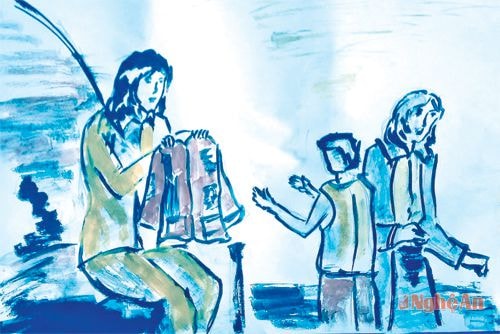
I'll never forget that day, a clear autumn morning, when suddenly gray clouds slowly gathered and swirled overhead. My mother still pulled my sisters and me along, little Giau lying in a basket, rocking back and forth like a cradle. My mother's brown áo dài (traditional Vietnamese dress) was patched with numerous patches. The patches, made of cotton fabric she'd picked up somewhere, seemed intentionally decorative, but in reality, they were just to hide the torn fabric. In her hands, she had nothing of value more than a few jars of fish sauce, pickled vegetables, and a few handfuls of rice for the journey. My mother worked for a pottery workshop, and my sisters and I, the oldest and youngest, stayed home to look after each other. Nearly half of her wages went to medicine for Giau, who was constantly ill.
When Giàu was five, his mother said he was "going to be burned." He became healthier, and they spent less on medicine, but he was still simple-minded and naive. Occasionally, someone would play a cruel trick on him, beckoning him to follow them, leaving him hundreds of meters away from home, causing his mother and siblings to frantically search for him. My childhood was filled with those haunting scares every time I thought my simple-minded younger brother had gone missing.
Thắm still considered those past events shameful, sad, and not worth mentioning, but whenever she had free time, her mother would still recount them to everyone. Especially today, her heart felt heavier as the first rain of the season poured down, and her mother had just returned home after days of emergency treatment following a stroke. She lay drowsily, sleeping more than she was awake. At the foot of the altar dedicated to the Bodhisattva Guanyin, Giàu, now over 20, lit incense and prayed for peace, while weeping like a child because he felt so sorry for his mother.
From the days when her hands were calloused from working as a hired hand, nearly 20 years after leaving home with her children, my mother built a successful business: a four-story house and the family's famous export ceramics factory. She didn't want us sisters to live separately, so even though we had husbands and children, Hoa and I, along with Tham and Giau, still lived with her. Each of us lived on a different floor. The staircases and walkways were separate, so there was almost no conflict. Giau lived on the same floor as my mother so she could easily cook for him. Giau, still crying, recounted how, just last week, while my mother was relaxing in a hammock watching TV, she somehow tumbled to the ground, unable to get up or speak. Tham's eyes widened, and she spoke in a raspy voice:
- Do you like it so much that you keep talking about it?
The rich man replied:
- I don't like it. I'm so afraid Mom will die. Mom, please don't die.
While Giàu was talking, he suddenly remembered something:
- My mother gave me this a while ago to give to my sisters and me. It might be her will. She said we should give it to her whenever something happens to her.
"Why did you only remember this now, you idiot? Show me," Thắm urged.
Unfortunately for him, Giàu, being prone to forgetfulness, couldn't immediately remember where he'd hidden what he thought was the will. Thắm continued to yell, "Useless idiot, hurry up or I'll miss my flight!" Thắm was getting ready for the airport. She'd been preparing for this study abroad trip for a whole year. About two hours later, after searching every nook and cranny of her mother's room and Giàu's room, they were still searching in vain. Giàu sat lamenting his uselessness. Thắm speculated, "Maybe Mom divided the inheritance among us sisters and didn't give him any, so he disposed of it. This guy is just mildly depressed, pretending to be stupid, how devious!" Giàu sobbed, feeling wronged, assuring her that he didn't need to fight for it; he'd rather take it than compete for it. After a while, after crying, Giàu suddenly remembered that he'd hidden it under the statue of the Goddess of Mercy... discreetly.
It was a faded piece of paper. My mother's slanted handwriting clearly stated that her inheritance consisted of only two valuable parts. One was the house and company, which all four sisters would maintain and manage together, and if sold later, the proceeds would be divided equally among them all. The second was a priceless memento hidden in the bottom drawer of the ancestral altar. Anyone could keep it, as long as they believed they could keep it for a long time. Thắm turned around and said, "Open it quickly, I have to go to the airport. Only 5 minutes left." Hoa solemnly said:
- Why is it so confusing? Why does this priceless memento, which anyone can keep, have to be kept for such a long time? Perhaps we have to wait until everyone leaves before opening it so there are enough witnesses.
"No way. I have to be at the airport in 5 minutes," Tham said sharply.
Without waiting for anyone's opinion, she rushed to the ancestral altar cabinet and opened it. In the bottom drawer, Thắm pulled out an old wooden box. Inside was her mother's old brown dress, patched with a few chrysanthemum flowers. It was the dress her mother wore when they all went back to their hometown. Thắm pouted in disappointment: "What a waste of time." She quickly pulled her suitcase and hurried out of the house. The remaining sisters remained silent, each lost in their own thoughts. Nearby, their mother still seemed to be smiling faintly – a smile the midwife had taught her, neither clearly sad nor happy.
Only Giau happily exclaimed, "Let me keep it, ladies! I'll keep it for a very long time, for the rest of my life!"
Short stories by
Vo Thu Huong


