
"What time is it now?"
(Baonghean) - This afternoon, while driving my niece to school at the Cultural Center, passing by Vinh Bus Station, I suddenly felt a pang of nostalgia. It's because I once had a romance with a girl in a lower grade at the same high school; the story began at this bus station and ended at this very "fateful" place. Lost in my memories, my niece whispered, "Uncle, we're not going to the bus station to pick anyone up, why are you turning in like that? We have to go straight to the Cultural Center, don't we?" I admitted that returning to the old place felt embarrassing, so I steered in a different direction: "I was just trying to remember, when exactly was Vinh Bus Station established?"
My curious and mischievous niece absolutely refused to let go, persistently asking me when the bus station was established. I racked my brain trying to remember: The first time I went to the bus station was with my mother and eldest sister to take a bus to Hanoi to enroll her in university. I was the youngest child in the family; my sister was 18 and I was only 7. It was also my first time riding a bus to the capital, so I was very excited. While my mother and sister were carrying bags and luggage, my only task was to hold a few loaves of bread and a carton of condensed milk for them to eat on the way.
After buying the tickets, while my mother and sister were busy loading things under the bus, I slipped away to play around the bus station. This caused my mother and sister to think I'd been kidnapped, and they searched frantically, crying their eyes out. I'd misplaced my bag of bread while playing, so I lied, saying, "Someone pickpocketed me." I was too young then to understand what "pickpocketing" meant. I overheard my mother telling my sister, "Sew a pocket on your waistband for your money and documents, to protect yourself from pickpockets," and I just repeated what she said. Thinking back on that incident of having my bread stolen at Vinh Bus Station, it still makes me laugh.
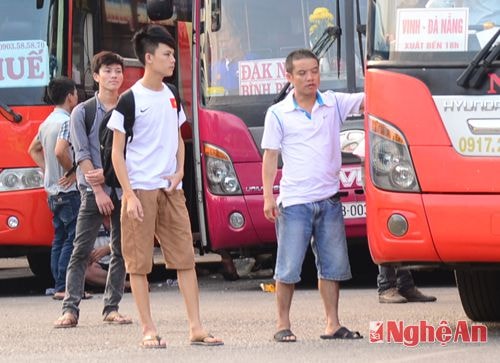 |
| Passengers are preparing to board the bus. |
That means the bus station has been there since the 80s and 90s. I thought about it for a long time and was surprised to realize that I pass this road every day, yet I've never once asked myself: When was this bus station built? Probably because it's a "veteran" of this city; it's been there even before many generations of people living here today were born. My mother, a woman from the North who used to carry her burden on foot from Son La to Nghe An, said: "In the old days, we were poor and didn't have money for trains or buses. Your father was a soldier, away all year round, you never knew when he would die. Your great-grandmother was all alone in the countryside, how could I leave her like that?"
"And so, on a long journey, she carried her burden to the south, to find her husband's hometown." That's the story my mother told me when she led my sister and me to the bus station on the day she took my sister to school. The bus, the bus station – luxuries for a hardworking woman far from home, single-handedly raising her small family, and remaining so even after my father's death on the battlefield. I will never forget my mother's trembling hands as she received the ticket from the bus conductor, respectfully and with a touch of fear, as if receiving an invaluable gift. I will never forget that first trip – the first for me, my sister, and my mother. Poor mother, never having traveled long distances by bus before, she got motion sickness, pale and sickly like a wilting leaf...
The bus station is the "kingdom" of laborers – perhaps that's a truth more accurate than any fact. Nowhere else are laborers concentrated in such large numbers. Those traveling by bus are mostly workers from the less affluent classes of society: if they had ample money, they would have traveled by plane or train – if they had ample time. But alas, both time and money are luxuries for the poor laborers. There, one easily encounters travelers from mountainous districts, coming to the city to pick up goods, deliver supplies, or visit relatives – often on special occasions like funerals or weddings.
Even though the passengers come from all over the country, the most common thing they share is: heavy luggage, wrinkled faces with obvious worries, and notebooks filled with numbers and names. Only by visiting the bus station during holidays can one truly understand the anxieties and worries of migrant workers. "Hey, is there any seat left?", "If there are no seats, I'll sit in the aisle," "Are there any more buses?", "I wonder what time I'll get home...". During my student years, I frequently took buses between Vinh and Hanoi, so I'm no stranger to these questions – repeated endlessly amidst the noisy, chaotic sounds of blaring car horns, bustling crowds, and noisy poultry at the bus station. At those times, I often joined the shared thoughts of these travelers: What time is it now?
“What time is it now, miss?” – A young man’s voice rang out, making me feel as if I were hearing and seeing a reflection of myself from my student days, packing my bags and heading to the capital for my studies. When the bus hadn’t left by the station yet, I would often stop at the tea stall run by the aunties and ladies near the entrance, sipping a cup of bitter tea and watching the motorbike taxi drivers leisurely puffing on their pipes. Back when I was a student, there were rickshaws too, but they weren’t as popular as motorbike taxis. Rickshaws were cumbersome and couldn’t compete with the crowded, bustling streets like the tiny Honda 82s or Honda Cubs. Another group frequently seen at the bus station were the porters. These men lacked the boisterousness and outgoingness of the motorbike taxis and rickshaws; perhaps the nature of their work made them reserved and withdrawn. Tall and heavily tanned, they stood there like boulders or blocks of earth. But it's harmless, as harmless as the earth.
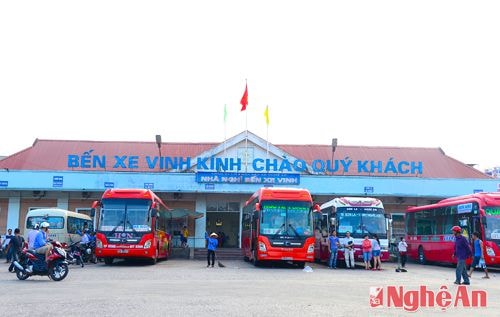 |
| Vinh Bus Station. |
Late-night sticky rice stalls are another unmistakable characteristic of the bus station. So much so that people have even given it the name "Bus Station Sticky Rice," referring to the stalls run by women on the other side of Minh Khai Street, diagonally across from Le Loi Street. During the day, the sidewalk is occupied by shops and businesses, but from dusk until late at night or dawn, it becomes a "culinary kingdom" catering specifically to the bus station, or more accurately, to the passengers and workers who flock there. The stalls only start getting busy after 11 PM, and they continue selling until 2 or 3 AM before packing up and going home. To put it bluntly, the sticky rice there isn't anything special; it's just sticky rice with eggs and pork sausage like everywhere else. But the unique thing is that people flock to these stalls at these unusual hours, and frankly, their stomachs aren't that picky then. Especially when selling to working-class people who have very sensitive stomachs.
Looking back, I'm startled to realize how this seemingly ordinary bus station could hold so many memories, images, and sounds. Now that I have a stable job and a little money coming in, I haven't taken the bus for a long time. The student I once was, saving up for bus tickets to visit my girlfriend back home, has long since been relegated to the drawer of the past. All that remains is a touch of nostalgia, a hint of regret for those bright, innocent days – preserved intact by the bus station, a place often associated with the most chaotic and competitive aspects. Because, within that noise and hustle, lies the breath of life in a city rushing to keep up with the times. The sweat of labor, salty and arduous, yet precious and endearing. Watching the bustling stream of cars coming and going amidst the long, urgent honking of horns, my heart suddenly calmed down with the lyrics of the song, "Hurrying back, hurrying away"...
Thuc Anh


