
Sugarcane grassy shoot disease - Confusion in control and prevention.
(Baonghean.vn) Sugarcane grassy shoot disease has now damaged nearly 10,000 hectares of sugarcane in the province's raw material area. The disease usually breaks out and causes severe damage between March and November each year. The risk of reducing the province's sugarcane raw material area is entirely possible if decisive measures to control the outbreak are not implemented promptly.
(Baonghean.vn) Sugarcane grassy shoot disease has now damaged nearly 10,000 hectares of sugarcane in the province's raw material area. The disease usually breaks out and causes severe damage between March and November each year. The risk of reducing the province's sugarcane raw material area is entirely possible if decisive measures to control the outbreak are not implemented promptly.
Mr. Ta Dinh Tro, Director of Agricultural Extension at Nghe An Tate & Lyle Sugar Company – the unit with the largest sugarcane growing area in the province – could not hide his concern: Currently, 6,520 hectares in the company's sugarcane growing area are affected by sugarcane grassy shoot disease, of which 3,016 hectares are severely infected and 3,004 hectares are mildly infected. What is worrying is that the area of sugarcane affected by the disease is increasing rapidly.
Mr. Tro stated that previously, it took 12 months for sugarcane grassy shoot disease to damage sugarcane fields planted with disease-free varieties imported from the South and China, but now that time has been reduced to only 6 months. According to statistics, the annual spread area as the crow flies is 10 km/year, and currently, only some areas in Quy Chau and Que Phong within the company's sugarcane growing region are considered "disease-free." Meanwhile, control measures are almost ineffective. Besides strictly following the guidelines of the Department of Agriculture, Tate & Lyle Sugar Company has proactively sought disease-free seed sources; however, the infected or re-infected areas are increasing rapidly. Despite excellent efforts to destroy infected sugarcane fields, the rapid spread of the disease has not been prevented.
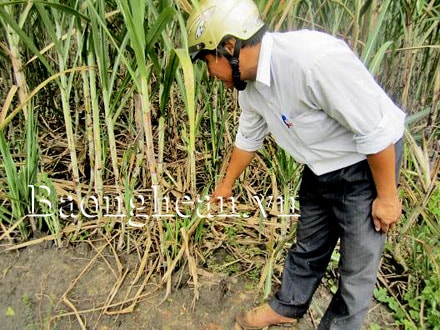
Sugarcane grassy shoot disease is causing damage to the sugarcane growing area of Song Con Sugar Company (Tan Ky).
In Tan Ky, both the people and the relevant departments and the Song Con Sugar Company are struggling to find a solution to the sugarcane grassy shoot disease. Mr. Nguyen Dinh Hai, Deputy Head of the Agricultural Department of the company, said: Currently, out of a total of 4,960 hectares of sugarcane raw material area in Tan Ky, more than 1,734 hectares are infected, with nearly 1,400 hectares severely affected. The company is currently purchasing disease-free sugarcane seedlings from Lam Son (Thanh Hoa) and some areas of Yen Thanh and Anh Son to supply to farmers, and strongly advises against using seedlings from areas already affected by the disease, even if they are not yet infected. However, this is only a temporary solution. In the long term, the company hopes the province will soon help it build a clean sugarcane seedling production facility to provide completely disease-free sugarcane seedlings to farmers in the raw material area.
Mr. Ta Dinh Tro stated: Along with policies to support farmers in destroying and replanting, the unit has also agreed to issue harvest orders before December 30, 2011, for areas of early-ripening sugarcane and those severely infected with sugarcane grassy shoot disease. Areas of medium-ripening sugarcane will be harvested before January 30, 2012. At Song Con Sugarcane Company, Mr. Hai shared: For the 2011-2012 crop year, with a target of planting 1,500 hectares and replanting 1,000 hectares (including areas already affected by sugarcane grassy shoot disease), the unit has also implemented appropriate policies to encourage sugarcane growers, such as providing support for seeds, fertilizers, land preparation costs, etc., for newly planted sugarcane areas, and supporting pesticides in case of pest and disease outbreaks...
However, these are only considered "temporary" solutions. In sugarcane growing areas, many opinions suggest that, until the mechanism of disease spread is found, the province should have a suitable solution that both ensures the operation of sugarcane companies and allows for crop rotation in areas previously affected by the disease.
According to Mr. Nguyen Van Lap, Deputy Director of the Department of Agriculture and Rural Development: Although the agricultural sector has issued very clear recommendations on disease control measures, people and localities have not implemented them seriously. In many places, not all areas with moderate and severe infections have been destroyed, and this situation is even more common in lightly infected areas. In reality, areas with mild infections are almost always reinfected. However, if we proceed with destroying all infected areas and surrounding regions as some localities have suggested, the area of sugarcane destroyed will reach nearly 10,000 hectares, which will be very difficult for the factories to operate.
Therefore, the policy of complete destruction has not yet been implemented, but the agricultural sector encourages that in areas where conditions permit, destruction can be carried out and other crops can be rotated. Currently, the Institute of Plant Protection is conducting a research project on sugarcane grassy shoot disease in Nghe An, but so far, the causative agent has not been identified as a virus or an intermediate microorganism between a virus and bacteria; therefore, there is no effective method for spraying to eradicate it. However, the cause of sugarcane grassy shoot disease has been identified as phytoplasma, which is not transmitted through soil or dead sugarcane plants but only through living plants and animals. Therefore, destroying diseased sugarcane plants is necessary and the only solution at the present time.
Forecasts indicate that sugarcane grassy shoot disease will continue to spread and cause severe damage over a wide area, seriously affecting the province's sugarcane growing areas, especially in areas with moderate to severe infection, and ratoon sugarcane from the 2011-2012 crop year. The disease is expected to develop strongly from January to March. Given this situation, the Department of Agriculture has issued specific recommendations, which local authorities need to seriously implement thoroughly.
First, a comprehensive review of the entire sugarcane area should be conducted to identify and demarcate areas with varying degrees of infection. Sugarcane companies must plan to issue early and simultaneous harvest orders for these areas so that farmers have time to prepare the land and dispose of infected plants, in preparation for replanting the spring crop. Destroying the source of infection is a crucial measure to limit the spread of the disease. Appropriate measures are needed for each level of infection. Accordingly, 4,381 hectares in the province with 20% or more infection need to be plowed, uprooted, and burned; 3,877 hectares with less than 20% infection need to have diseased plants dug up and destroyed. This treatment should be carried out as soon as possible and completed before April 30, 2012, to allow for sugarcane care. In addition, herbicides can also be used to kill diseased sugarcane clumps.
Currently, the vector transmitting the disease has not been identified, so replanting with disease-free varieties is considered the most feasible measure. First, it is necessary to investigate and review the existing disease-free sugarcane area in the locality, and inform farmers to proactively purchase and replant immediately after harvesting. For areas that are not suitable for replanting, crop rotation with other crops should be implemented, and sugarcane should be planted again in the autumn of 2012. It is estimated that 4,380 hectares will be plowed and replanted in 2012, and 2,829 hectares will be newly planted.
It is especially important to absolutely avoid using seeds from fields already infected with the disease or from areas with high infection rates. Only use seeds that are disease-free and from areas far from disease-free sugarcane fields. To increase sugarcane resistance, it is essential to care for the sugarcane according to proper technical procedures, ensuring healthy growth and development, good disease resistance, and preventing the sugarcane from being ratooned for more than 3 years. In the long term, it is necessary to urgently establish disease-free sugarcane seed production areas to meet the needs of the raw material region, while also effectively disseminating information to sugarcane growers so that they can proactively control sugarcane weeds.
Phu Huong


