
A social epidemic
(Baonghean) - Faced with an unprecedented outbreak of Ebola hemorrhagic fever, the health ministries of 11 African countries have agreed to participate in a collaborative campaign to combat this deadly disease. Accordingly, the World Health Organization (WHO) will establish a regional testing center in Guinea – one of the three West African countries at the epicenter of the outbreak.
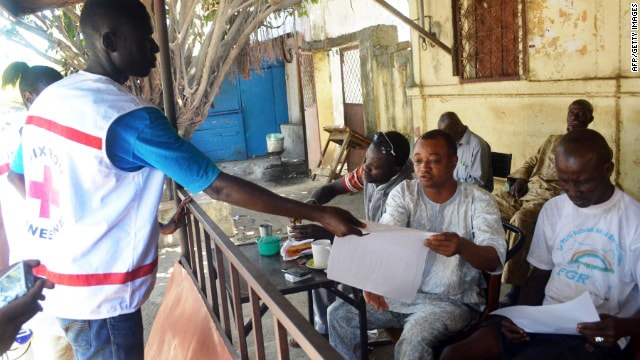 |
| Healthcare workers are educating people on how to prevent Ebola. |
The campaign was announced late last Thursday, following a two-day meeting in Ghana attended by ministers from the Democratic Republic of Congo, Gambia, Ghana, Guinea, Guinea-Bissau, Ivory Coast, Liberia, Mali, Senegal, Sierra Leone, and Uganda; health experts; Ebola survivors and recoveries; and WHO representatives. The campaign calls for close monitoring, community cooperation, and political leadership to raise awareness and understanding of the disease, as well as cross-border collaboration. Previously, the WHO warned of the need for "decisive action" to stop the spread of this virus, which has a potentially fatal 90% mortality rate. Professor Luis Gomes Sambo, WHO Regional Director for Africa, enthusiastically endorsed this move: "It is time for concrete action to end the suffering and death caused by Ebola and to stop its spread." According to the WHO report, as of June 30, there had been 759 cases of the disease, with 467 deaths in Guinea, Sierra Leone, and Liberia.
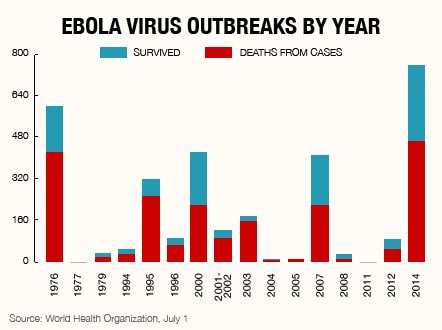 |
| A graph showing the spread of the Ebola virus over the years. |
The Ebola virus is a "brutal killer," and its initial symptoms closely resemble those of the flu: headache, fever, and fatigue. However, once the disease develops, patients experience severe diarrhea and vomiting, along with blood clotting disorders caused by the virus. As a result, patients suffer internal and external bleeding, with deaths occurring within an average of 10 days of symptom onset. The incubation period can range from 2 to 21 days, making the disease easily transmissible as many people are unaware they are carrying the virus. Fortunately, the Ebola virus is not as easily transmitted as many believe: a carrier cannot transmit the disease until symptoms appear. The disease is transmitted through blood and bodily fluids from infected humans or animals.
Mr. Sambo stated, "The epidemic started last March, causing enormous human losses and negatively impacting the socio-economic situation." According to him, one of the reasons for the rapid spread of the disease is related to certain local customs and practices. These customs contradict the prevention and treatment measures that health workers are trying to promote within the community, leading to "misunderstandings, suspicion, and lack of cooperation," hindering the relief efforts of health workers. For example, people often conceal and treat Ebola patients at home, and at funerals, people often touch the corpses; these practices increase the risk of Ebola virus transmission, according to a WHO report. In addition, movement within and outside borders facilitates the easy spread of the disease across three countries. In conclusion, Mr. Sambo expressed his regret for the healthcare workers – those at the forefront of the battle against the epidemic, many of whom have been infected: more than 60 cases, including 32 deaths.
Uganda, one of the countries participating in the conference in Ghana, announced on Friday new quarantine measures for people arriving from countries affected by the outbreak. Uganda's Health Minister, Ruhakana Rugunda, stated, "Quarantine measures will be strengthened at border checkpoints, especially for those who have traveled through Guinea, Sierra Leone, and Liberia in the last three months." While no travel ban has been issued, Ugandans are advised to limit unnecessary travel to affected countries. Furthermore, Uganda, a country with experience in handling Ebola outbreaks (most recently in 2012), has been requested by the WHO to provide technical assistance in the Ebola containment and control campaign.
This is the first Ebola outbreak in West Africa, affecting three countries, and also the first time it has occurred in capital cities. Authorities believe the reason for the widespread outbreak is the proximity of the forest where the virus was detected to cities like Conakry, the capital of Guinea, which has a population of 2 million and an international airport. The problem is that the countries most severely affected are those with poorly developed healthcare infrastructure. Although there is no cure, according to Professor Peter Piot, who discovered the Ebola virus in the 1970s, it is not difficult to prevent the spread of the disease because it is not easily transmitted. Simple measures such as washing hands with soap, not using used syringes, and not touching the bodies of infected people are sufficient to prevent the spread of the disease. According to Professor Piot, this is "an epidemic of a dysfunctional healthcare system. The fear of the disease, the lack of trust in the government and the healthcare system, is just as dangerous as this terrible virus itself."
Summer epidemics are not only affecting Africa but also other continents. In France, the Chikungunya epidemic, originating in the French Antilles, is causing concern among authorities because the tiger mosquito, the vector of the disease, has been detected in 18 southern French provinces. In France's overseas territories of Martinique and Guadeloupe, 8% of the population has contracted the disease, and the rate of spread is increasing rapidly with the arrival of the rainy season. While not severely affecting healthy individuals, the disease can cause joint pain, and the only effective way to prevent it is to treat stagnant water sources that can breed tiger mosquitoes. In Vietnam, there is currently an outbreak of Japanese encephalitis. Favorable climatic conditions provide an opportunity for diseases of varying severity to develop and spread, and it is also a time when a scientific and efficient operation of the entire society is needed, so as to avoid, as Professor Piot said, a plague of a "dysfunctional society".
Reishi Mushroom


