
Dermatitis is a common skin condition in children.
Many mothers worry because their children have oily flakes on their scalp, commonly known as "cradle cap," or older children feel uncomfortable and self-conscious because of dandruff.
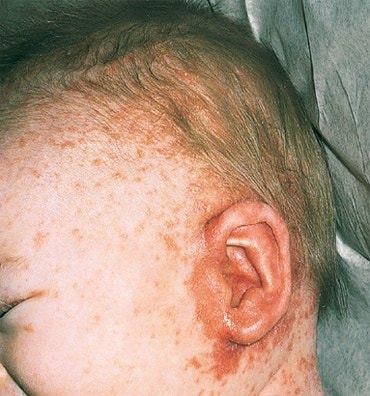
Another form involves scaly patches accompanied by erythema in areas such as the eyebrows, behind the ears, cheeks, neck, or armpits and groin. This is easily mistaken for heat rash but is actually diagnosed as seborrheic dermatitis.
What is seborrheic dermatitis?
According to Dr. Nguyen Dinh Huan, this is a common, chronic skin disease characterized by erythematous, oily, scaling rashes with relatively well-defined boundaries, mainly concentrated in areas with many sebaceous glands such as the scalp, face, and upper body; therefore, it is called seborrheic dermatitis.
The cause may be an increased inflammatory response to the fungus Malassezi furfur, a lipophilic fungus that commonly lives in sebaceous glands, and genetic and environmental factors also influence the onset and progression of seborrheic dermatitis.
|
Image of seborrheic dermatitis in children. Photo:SKDS. |
Symptoms of the disease
Diagnosis is primarily based on clinical findings; laboratory tests are rarely necessary. Patients are usually divided into two age groups with different clinical manifestations:
Infants and young children: The most common symptom is sticky, greasy scales concentrated on the top of the head, which can form a thick layer spreading across the scalp, creating a hat-like appearance (commonly known as "cradle cap"). The second most common location is diaper dermatitis, usually presenting with more redness than scaling. It can also occur on the face and in skin folds (behind the ears, armpits, groin). In a few cases, secondary infections such as Candida fungus or bacteria may develop.
The condition typically begins early, between 2 and 10 weeks of age, and generally resolves by 8 to 12 months of age before potentially recurring during puberty. Children of all ages can be affected, even if they don't produce as many sebaceous glands as adults.
In older children, adolescents, and adults: most cases manifest as dandruff. It may appear as scaly patches with some erythema in areas with many sebaceous glands such as between the eyebrows, on the forehead between the eyebrows, nasolabial folds, around the eyelids, behind the ears, in front of the sternum, between the shoulder blades, under the breast folds, behind the ear grooves, and in the external auditory canal...
Is the disease dangerous and long-lasting?
The condition is not life-threatening, only causing some discomfort and affecting aesthetics. Seborrheic dermatitis in infants has a good prognosis, is self-limiting, and mostly responds very well to appropriate topical treatment. In older children, adolescents, and adults, longer treatment is usually required.
How should young children be treated?
"Buffalo dung" or scalp flakes:
You can apply mineral oil or baby oil to soften the scales on the scalp a few hours before shampooing. You can also use a soft-bristled baby brush to gently comb through your baby's hair daily while shampooing to help remove more scales.
If the above methods are ineffective, you can use shampoos containing anti-sebum agents such as pyrithione zinc or selenium sulfide. Antifungal shampoos like ketoconazole are also highly effective.
Products containing salicylic acid should not be used because they can cause irritation and salicylic acid poisoning.
If the scalp is severely inflamed: use a mild topical corticosteroid such as hydrocortisone 1%. If there is a bacterial superinfection (oozing, yellow crusts, etc.): use an antibiotic against staphylococcus before treating with topical corticosteroids.
Skin lesions:
Mild topical corticosteroids such as hydrocortisone 1% or 2.5%, or desonide 0.05% can be applied to the skin twice daily when there is significant inflammation.
Ketoconazole is an alternative treatment for seborrheic dermatitis in infants and young children to avoid the side effects of long-term or large-area topical corticosteroid use.
How are older children, adolescents, and adults treated?
Scalp scales:
To control scalp scaling: use an anti-sebum shampoo containing active ingredients such as pyrithione zinc, selenium sulfide, ketoconazole, tar, or salicylic acid. To control erythema: apply a mild corticosteroid such as fluocinolone or triamcinolone at bedtime.
Skin:
Hydrocortisone 1% or 2.5%, and/or ketoconazole cream applied topically twice daily if needed. Ketoconazole or ciclopirox olamine cream applied once or twice daily is effective in treating even difficult and widespread cases. Oral Itraconazole is effective for moderate to severe cases of seborrheic dermatitis.
Seborrheic dermatitis of the face in adolescents is usually treated with intermittent hydrocortisone cream and/or ketoconazole cream. Other medications that may be used include pimecrolimus 1% ointment, metronidazole 0.75%, etc.
Periblepharitis:
Gently massage the eyelids and wash frequently with an anti-dandruff shampoo containing zinc or tar. Ketoconazole cream applied once a day is valuable in refractory cases. Limit prolonged use of topical corticosteroids as they can cause glaucoma.
All of the above treatments should be carried out under the examination and prescription of a doctor.
According to Health & Life - NT


