
The mystery of the Bermuda Triangle has been solved.
The Bermuda Triangle (also known as the "Devil's Triangle") has become a legend, sparking both curiosity and fear worldwide due to the numerous anomalies that occur there. Recently, scientists have claimed to have uncovered the secrets of this infamous area.
The Bermuda Triangle is an area located in the northwestern Atlantic Ocean, encompassing the eastern coast of the US state of Florida and Puerto Rico. Part of the triangle also extends into the neighboring state of South Carolina, USA. The area is named Bermuda because it was first discovered in 1503 by the Spanish admiral Juan Bermuda.
In general, the Bermuda Triangle is a sunny, windy area with no distinct seasons. It is one of only two places on Earth where a compass will not point accurately to north. Many people even say that the laws of physics no longer apply there.
The Bermuda Triangle earned its nickname "Devil's Triangle" primarily because of the mysterious disappearances that have occurred there. Statistics show that more than 100 aircraft and ships have been mysteriously "swallowed up," leaving almost no trace in the area.
Christopher Columbus, the famous Italian maritime explorer, also recorded chilling diary entries about his journey through the Bermuda Triangle in 1492, with unusual deviations of navigational instruments, strange lights illuminating the horizon, and "a huge fire" plunging from above into the sea.
Numerous documentaries investigating the infamous "Bermuda Triangle," with its countless events, theories, mysteries, and legends, have been made and released, but none have offered a widely accepted explanation. However, scientists have recently discovered giant craters at the bottom of the Barents Sea, believed to hold the key to unraveling the mystery of the Bermuda Triangle.
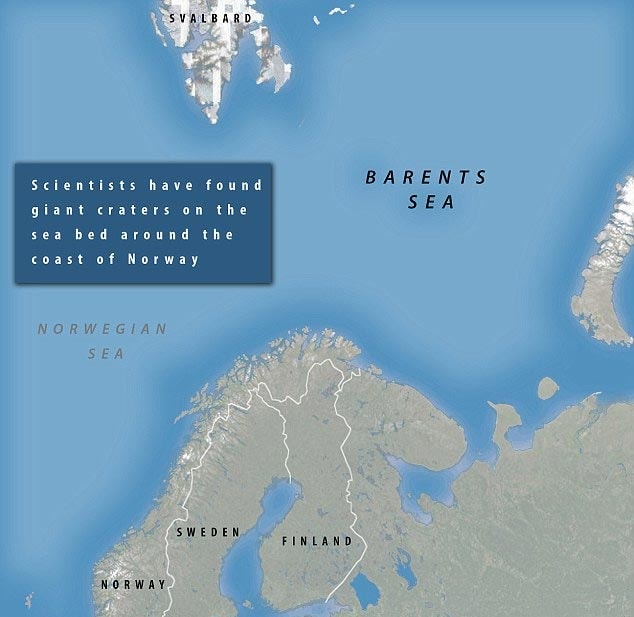 |
According to a research report, experts from Norway's Arctic University have discovered several craters up to 800 meters wide and nearly 45 meters deep in the central seabed, slightly west of the Barents Sea. These giant seabed craters are believed to have formed from the accumulation of methane gas off the coast of Norway – a country rich in natural gas.
Methane leaks from natural gas fields deep beneath the surface may have created cavities that eventually ignited on the seabed. Experts believe that these gas explosions, causing the cavities to expand, likely pose a risk to vessels navigating the Barents Sea. This could explain the unexplained disappearances of ships and aircraft in the Bermuda Triangle.
Last year, Russian scientist Igor Yeltsov, Deputy Director of the Trofimuk Institute, stated: "There is an explanation that the Bermuda Triangle was formed from the reactions of gas hydrates (also known as methane hydrates). These reactions rapidly destroy the methane hydrate, releasing gas. The reaction occurs at a speed like an avalanche, like in a nuclear reaction, and produces a huge amount of gas. It causes the ocean temperature to rise and ships to sink because the seawater is mixed with a huge amount of gas."
Methane hydrate is essentially frozen water containing numerous gas molecules, primarily methane. It exists in permafrost regions such as northern Siberia and at the bottom of some oceans around the world. Yeltsov added that the reactions of methane hydrate can release enormous amounts of methane gas and cause air turbulence, leading to aircraft crashing if they pass through these turbulent areas.
According to Vietnamnet.vn
| RELATED NEWS |
|---|


