
Defendant Duong Chi Dung hopes for a reduced sentence.
In his final statement on the afternoon of April 24th, defendant Duong Chi Dung continued to plead not guilty to "embezzlement," hoping for a reduced sentence so he could live and wait for the day he is exonerated. Speaking about his family's revolutionary traditions, especially his parents and his wife's parents, Dung stated that he had been very sincere and remorseful, and would encourage his family to make amends. He thanked and apologized to the Party, the State, and the people.
Here are the developments from the trial on April 24th:
At exactly 8:00 AM, the Appellate Court of the Supreme People's Court resumed the appeal hearing of the "embezzlement" and "intentional wrongdoing" case at Vinalines with the debate phase.
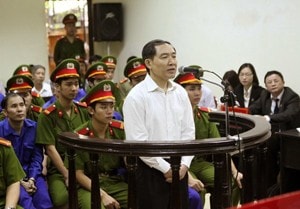 |
| Defendant Duong Chi Dung before the court. Photo: VNA |
Is the problem with the mechanism?
Lawyer Nguyen Dinh Hung, defending defendant Tran Hai Son, argued that after reviewing the documents, files, the questioning at court, and the conclusions of the prosecutor's representative, the comments on the case file contained individual viewpoints. He stated that he had not seen an objective basis for evaluating and proving the act of "embezzlement," nor had the elements constituting the crime of "embezzlement" been clarified. The sum of 1.66 million USD, part of the 9 million USD used to purchase the floating dock, was an asset resulting from the act of "intentionally acting against the law," and could not be the result of another crime ("embezzlement").
Regarding defendant Tran Hai Son, the lawyer argued that the distribution of $1.66 million, if any, constituted profiteering from "intentional wrongdoing." Concerning this act by defendant Tran Hai Son, the lawyer requested consideration of the extent of the violation, demonstrated by merely "initialing" documents and reports related to the purchase of the floating dock… The lawyer also requested a review of the extent of the damage in the case, due to the duplication of the aforementioned amount, without considering the remaining value of the 83M floating dock. To defend Tran Hai Son, the lawyer argued that mitigating circumstances should be considered, as the crime was committed under circumstances lacking strict legal documents and with a lax and flawed approval system. Furthermore, at that time, the demand for building shipbuilding and repair facilities was very high, motivating the defendants to proceed with related projects.
The defense lawyer for defendant Tran Huu Chieu agreed with the viewpoints regarding the determination of the criminal act and its severity, as well as the subjective intent during the commission of the crime. Regarding defendant Tran Huu Chieu, the lawyer argued that he took over the job from his predecessor at Vinalines without fully understanding the situation. Tran Huu Chieu could not have failed to implement the decisions of the Vinalines Board of Directors. The defendant's role in the case was passive, acting under the direction of the leadership. It is entirely possible to exempt or reduce the sentence for the crime of "intentionally acting against the law" against Tran Huu Chieu.
The lawyer also argued that, regarding the charge of "embezzlement," Chieu's role was very vague and passive. Based on the case file and questioning, applying the charge of "embezzlement" to the group of defendants in this case does not ensure the necessary legal elements. Defendant Chieu only acknowledged receiving money as a "kickback" during the investigation of the case. Tran Hai Son's testimony also lacked sufficient legal evidence to convict Tran Huu Chieu. The lawyer also requested that the charge of "embezzlement" in the first-instance judgment be overturned for reinvestigation... Regarding defendant Chieu, the lawyer argued that there were many mitigating circumstances, but these were not addressed in the first-instance trial. The lawyer argued that there were grounds to reduce the sentence for the charge of "intentionally acting against the law," requested consideration of the level of civil compensation, and requested that the first-instance judgment on the charge of "embezzlement" be overturned.
8:45 AM: The lawyer for defendant Mai Van Khang began his arguments, stating that the defendant did not receive instructions regarding the purchase of the floating dock, but only participated in the floating dock survey team as a member, primarily acting as an interpreter, without influencing the content of the survey report. Before Vinalines leaders signed the contract to purchase the floating dock, Khang had been transferred to another position. The defendant's initialing of the survey report was not intended to "do everything possible" to purchase the floating dock, and in reality, this report had no decisive value in the purchase. The accusations against the defendant in the first-instance judgment are incorrect and unfounded… The lawyer requested the court to consider mitigating circumstances for defendant Khang, given his family's meritorious service, and argued that applying the aggravating circumstance of "causing serious consequences" to defendant Khang was incorrect because it already established the crime and should be removed.
9:30 AM: The defense lawyer for defendant Le Van Duong presented his views, agreeing with the prosecutor's opinion, accepting the appeal, and requesting a reduction in the sentence and compensation for the defendant. The lawyer argued that Le Van Duong was only involved in the crime of "intentionally acting against the law" through his participation in the assessment during the preparation of the survey report. The lawyer argued that Vinalines had actually decided to purchase the 83M floating dock before the survey team was formed, without waiting for the survey report or the report from surveyor Le Van Duong. This report was merely a formality. Duong Chi Dung and Mai Van Phuc did not read Le Van Duong's assessment report. The lawyer argued that Le Van Duong himself had no intention of profiting and was merely a victim of a pre-planned "conspiracy."
The lawyer argued that Le Van Duong was only acting on the instructions of his superiors (the Vietnam Register). As an inspector, Duong's discussion of the inspection results with Tran Hai Son was normal. To determine whether the report was accurate, it was necessary to ascertain whether the floating dock was a seagoing vessel. The inspection results presented by Le Van Duong were based on objective perception, not intentional wrongdoing. Duong's report only addressed the issues that required inspection. While acknowledging Le Van Duong's mistakes, the lawyer stated that Duong acted "irresponsibly" rather than "intentionally acting wrongly." The lawyer suggested reducing the compensation amount for Le Van Duong, if any.
10:00 AM: The defense lawyers for the group of defendants, who were former customs officers (Huynh Huu Duc, Le Ngoc Trien, Le Van Lung), argued that there was insufficient evidence to determine the defendants' criminal conduct. However, since the defendants only appealed for leniency, the lawyers only presented corresponding arguments. The lawyers argued that the prosecution's indictment was inaccurate in accusing the defendants of "intentionally acting against the law." The lawyers cited international and Vietnamese legal documents on customs procedures to argue that the defendants did not violate any regulations. Defendant Huynh Huu Duc acted correctly in his duties by requesting a thorough inspection of the goods (floating dock). The lawyers also argued that all relevant customs documents for the floating dock were complete.
Regarding the classification of goods, the customs officers acted correctly. The lawyer argued that the floating dock is not a ship, but merely a ship repair yard, according to many expert opinions and specialized documents. Therefore, the assessment of goods during customs clearance should be based on the standards for floating docks, not on ships. Floating docks are not on the list of prohibited imported goods.
The lawyer argued that defendant Le Ngoc Trien had correctly and fully calculated the tax on imported goods, collecting over 22 billion VND. Therefore, prosecuting Le Ngoc Trien was incorrect. Defendant Le Van Lung had inspected the goods, clearly identifying the type, name, and origin of the goods as declared to Customs. Therefore, the lawyer requested a reduction in the criminal sentence.
Regarding civil liability compensation, the lawyer argued that the defendants were not involved in the crime of "embezzlement," and the amount related to the "embezzlement" should be offset. It also needs to be clarified whether other damages resulted from customs clearance. The bank disbursed funds for the purchase of the floating dock without requiring customs clearance documents, therefore it was not related to Customs. The defendants had no personal motive or purpose in the customs clearance of the floating dock. The civil plaintiff (Vinalines) has not yet filed a claim for compensation. The first-instance judgment did not individualize civil liability for compensation. The compensation for the customs defendants in the first-instance judgment included many unrelated items… Therefore, the lawyer argued that the compensation for the former customs officers was inappropriate.
To present further mitigating circumstances for the defendants, the lawyers highlighted their backgrounds, their struggles and contributions, demonstrating their good character. In addition, the defendants, who were former customs officers, came from difficult family circumstances, and defendants Triện and Lừng suffered from illnesses.
Continuing his defense of the defendants, lawyer Nguyen Van Chien argued that not every plea of guilt automatically makes a defendant guilty, let alone an understanding of the charges. Regarding the charges against the three defendants, the lawyer asserted that the first-instance judgment was flawed. He further argued that the Customs classification of the 83M as a floating dock, not a seagoing vessel, was entirely correct according to international law and international conventions to which Vietnam is a signatory; the customs clearance process was carried out correctly and in accordance with regulations in the field of Customs… Therefore, the defendants acted correctly. Furthermore, the defendants' records and testimonies show that they did not know or meet the defendants at Vinalines, and therefore could not be considered "active accomplices" of the Vinalines defendants as the first-instance judgment stated.
Duong Chi Dung and Mai Van Phuc are sworn enemies.
2:00 PM: The court summoned defendant Duong Chi Dung to give his opinion. Duong Chi Dung fully agreed with the opinions of his defense lawyers, but added that he did not give any instructions to "buy at all costs" the floating dock as claimed by Tran Hai Son.
When questioned, Mai Van Phuc presented his case regarding the charge of "embezzlement," stating that defendant Tran Hai Son's testimony was completely untrue and deceitful. Son's testimony about Dung directing the distribution of money to Phuc was also denied by defendant Dung. Mai Van Phuc argued that the negotiations for the purchase of the floating dock began in late 2006, before he had taken office at Vinalines. He only met Goh Hoon Seow once, after the decision to purchase the floating dock had been made through AP Company. This means that the embezzlement and wrongdoing occurred before he took office as General Director of Vinalines. He claimed he had no motive to act illegally other than trying to do the best for Vinalines, and that he was an irreconcilable enemy of defendant Dung, making it impossible for him to participate in such wrongdoing.
Defendant Tran Huu Chieu requested the court to consider the time when the project was implemented, as Vinalines had already reported to the Government and received approval for the direct awarding of the contract to build the shipbuilding and repair factory. At that time, the defendant's actions were not "illegal." Regarding the signing of documents to process disbursements, the defendant argued that initialing the documents was due to Vinalines' regulations and was his oversight. Regarding the charge of "embezzlement," the defendant continued to plead not guilty.
Defendant Mai Van Khang agreed with his lawyer's defense, arguing that the first-instance judgment and the prosecutor's closing arguments did not provide concrete evidence to establish guilt, failed to state the motive for the crime, and that he did not meet the conditions to commit the crime. Defendant Le Van Duong added that the technical inspection report accurately reflected the technical situation, and only the survey team's report was altered. Defendant Tran Hai Son had no further comments. Defendant Huynh Huu Duc maintained that he did not commit the crime of "intentionally acting against the law." Defendants Trien and Lung had nothing to add.
2:35 PM: The representative of the Procuratorate began their arguments in court. The representative of the Procuratorate reiterated that they had presented very specific details regarding the attribution and determination of guilt for the defendants' criminal acts in the Procuratorate's concluding remarks before the court. Regarding the lawyers' request to overturn the first-instance verdict on the charge of "embezzlement" due to the need for a witness from a foreign partner, the Procuratorate argued that this was unnecessary because the money transfer was real and the violation was real. Regarding the charge of "intentionally acting against the law," there were many viewpoints to consider. However, the Procuratorate maintained that the compensation amount for the defendants remained unchanged (over 366 billion VND). Civil compensation in criminal cases also does not require a claim from the civil plaintiff.
Regarding whether the bank's disbursement process was correct, the Procuratorate argued that it does not depend on the bank's own assessment but must be based on the law. According to the assessment of the appraisal agency, this transfer of funds was contrary to the Commercial Law. Regarding the valuation of damages, although lawyers previously argued that the assessment was incomplete, the Procuratorate stated that the expert's conclusion indicated that the damages were assessed after deducting the remaining actual amounts. If the total damages are calculated at over 500 billion VND, after deducting the remaining amounts (such as the value of the floating dock at 37 billion VND), only over 366 billion VND remains…
Regarding the determination of whether 83M is a floating dock or a ship, the Procuratorate relied on numerous legal documents (Article 11 of the Maritime Law, the 83M dossier, the sales contract, etc.), therefore, the management of 83M must be understood as that of a seagoing vessel. Consequently, the representative of the Procuratorate determined that the criminal act was as if it were a seagoing vessel. Also concerning the "identification" of 83M, the Procuratorate argued that relying solely on the international convention on the identification of goods to conclude that 83M is a floating dock is insufficient; other legal provisions must also be considered and fully applied to determine the criminal act of the defendants.
Vinalines is a 100% state-owned enterprise, meaning it's the people's money. The money lost in this case is state money, so the process of executing contracts and organizing bidding must comply with regulations on state capital management. In short, the Procuratorate maintains its indictment against the defendants.
3:00 PM: During the debate with the prosecutor's representative, lawyer Ngo Ngoc Thuy, representing Duong Chi Dung, requested clarification on whether the $1.66 million USD was Vinalines' property to determine the charge of "embezzlement"; who directed the transfer of money to the account of Tran Hai Son's sister's company; who agreed on the $1.66 million USD; and how to evaluate Goh Hoon Seow's "oath of allegiance." In response, the prosecutor's representative argued that, legally, responsibility for all of Vinalines' assets rested with Duong Chi Dung. According to the investigation documents and Goh's testimony, the $1.66 million USD was deducted from Vinalines' more than $9 million USD. This more than $9 million USD was deducted from a bank loan secured by Vinalines' assets. The prosecutor argued that the investigation showed the defendants acted in secrecy, with no one else involved to report the crime, and the defendants did not confess. This characteristic makes it difficult to determine who directed or orchestrated the plan. Defendants Dung and Phuc denied any involvement. The investigation process objectively assessed Son's testimony and other characteristics, concluding that Son's statement was credible.
Regarding Goh Hoon Seow's "swore oath," the prosecutor's representative stated that the document shows Goh had prior acquaintance with Duong Chi Dung. The document also shows Goh admitting that Vinalines had conducted a prior survey before enlisting AP's help. The involvement of AP as a broker resulted in an additional difference of over $4 million USD. The $1.66 million was allegedly for completing import/export procedures, although it was not mentioned in the sales contract.
Lawyer Tran Dinh Trien, representing Duong Chi Dung, continued to demand evidence from the owner of the floating dock (a company from the Russian Federation) because the investigation had not clearly shown the extent of involvement of many other individuals in transferring $1.66 million to Tran Hai Son. The lawyer proposed arguments regarding: evidence that Dung and Phuc directed the "purchase at all costs" of the floating dock; evidence that the survey team worked with the owner of the floating dock and knew the price beforehand; and evidence that Goh asked Dung for help in the floating dock purchase... The lawyer for defendant Mai Van Phuc also requested clarification on who negotiated to obtain the $1.66 million and why it was transferred to Tran Hai Son's sister's company. The lawyer for Mai Van Khang requested the Procuracy to clarify some documents not included in the case file, such as the independent expert report on the floating dock. This could clarify the extent of the defendants' involvement… The lawyers for the group of defendants, former customs officers, argued that the prosecutor's representative had not clarified the definition of the 83M floating dock. The wife of defendant Dung maintained her appeal regarding the seizure of assets. Conversely, the wife of defendant Phuc stated that she was willing to do everything possible to “save” her husband.
4:25 PM: The representative of the Procuratorate continued the debate. Regarding the "irreconcilable" conflict between the two defendants, Dung and Phuc, the representative of the Procuratorate stated that they were unaware of the matter and could not draw any conclusions or make any assessments. Regarding the document authorizing the direct awarding of contracts, the Procuratorate stated that the direct awarding of contracts must still meet other legal requirements. At the trial, all defendants accepted responsibility for the crime of "intentionally acting against the law." Regarding the crime of "embezzlement," the representative of the Procuratorate acknowledged that Tran Hai Son's testimony was contradictory and would continue to assess it.
The prosecutor maintained that the Vinalines project had not been authorized, and that defendants Dung, Phuc, and Chieu must bear responsibility. The payment for the floating dock was indeed flawed. The survey clearly had errors. Customs clearance was deficient. This series of actions led to losses. The defendants all held positions in the government and performed their duties; they cannot claim ignorance. The prosecutor defended the prosecution's argument that the defendants committed the crime of "intentionally acting against the law."
Regarding the charge of "embezzlement," a set of grounds must be established to determine the crime, starting with the act of "intentionally acting against the law." After transferring the full amount for the purchase of the floating dock, 5 days later, 1.66 million USD was transferred back, from the over 9 million USD already paid. Tran Hai Son claimed that this money was transferred to Dung, Phuc, and Chieu, under Dung's direction. Based on other documents, the representative of the Procuracy stated that the direction did exist, but the defendants did not admit to it. The contradictions in the testimonies regarding the dates of the money transfers are due to the long time elapsed and the clandestine nature of the actions, which could lead to inconsistencies in testimony. If Son and Chieu benefited from the transferred money, did Dung and Phuc not? Therefore, the representative of the Procuracy expressed sufficient grounds and confidence in defendant Son's testimony, thus maintaining the original indictment of the crime of "embezzlement."
4:50 PM: Before adjourning for deliberation, the court allowed the defendants to make their final statements. Defendant Duong Chi Dung continued to plead not guilty to "embezzlement," hoping for a reduced sentence so he could live and wait for the day he would be exonerated. Speaking about his family's revolutionary traditions, especially his parents and his wife's parents, Dung stated that he had been very sincere and remorseful, and would encourage his family to make amends. He thanked and apologized to the Party, the State, and the people.
Defendant Mai Van Phuc hopes the panel of judges will be objective and consider his case fairly, as he is innocent.
Defendant Tran Hai Son stated that his testimony regarding the transfer of money to Dung and Phuc was accurate. He acknowledged his wrongdoing and hoped his family and relatives would help him mitigate some of the consequences, but also hoped the court would individualize his role to ensure that the right person is punished for the right crime. He hoped the court would not impose the death penalty on Dung and Phuc.
Tran Huu Chieu requested the court to consider the charge of "embezzlement" to exonerate him and to consider reducing the compensation.
Defendant Mai Van Khang stated that it was deeply distressing to have to stand before the court simply because of a signature. He and his family have made many contributions. He is elderly, has illnesses, an elderly mother, and young children, and he hopes the court will reduce his criminal sentence and civil liability.
Defendant Huynh Huu Duc requested the court to consider reducing his sentence and the amount of compensation due to his difficult family circumstances.
Defendant Le Ngoc Trien hopes for a reduced sentence.
Le Van Duong expressed remorse, stating that it was his first offense and he had no intention of profiting, and hoped the court would grant him leniency.
Defendant Le Van Lung also presented his difficult family circumstances and requested a reduced sentence.
The court is expected to announce the verdict at 2 PM on April 25th.
According to Hanoi Moi Online


