
The South China Sea is a "hot spot" in Malaysia.
(Baonghean) - On August 4th, the 48th ASEAN Foreign Ministers' Meeting (AMM 48) officially opened in Kuala Lumpur, Malaysia. Only the foreign ministers of Southeast Asian countries met at this meeting, and in the following days, negotiations expanded to the ASEAN Regional Forum (ARF), with the participation of US Secretary of State John Kerry, Chinese Foreign Minister Wang Yi, and delegations from neighboring regions including Japan, North Korea, South Korea, and Russia.
Commenting on this annual conference, Deutsche Welle reported that the foreign ministers of Southeast Asian nations began discussing regional security issues with an agenda fraught with conflicting viewpoints. It is readily apparent that China's neighbors are now concerned about its illegal construction activities on islands and reefs in the South China Sea – a vital shipping lane with an estimated $5 trillion worth of trade passing through it annually.
Ahead of regional security talks organized by the 10 ASEAN member states, Chinese Foreign Minister Wang Yi signaled his unwillingness to compromise on the issue. Beijing is currently expanding small reefs in the South China Sea into islands and constructing military outposts on these artificial islands to strengthen its unfounded claims to this resource-rich sea. Before arriving in Malaysia to attend the ARF as a guest, Wang warned that attempts to bring the issue up for discussion in ASEAN security talks would be “counterproductive” and would “escalate confrontation.”
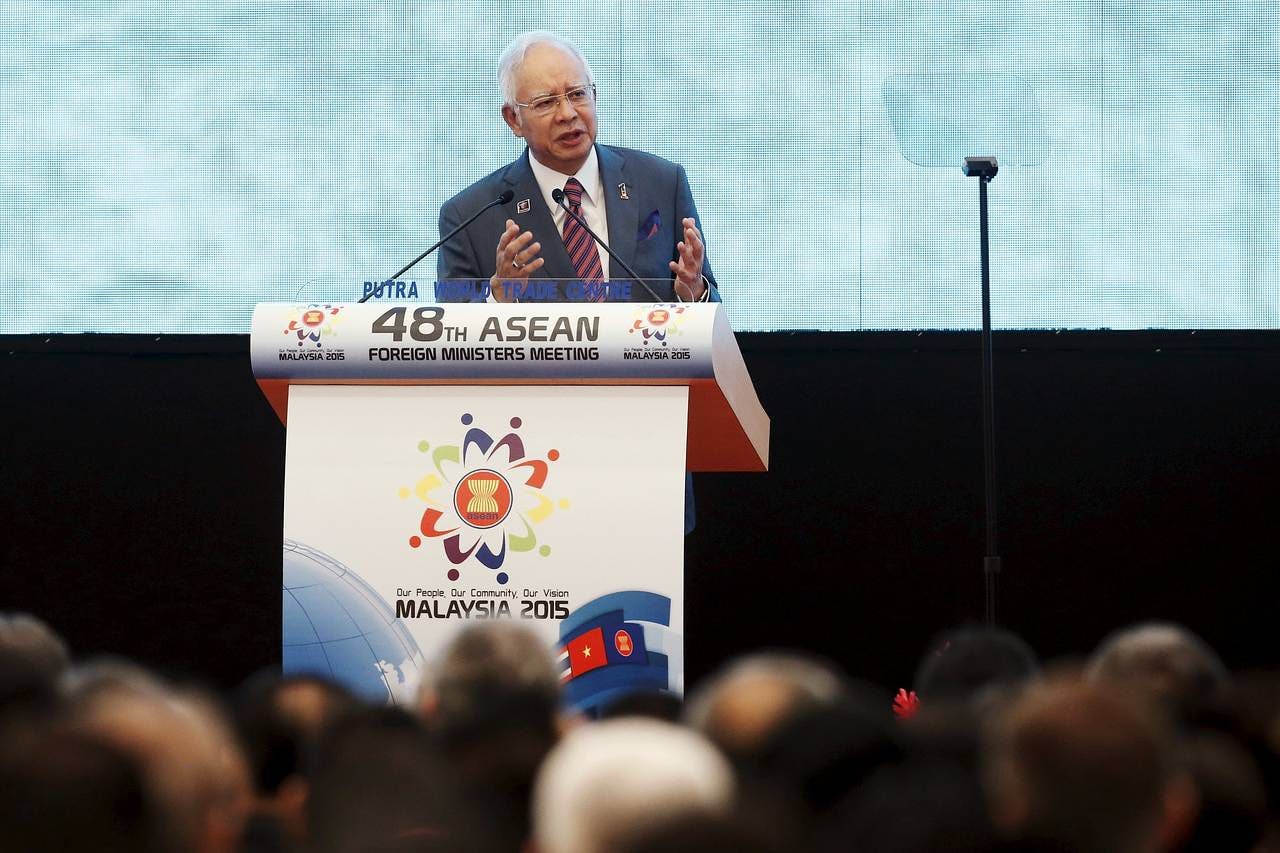 |
| Malaysian Prime Minister Najib Razak speaks at the 48th ASEAN Foreign Ministers' Meeting in Kuala Lumpur on August 4. Photo: Reuters |
Despite those somewhat "high-pitched" statements, Malaysian Foreign Minister Anifah Aman affirmed to his counterparts at these security talks on August 4th that the group of Southeast Asian nations "can and should play a crucial role in bringing about a peaceful resolution" to the South China Sea issue. He added: "Above all, we must address this issue peacefully and cooperatively. We have made a positive start, but we need to do more."
China has illegally claimed sovereignty over almost the entire South China Sea, a strategically important shipping lane. Beijing insists that disputes in this sea region must be resolved bilaterally with each directly involved party, not with a unified bloc. The Center for Strategic and International Studies (CSIS) says Beijing may be preparing to build a second runway on an artificial island in the area, potentially escalating tensions. According to the Washington-based think tank, China is already constructing a runway on Fiery Cross Reef, part of Vietnam's Spratly Islands.
In light of this situation, the US has called on China to cease building artificial islands in the South China Sea. Aware that the South China Sea issue is a "hot spot" dominating the discussions at this regional security forum, on August 5th, the US Secretary of State delivered a speech to foreign ministers from countries with whom the US shares the aspiration to resolve territorial disputes in the South China Sea through negotiations. Kerry stated: "We want to ensure the security of vital sea lanes and fishing grounds; we want to see disputes in the region resolved peacefully and on the basis of international law."
According to AFP, citing a senior US official, Secretary of State John Kerry had previously held a closed-door meeting with his Chinese counterpart Wang Yi and frankly discussed de-escalating tensions in the South China Sea. During this bilateral meeting, Kerry reportedly reaffirmed US concerns about escalating tensions and “China’s large-scale reclamation, construction, and militarization of features,” and “encouraged” China and other countries to “cease disruptive actions to create space for diplomacy.” Kerry also told ASEAN foreign ministers that his meeting with Wang Yi went “well” and expressed hope that within the framework of the two-day forum from August 5-6, the parties “will find ways to achieve effective progress together.”
However, China's Foreign Minister brazenly declared that all of Beijing's actions were within its own territory, and insisted that they would not discuss the issue in official forum meetings, arguing that conflicts and disagreements must be resolved on a bilateral basis. Even the Vice Foreign Minister told Reuters: "If the U.S. raises this issue, we will, of course, object. We hope they won't bring it up."
Frankly, Beijing's hopes will soon become hopeless, as has been the case annually since former US Secretary of State Hillary Clinton publicly raised the issue at the 2010 ARF summit. This year, Malaysia, as ASEAN Chair, has affirmed that it will include the South China Sea issue on the agenda. This is understandable, because, as the Singaporean Foreign Minister said: "The South China Sea is a problem. We cannot pretend there is no problem." While China will certainly oppose the proposal to discuss the South China Sea, ASEAN's standing shoulder to shoulder in demanding that China cease its illegal land reclamation activities in the South China Sea truly reflects the bloc's dissatisfaction with the slow progress in reaching a formal Code of Conduct with China (also known as the COC) to govern the actions of the parties in this sea region. And as the Singaporean Foreign Minister stressed, all parties need to move beyond the confines of philosophical discussions to address the reality of the agreement's nature.
ASEAN comprises 10 Southeast Asian countries: Brunei, Cambodia, Indonesia, Laos, Myanmar, Malaysia, the Philippines, Singapore, Thailand, and Vietnam. These countries are currently seeking deeper integration within the bloc as they prepare to become a common market by the end of this year. In this context, cooperation and solidarity on the South China Sea issue, in the face of China's unreasonable claims and illegal land reclamation and artificial island building activities, demonstrate the efforts towards the formal establishment of a common community in the near future.
Phu Binh
| RELATED NEWS |
|---|


