
Transform barren fields into golden harvests.
(Baonghean) - A few years ago, people in Hung Chau (Hung Nguyen) considered Mr. Nguyen Van Luu "eccentric" or "crazy" for taking on 40 acres of rice fields despite having no family support. Then there was the story of him using a tractor with a trailer to collect garbage throughout the hamlets, cleaning up the commune's environment without receiving any payment… which also caused much criticism. Now, Mr. Luu's large tractor has become a familiar sight in the Hung Chau rice fields. After work at the commune's People's Committee, he works tirelessly in the fields all night. Now, the people of Hung Chau speak of him with admiration: "Farming like Mr. Luu is so easy. He plows, harrows, harvests, sprays pesticides, threshes rice… all with a machine!"
Transform barren fields into golden harvests.
Visiting Hung Chau in the last days of the year, the atmosphere of preparing for the Lunar New Year is pervasive. Besides farming, the Catholic community here engages in many other occupations such as making candy, vermicelli, cakes, raising pigs, and trading. Hung Chau has the famous My Market, known throughout the region, offering a wide variety of products from the riverside. The market serves the communes of Hung Khanh, Hung Phuc, Hung Lam, Hung Chau, Hung Phu, Hung Loi, Hung Nhan, etc. With the booming trade, many households are involved in commerce, leading to the abandonment of farmland. At its peak in 2009, the area of abandoned farmland reached 5 acres. The district and commune authorities were concerned and tried to encourage farmers to cultivate it, but the people were uninterested due to low production efficiency and inadequate irrigation systems. Hung Chau commune even tried to get people from other communes to plow and cultivate the abandoned land, but they gave up after just one season.
Seeing this, Mr. Nguyen Van Luu, Deputy Secretary of the Party Committee of Hung Chau commune, volunteered to cultivate 4 acres (40 sao) of abandoned farmland belonging to the villagers. His family includes two grandchildren studying at university in Hanoi, his monthly salary as deputy secretary of the commune is only 3.3 million dong, and his wife is also a farmer. If he doesn't cultivate the land, how will they support their children's education? But deep down, he felt that land was precious, and leaving it fallow would only lead to criticism from his superiors. As a commune official and former Youth Union secretary, he was extremely worried. However, lacking labor, he thought the only solution was machinery. Borrowing from relatives and friends, in early 2012, he invested in a Japanese-made multi-purpose four-wheel tractor – the largest in the commune, capable of plowing, harrowing, pulling, and tilling alluvial soil – costing 60 million dong. This type of machine can easily traverse high embankments and small ditches.
After learning to drive, he took his huge tractor to the fields, and everyone was amazed, coming to watch him plow. In just a moment, the machine neatly plowed several acres of land, eliminating small embankments and leaving only continuous plots. During the day, he worked at the commune, and in the evenings and on his days off, he took advantage of the time to plow and harrow, even borrowing extra people to help with planting. In about four days, he finished his own plot of land, and he also took on extra work for anyone who hired him to plow to cover the cost of the machine and fuel. Racing against time to catch the water, he worked tirelessly until 1 or 2 in the morning. The work went smoothly; thanks to the well-plowed land, the rice grew abundantly. When it was time to harvest, he invested in a combine harvester, financed by a government support program for 23.5 million dong. He drove the machine, and the rice fell down on both sides like waves. There was so much golden rice, about 9 tons from 4 acres.
He was overjoyed with his success. Unable to bring it all home, he took advantage of the strong sun to thresh the rice and dry it right in the field. He then attached a trailer to his tractor and laboriously transported nearly ten tons of rice home. His house didn't have enough space to store the rice, so he had to leave it with relatives. After milling the rice, he earned nearly 30 million dong per harvest – a significant amount from his farming. In subsequent seasons, he invested in more machinery such as a pesticide sprayer and a water pump. He also invested 20 million dong to improve the irrigation system, bringing water from upstream to the rice fields in Hamlet 1 where he worked. Ms. Hoa Thi Tuyen, a farmer in Hamlet 1, who was working in the fields, smiled brightly when asked about Mr. Luu: “Thanks to Mr. Luu, many people in Hamlet 1 now have water for production. Mr. Luu built a dam upstream, retaining water for irrigation for the whole area. He's truly brilliant.”
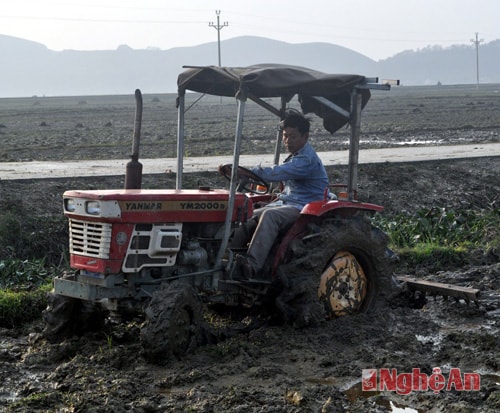 |
| Mr. Nguyen Van Luu is plowing his field in preparation for the new planting season. |
The simple, honest farmers in his hometown are very loyal and compassionate. Giving them a fish or some money is sometimes not as valuable as showing them how to do business, pointing out new and progressive things. Many people followed his lead and bought tractors to farm, learning from him how to plow and spray pesticides. His Hamlet 4 now has 4 more tractors. The whole of Hung Chau now has 28 tractors, mostly small ones, purchased in the last 3 years. He mobilizes each household to dredge canals and clear waterways; he helps transport rice for those who need it, and he's always willing to repair broken tractors. "Mr. Luu is truly talented; he knows how to repair any machine. Farming the way Mr. Luu does is so easy. He plows, harrows, harvests, sprays pesticides, threshes rice… everything with machines, and he's incredibly diligent and enthusiastic!" - Mr. Nguyen Dinh Chat, head of Hamlet 4, confided.
Leading us on a tour of his rice fields amidst the crisp late-winter breeze, he confided: “When growing rice, I focus on base fertilization, not top dressing. I prepare the land thoroughly and cover the seedlings with plastic sheeting. The seedlings need special attention to ensure the rice plants are healthy from the start. Sadly, in my hometown, farmers haven't paid enough attention to pest control. But my fields are always fully protected against diseases like rice planthoppers, blast, neck rot, and leaf-rolling caterpillars… The commune has also held two training sessions a year on cultivation techniques, but not many people attend. My rice harvest is also thanks to adequate investment: I apply 25 kg of NPK, 3 kg of potassium, and 1 kg of urea fertilizer per sao (approximately 1000 square meters), not to mention manure. Therefore, the commune is directing the Agricultural Committee and the Cooperative to do a good job of disseminating this information to the farmers.”
Rice farming brings him about 60 million VND per year. Previously, he also raised a dozen pigs, but now he lacks the strength, so he gives the by-products to relatives and neighbors. At a committee meeting, he stood up and said, “I farm, and after deducting expenses, I still make a 50% profit – that’s a profit margin not every profession can achieve.” Everyone was amazed and impressed. That’s right, everyone knows that, but not everyone can do it… Along with the Party Committee and the People’s Committee, in his capacity as deputy secretary of the Party Committee, he contributed to directing the closed-loop rice cultivation, proposing state investment, dredging canals, instructing farmers not to sow seeds to save water, and converting inefficient rice fields to aquaculture. Thanks to this, Hung Chau has significantly reduced the area of abandoned rice fields, and rice cultivation is now closed-loop, yielding two crops a year with a productivity of 6.2 tons/ha.
In the commune, besides Mr. Luu, there are also Mr. Nguyen Van Thuan (Hamlet 4) cultivating 1.6 acres, Mr. Le Van Thanh (Hamlet 1) cultivating 2.4 acres, Mr. Nguyen Van Trieu (Hamlet 1) with 1.5 acres, and also raising aquatic animals… their economic situation has improved compared to other households. Seeing Mr. Luu's work, the villagers only wish they had more capital to invest in buying plows and harvesters to reduce labor. From people like Mr. Luu, Mr. Thuan, Mr. Thanh… on this land, I realize that land needs to be consolidated, needs large-scale production, and needs capital so that land remains "golden land," and the leadership and vision of the person in charge are very important.
Beautifying the village
Mr. Luu is also famous throughout the district for his position as the head of the garbage collection team, being the first person to think about the environment in the commune. Hung Chau commune has 4,000 inhabitants, My Market which is a trading hub for 6 surrounding communes, Lam Thanh Secondary School with over 500 students, Pham Hong Thai High School with over 1,000 students, a tourist road along the Lam River running through it, and many shops and restaurants. The amount of waste generated is enormous, and for many years the locality has been struggling to deal with the accumulated waste, which then multiplies, causing unsightly conditions and affecting the lives of the people. Even the canals are flooded with garbage whenever irrigation water is pumped, making it impossible for anyone to use the water for their fields because they have to "receive" the garbage as well. After many sleepless nights, at the annual meeting of officials and civil servants, Mr. Luu boldly presented his solution.
His plan was to pilot the project from Hamlet 1 to Hamlet 4. He advised the commune to establish a waste collection team, with himself as the team leader, Mr. Le Van Quang, a cultural officer, as the deputy leader, and Mr. Le Minh Quang, a member of the Commune Youth Union Standing Committee, as a team member. With strong support from the commune, he developed the initial proposal. The commune provided each waste collection team with 300,000 VND and 300,000 VND for fuel for the vehicles transporting waste from the hamlets to the collection point, and contracted with Vinh Urban Environment Company to collect and transport it to the city's landfill. Mr. Luu, who owned his own vehicle, personally collected the waste without receiving any payment. Waste collection was not simple, as the amount of waste was enormous; each hamlet had to have a collection team gather the waste in one place for Mr. Luu's vehicles to transport it to the collection point. He recalled: "Having clearly understood that everything must have the leadership of the Party and the consensus of the people, I suggested that the Party branches organize meetings to enlist the leadership of the Party branches, and hold neighborhood meetings to disseminate information about the responsibilities and benefits of waste collection."
"In a short period, I attended 8 meetings, including 4 Party branch meetings and 4 village meetings. I was very pleased that Party members and the people all agreed to refrain from littering and instead collected garbage at home, waiting until the designated day to bring it out to the street for the collection team." On the first Saturday and Sunday of the campaign (March 2013), over 600 people were mobilized to collect accumulated garbage throughout the commune, from embankments, pond banks, and alleyways, to the collection point. He had to transport 16 truckloads of garbage, totaling 32 cubic meters, to the location for the sanitation company to transport to Vinh. He returned home exhausted but happy because the next day all four villages were spotlessly clean, and everyone felt a new, fresh, and cool atmosphere.
In the following months, garbage collection became much easier because there was no more accumulated waste. For three consecutive months, the environment in all four hamlets (hamlets 1, 2, 3, and 4) was clean and tidy. Garbage was no longer scattered everywhere as before, the grass on the embankment was greener, the cows grazed more freely, and the ducks and geese swam in the ponds more peacefully. Not content with these results, he continued to ponder expanding the model to the entire commune, but who would replace him? And he couldn't keep collecting garbage forever. After seeing the improved hygiene awareness among the villagers, he advised the commune Party Committee and People's Committee that a resolution was needed to thoroughly address the environmental sanitation issue in the commune.
This involves mobilizing the people's resources, requiring residents to pay environmental sanitation service fees to garbage collectors and urban sanitation companies as stipulated by the province, while also creating jobs for disadvantaged households. To date, the commune has passed a resolution on collecting a sanitation fee of 3,000 VND/person/month and has contracted with Vinh Urban Environmental Sanitation Company to collect waste for the entire commune. Hung Chau has successfully solved the environmental sanitation waste problem, one of the difficult criteria in implementing the New Rural Development program. He has been praised by Hung Chau commune and Hung Nguyen district as a model example of studying and following the moral example of Ho Chi Minh. Born in 1967, he is now 47 years old, but Mr. Luu drives his tractor swiftly through the fields overflowing with the colors of spring, preparing for a new production season; many say he looks younger than his age. It seems that he still possesses the "fire" of a former grassroots Youth Union official, now further fueled by his commitment to Party work. These two factors create a synergy that motivates him to take the lead, undertake difficult tasks, and set an example for others to follow...
Text and photos:Chau Lan


