
Symbols and landmarks of Nghe An province on the nine bronze cauldrons.
The Nine Bronze Tripods, cast during the reign of Emperor Minh Mạng, are placed in front of the Thế Miếu (Ancestral Temple) in the Huế Imperial Citadel. Engraved on the tripods are numerous symbolic images representing various regions from North to South Vietnam, forming a vivid picture of a unified and prosperous Vietnam under the Nguyễn dynasty, including symbols and images of Nghệ An province.
(Baonghean)The Nine Bronze Tripods, cast during the reign of Emperor Minh Mạng, are placed in front of the Thế Miếu (Ancestral Temple) in the Huế Imperial Citadel. Engraved on the tripods are numerous symbolic images representing various regions from North to South Vietnam, forming a vivid picture of a unified and prosperous Vietnam under the Nguyễn dynasty, including symbols and images of Nghệ An province.
The nine bronze cauldrons feature numerous different groups of symbolic motifs, arranged into nine categories depicting rivers, mountains, clouds, wind, flowers, plants, fruits, and mythical creatures—characteristic of various regions across the country, totaling 153 carved images. These vibrant motifs are the soul and essence of the nine cauldrons. Among these groups of imagery, two stand out: nine high mountains and nine major rivers, representative of the country. Just as Thanh Hoa province has Thien Ton Mountain and Ma River, and Quang Binh province has Hoanh Son and Gianh River, we are honored to have the image of Hong Mountain and Lam River—sacred symbols of Nghe An province.
Mount Hong is inscribed on Anh Dinh peak. Also known as Ngan Hong, Ru Hoong, or Hong Linh, it is the highest and most famous mountain in Nghe An province. The mountain is located between Hong Linh town and the two districts of Nghi Xuan and Can Loc (Ha Tinh province). The Hong mountain range runs from Tra mountain down to the east, with a wide, high, and majestic shape. Viewed from the south, the mountain range resembles a Hong bird spreading its wings, hence the name Hong Linh (Red Mountain). The mountain is surrounded by the Lam and Hoang rivers, and controlled by the Hoi and Sot estuaries.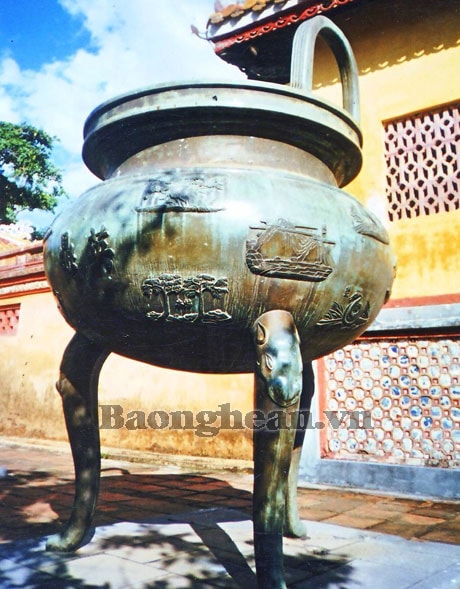
The incense burner is engraved with an image of Hong Mountain in Nghe An province.
In the 17th year of Minh Mạng's reign, after the nine bronze cauldrons were cast, the king ordered the image of Hồng Lĩnh Mountain to be engraved on the Anh cauldron. On the Giáp Thân day, in the second month of the Nhâm Dần year, the second year of Thiệu Trị's reign, during a tour to the North to receive a royal decree, the king sailed from the Đại Nại River past Hồng Lĩnh Mountain and summoned the provincial official Vũ Đức Nhu to inquire about this scenic spot. The king then composed a poem in praise of it and had it engraved on a stele erected at the foot of the mountain. Later, this poem was recorded in the Thánh Chế thi tập (Collection of Sacred Poems).
The Lam River is depicted on the Tuyen Dinh monument. The river also has many other names such as Rum River, Ca River, Thanh Long River, etc., and is the largest river in Nghe An province. It has two major sources: the Hieu source and the Tuong source. The Hieu source originates from Thanh Dong in Quy Chau district, while the Tuong source originates from a rocky waterfall in Tra Lan district. When the two sources merge into a main channel, it continues flowing through the districts of Do Luong, Thanh Chuong, and Nam Dan, down to Dung Quyet (Vinh City), then loops around Duc Tho and Nghi Xuan before flowing into the Cua Hoi sea. Along its journey towards the East Sea, it is joined by smaller rivers, forming a large river with a system of tributaries that runs through most districts of Nghe An province and some districts of Ha Tinh province.
In the 17th year of Minh Mạng's reign (1836), the king had the image of the Lam River engraved on the Tuyên đỉnh (a type of bronze cauldron). By the 3rd year of Tự Đức's reign (1850), the Lam River was ranked among the country's major rivers and was included in dictionaries; a grand ceremony to worship the river god was held annually.
Besides Hong Mountain and Lam River, Nghe An province also boasts several other famous landmarks inscribed on the Nine Dynastic Urns. While these landmarks are not native to Nghe An, the province is renowned for its distinctive features. The Cao Urn features an image of an agarwood tree, a species abundant in the mountainous regions of Nghe An, Ha Tinh, and extending to the South Central region. Similarly, the Nhan Urn depicts a peacock, known colloquially as Cong (or Cuong). This bird is common in Go Cong, Tien Giang province, Tu Bong, Khanh Hoa province, and other provinces in the South Central region. In Nghe An, there is the Cuong Temple, dedicated to King Thuc Phan, located on Mo Da Mountain in Dien Chau district. Legend says that Mo Da Mountain used to have many peacocks, which later became known locally as Cuong. Con Cuong district is also said to have been home to many peacocks, hence its name.
The Nine Tripods are national treasures, cultural heritage of multifaceted value, and symbols of a prosperous and unified Vietnam under the Nguyen dynasty. Through the motifs of rivers, mountains, and famous landmarks of Nghe An province depicted on the Nine Tripods, we gain a clearer understanding of the position and image of Nghe An in the heart of the country.
Tran Tu Quang (Nghe An Provincial Library)


