
Sunrise over Huoi Co
(Baonghean) - The elders in Huoi Co village say that no one in the village has ever seen the sunrise. Since the people of Huoi Co settled on the summit of Pha Danh mountain, the village has been shrouded in clouds. The sun only appears on the baskets of corn and cassava in the late afternoon, when the villagers return from their fields. The lives of the Hmong people in Huoi Co have been so monotonous for generations… Until one day, the children came down from the mountain and brought literacy back to the village. The people of Huoi Co realized that this too was the light, the sunrise of Huoi Co village.
After crossing five mountains and walking for more than half a day, the people of Huồi Cọ reached the center of Nhôn Mai commune (Tương Dương district). Along this trail, only ancient trees witnessed the footsteps of the Hmong father and son, Và Chia Chư and Và Bá Tủa, half a lifetime ago. Now, Và Bá Tủa has become a doctor at the Nhôn Mai Health Station, but every time he returns to the village to visit relatives, the ancient ban trees draw him back to old memories.
In those days, the people of Huồi Cọ were so poor that each child in the village only had one set of clothes. When bathing, they had to wander naked in the fields with the adults. When they reached the age where their hands could lift a machete, they officially joined their parents in labor. Life continued like that, day after day, month after month, year after year. Almost all contact with the outside community was cut off by the Phà Đánh mountain range and the long, arduous journey. Poverty forced the elderly and young, men and women, to work tirelessly in the mountains and forests year-round, struggling to make ends meet. But how could they be well-fed when the land for farming was drying up and wild animals were escaping into the deep forest? During the lean months, when rice was scarce, the Hmong people of Huồi Cọ had to eat corn and other grains to survive… Hunger and poverty seemed to permeate the very fabric of the entire community. Why is it that our people, living closest to the sky, still suffer from hunger and poverty? The elders in Huồi Cọ say it's because of the evil spirits hiding beneath the clouds on the summit of Phà Đánh. Because the people of Huồi Cọ rarely see sunlight.
One day, a man from the village climbed mountains, crossed streams, and trekked through forests all the way to the distant town of Hoa Binh (Tuong Duong). That man was Va Chia Chu. Upon reaching the lowlands and the town, Va Chia Chu noticed that the people there were wealthier than the Mong people in Huoi Co; they ate better food and wore nicer clothes. Curious, he learned that it was thanks to literacy. He didn't know what literacy was, but if it could buy rice for his family and his villagers, he had to find it. So, Va Chia Chu, with the help of his son Va Ba Tua, traveled for four days, from Huoi Co to Nhon Mai and then to Hoa Binh, to the school, asking the teachers to let his son learn to read and write. And Chia Chu confided: “The teachers also loved and cared for Ba Tua very much. Later, they sent him to study in the province, and he became a doctor. Now life is different from before. Ba Tua is no longer poor, and the people of Huoi Co village are also different from before. We are very happy.”
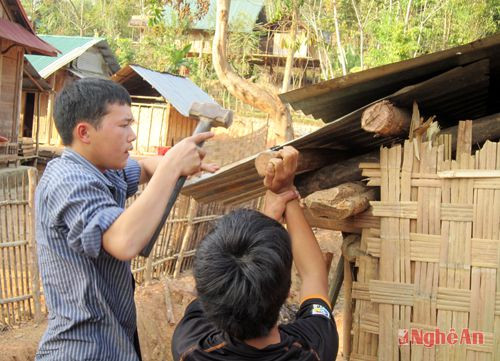 |
| Students at Huoi Co village junior high school have set up temporary shelters to live in while studying. |
And Bá Tủa became a doctor after more than 16 years of searching for literacy. He used literacy and knowledge to treat the Hmong people, and he was more skilled at driving out evil spirits from patients than even the shamans. Bá Tủa being more skilled than the shamans certainly made the villagers reconsider their beliefs. Sixteen years of learning to read and write was a long time, but now that Bá Tủa was literate, his parents built a new house, raised more buffalo and cattle, and his children had more clothes than the other villagers. So, one or two people in the village asked Bá Tủa how he learned to read and write.
The story of Tin and Ba Tua going to school and becoming successful spread among the Hmong people in Huoi Co. The Va family was overjoyed, everyone proud because no one in the villages above or below had achieved such success. The Hmong children began to aspire to be like Tua. The adults in Huoi Co thought: Learning takes time and effort, but we must educate our children, we must send them to school to change our lives, otherwise they will suffer like their parents. The people of Huoi Co went into the forest to collect wood to build classrooms and schools, welcoming teachers to the village to teach literacy. The number of children attending school increased steadily. During the day, the children studied, and at night, the adults lit lamps to teach literacy. Determined not to be left behind by the children, the adults also had to learn. Sometimes the teacher taught the class, sometimes the border guards stationed in the village participated in teaching the villagers. Learning to read and write was harder than wielding a machete to clear the fields, harder than using a bow and arrow to shoot wild animals, but everyone felt happy. Not learning to read and write, not knowing the common language, was very shameful.
Now, the State has opened up more roads, making travel easier than before. Many examples of people determined to learn to read and write have emerged in Huoi Co village. The village head of Huoi Co, Mr. Va Khua Do, is one such example. Now, with literacy, his family's life has changed. Following the Party branch's thematic resolution, Khua Do and the other Party members continue to focus on promoting the education of Huoi Co children. The village head always considers the education of the children his top priority. Ten years ago, he himself overcame his own insecurities to bring his two children to study at Nhon Mai Primary and Secondary School. It is rare to find a Hmong person as eager to learn to read and write as he is. And Khua Do, smiling, shared: “I feel ashamed, but if they let me into the class, I'll just go. I'm learning to read and write for myself, not for them, so no matter how much they scold me, I have to go to class to learn to read and write, to educate my local community, to know how to make a living and work in my locality. If I don't learn enough, I won't be able to do anything.” This is not only the saying of the exemplary village headman, Khua Do, but also the thinking of the households living in this poor village, perpetually shrouded in clouds on the summit of Pha Danh. Therefore, for the Hmong students in Huoi Co today, after finishing primary school, they pack their bags and head down to the commune center to continue their secondary education. And as if understanding the hearts of the adults, despite the long and arduous journey, despite their families' poverty, they persevere in attending school. On weekends, groups of secondary school students return to visit their village, and on Monday mornings, people see them descending the mountain slopes, eagerly carrying sacks of rice and bundles of upland vegetables. All of those things encapsulate dreams for the life ahead.
Now, the school buildings are much more spacious than before. Ethnic minority students attending Nhon Mai Ethnic Minority Boarding High School have much better learning conditions than their parents' generation, who lived in thatched huts. However, compared to the living and learning conditions of students in the lowlands, they probably never dared to dream of such a better future. By the flickering fire each morning, the Hmong students in Huoi Co huddle together to cook rice and enjoy their familiar meal of white rice with water and salt. This shows just how extraordinary their efforts are. In their journey to acquire knowledge, the students of Huoi Co have written miracles for Nhon Mai Ethnic Minority Boarding High School. Just last year, two 9th-grade female students from Huoi Co village surpassed tens of thousands of students in the same grade throughout the province to compete in Geography in Vinh City with hundreds of top students from Nghe An province. That is And Y Di and And Y May.
Also on their journey to school, many students in Huoi Co have traveled to the town or city to continue their high school education. They walk for half a day and travel by boat and bus for the other half. Their lives are not only difficult because of the hundreds of kilometers they travel from home to school. Interacting with classmates from other ethnic groups, especially the Kinh people, puts them at a disadvantage in every way. From living conditions and upbringing to their upbringing, Hmong students are always the most disadvantaged. But perhaps no one has a greater determination than these students. Therefore, despite living and studying in a new environment, Huoi Co students still achieve many good academic results. Understanding the hardships and difficulties their parents face in raising and educating them, Huoi Co students are always diligent, hardworking, and very confident.
The adults in Huoi Co village understand their children's dreams and determination, so they have devoted all their efforts and sweat to raising and educating them. The arduous journeys into the forest and the burden of carrying firewood have kept them poor for a lifetime. Now, the entire village will be free from hunger and poverty if each person makes a little more effort. The reality in Huoi Co proves that only through education can the Hmong people escape poverty. That's why, in the village, like the Va Chia Xa family, despite the couple working tirelessly year-round, their children have excelled in their studies. Currently, their two eldest children are attending university.
All 114 students of school age in Huoi Co village have attended school. Among them, 10 are currently studying at university, and 4 are attending vocational colleges and high schools. For a village with only 42 households and over 290 inhabitants, this number is perhaps the clearest evidence of the Hmong people in Huoi Co's exceptional thirst for knowledge and their extraordinary ability to overcome hardship. Adults go without food and clothing, selling buffaloes, cows, chickens, and pigs to raise money for their children's education. The entire village has established a scholarship fund to support and assist poor students. Any family in the village with children who excel in their studies receives support from the entire community. Huoi Co village has become a model Hmong village in Nghe An province for its movement to promote education and talent. According to Mr. Anh Va Gia Xua, Secretary of the Party Branch of Huoi Co village, in the 2014 school year, two students from the village took the university entrance exam, and this year there are three. Currently, the whole village is waiting for good news. Mr. Kha Duong Tien, Secretary of the Party Committee of Nhon Mai commune, said that the people of Huoi Co village have built a very good learning movement. Families set a good example for each other, and students also compete in their studies. "This is truly something to be proud of."
However, countless difficulties remain for the people of Huoi Co in pursuing their aspirations to attend school. Due to extremely difficult circumstances, many Huoi Co students have had to drop out of university. A Huoi Co village official said that some children from Huoi Co have dropped out of school to work in the fields. Even his son, Va Ba Co, who was in his third year studying Literature at Vinh University, had to drop out midway because of the family's extreme hardship. This is a matter that deserves attention and assistance from relevant departments and agencies.


