
Removing the minimum entrance score makes it difficult for vocational schools to recruit enough students to meet their quotas.
(Baonghean)Abolishing the minimum entrance exam score is predicted to be a "key" for private universities and lower-ranked institutions. However, it will be a "bottleneck" for colleges, vocational schools, and training centers, given the current widespread competition to get into university…
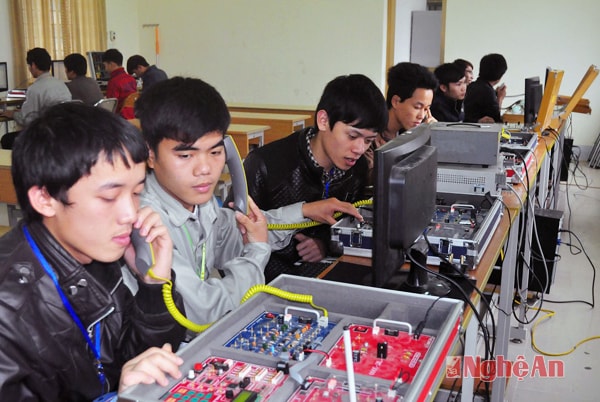 |
| Students from the Faculty of Electronics and Telecommunications, Vinh University of Technology, during a practical session. |
Difficulty in recruiting enough people to meet the target number.
Anxiety and apprehension are common feelings among many universities, colleges, and vocational schools in the province as the entrance exams for the 2013-2014 academic year approach. The biggest concern remains student recruitment.
According to a summary by the Department of Labor, War Invalids and Social Affairs, during the 2013-2014 enrollment period, many vocational schools and departments failed to recruit students. Specifically, these included: metal cutting (Vocational College No. 4), business accounting (Vietnam-Korea Industrial Technical Vocational College), animal husbandry and veterinary medicine, and plant protection (Technical and Economic - Handicraft School). Similarly, some vocational schools under district administration, such as agricultural machinery technology, refrigeration and air conditioning technology (Do Luong Economic and Technical Vocational College), industrial sewing, tourism and hotel management, and flower cultivation technology (Nghi Loc Economic and Technical Vocational College), also failed to recruit students.
In some cases, vocational schools and centers have 3 to 4 vocational fields that fail to recruit any students, such as the Vocational Training and Farmer Support Center and the Vietnam-Australia Professional Vocational College. According to Ms. Ho Thi Chau Loan, Head of the Vocational Training Department of the Department of Labor, War Invalids and Social Affairs, the reason for the difficulties in student recruitment at vocational schools is: A segment of students are not truly interested in vocational training and lack a serious attitude towards choosing vocational training as a path to self-reliance and career development. Students often choose light, office-based jobs and rarely opt for technical, manual, or strenuous professions. Therefore, some vocational training institutions struggle to recruit students. Some vocational schools have low training quality, a shortage of qualified vocational teachers, and training programs that are slow to innovate and do not meet the requirements of technological and technical modernization, leading to some vocational schools being unable to recruit enough students.
Furthermore, the proliferation of universities and colleges, low admission scores, and ever-increasing enrollment quotas have attracted a large number of students to pursue higher education. The Ministry of Education and Training's regulation extending the 2013 university and college admission deadline to October 30th has also created difficulties in vocational training admissions, as a large number of candidates are awaiting their university and college admission results.
With the removal of the minimum university entrance score, the opportunities for students to enter university will expand, while conversely, the enrollment pool for vocational colleges and secondary vocational schools is shrinking. Despite having relatively modern facilities, a large scale, and many years of experience in vocational training, Mr. Nguyen Xuan Phuong, the principal of the Nghe An Small-Scale Handicraft Vocational School, still expresses concern. Last year, the school only registered for 360 places in the secondary vocational program and fortunately managed to recruit enough students.
To achieve this result, for many months, school staff and employees had to actively go to the grassroots level, campaigning at each school and each family. Yet, two vocational programs still failed to recruit enough students. Anticipating these difficulties, in early March this year, the school organized its first large-scale recruitment conference, inviting over 100 principals from secondary and high schools in the area to attend. The purpose was to show the delegates the scale and investment of the school, thereby increasing its influence at the grassroots level. Although the outcome remains uncertain, Mr. Nguyen Xuan Phuong believes that: To survive, schools cannot rely on mechanisms; first and foremost, they must take care of themselves, and that is fair competition. Schools with higher quality and better facilities will certainly find it easier to recruit students.
Nghe An Teacher Training College is also facing difficulties in the enrollment process. In an interview with us, Mr. Dang Khac Thang, the school's principal, stated: "The school's target is over 2,000 students (across all programs), but we have never managed to recruit enough students. This year, enrollment will certainly not be easy, especially for early childhood education and physical education programs. While these programs still recruit students through entrance exams, another university in the area is using academic transcripts for admission."
Building trust
In this situation, the only way forward for Nghe An Teacher Training College is to improve the quality of training, enhance the quality of teachers, revise the curriculum, provide practical skills training for students, and diversify training programs. In addition, to ensure enrollment in the coming years, the college has also conducted surveys on teacher needs from education departments, aiming to establish enrollment targets and open programs that closely match local needs.
In the lower group, the Anh Son Vocational Training Center, after surveying and analyzing the vocational training situation in the district over the past years and learning that in the last 10 years the district had only trained over 300 people at the intermediate level and over 1,500 at the basic level, proceeded to develop a long-term vocational training strategy. The Center directly went to communes and schools to recruit students. In particular, the district organized a conference on vocational training and assigned specific responsibilities to each sector, with the education sector specifically tasked with effectively guiding students after graduating from high school or junior high school. The goal is to have at least 30% of students after graduating from junior high school or high school participate in vocational training to establish their careers – said Mr. Nguyen Trong Son, Director of the district's Vocational Training Center.
These actions demonstrate that instead of being passive, schools have become more proactive in student recruitment, diversifying their methods of promotion and career guidance. Some vocational colleges and secondary vocational schools, focusing on key vocational training programs at international, ASEAN, and national levels, have invested in modern facilities and equipment; improved the quality of teacher recruitment and training; and regularly updated and supplemented new technologies into their training curricula to enhance the quality of vocational education. Regarding the Department of Labor, War Invalids and Social Affairs, in the process of planning student recruitment for vocational colleges, secondary vocational schools, and vocational training centers in 2014-2015, careful consideration was given to "the training results of the schools, the capacity of vocational training institutions, the trends of businesses, and the needs of society to allocate quotas and funding" – Ms. Ho Thi Chau Loan, Head of the Vocational Training Department, stated this in relation to the quota development for this year.
It is crucial for candidates and parents to assess their own abilities, understand their children's strengths and weaknesses, and base their guidance on the family's financial capabilities to ensure their children follow the right path. Schools should also view the Ministry of Education and Training's decision to abolish the minimum entrance score as a "test" to evaluate the quality of education. The competition will be fair if all schools prioritize the quality of student recruitment, education, and graduate outcomes. Otherwise, they will lose their way after a few years if they chase quotas and profits while forgetting their primary mission: what to train and for what purpose.
My Ha


