
The Minister shares his thoughts on reforming education.
Throughout the nearly 90-minute conversation, the head of education consistently emphasized the power of collective action to find the most "beneficial" solutions for students... He avoided any questions that he felt would be misinterpreted as "the Minister trying to polish his own image."
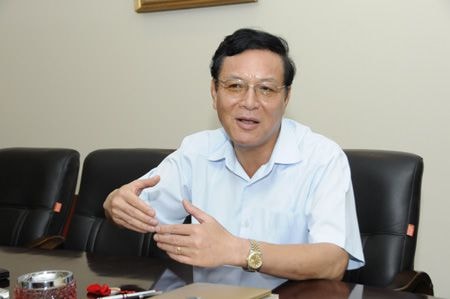
“Up to this point, we have carried out three reforms – innovations in the education process. It can be said that the previous reforms did not touch the methods but only increased or decreased the amount of knowledge… Therefore, it can be summarized that the amount of knowledge crammed in was much greater. But there is also an objective reason: the development of human knowledge…” – Minister of Education and Training Pham Vu Luan summarized.
 |
However, according to Mr. Luan, this fundamental reform not only touches upon knowledge but also upon the approach, methods, and techniques. "In terms of Marxist-Leninist principles, it's not about what you produce, but how you produce it." And in scientific terms, it's about "shifting from a one-way method of knowledge transmission to developing skills and competencies."
And this change has brought about a change in philosophy. “It’s because the development of students follows a path to becoming good workers – not a philosophy of simply equipping them with a lot of knowledge, not of memorizing a lot of knowledge and then repeating what they’ve learned to be considered excellent.”
Previously, we focused on teaching children how to learn, but now we focus on how to empower them to learn independently, and gradually develop their own research skills to address the challenges of lifelong learning.
"To implement that change, we must change our mindset. We should retain what is advantageous and discard what is outdated. With new things introduced, we must also have a new approach to select what is truly suitable," Mr. Luan analyzed.
Another approach
"When creating a new curriculum, if teachers bring in old ideas and point out what's missing, what subjects are missing, what subjects need to be included, then that's outdated thinking. Now, the overarching question is: what do we need to develop the children's abilities? This reform process will, of course, still build upon what we've learned; it's not about completely erasing everything to start from scratch. Instead, it's about building upon what we've learned, but not exactly the same as before."
To illustrate this point, Mr. Luan cited the reform of this year's exam. "If we look at the details, local exam centers are organized every year, and the university entrance exam centers have been operating for 14 years now. But previously, we followed a different approach. Now, we're building upon that but within a new system, with a new approach and a new arrangement to achieve different goals. If we were to start everything from scratch, it wouldn't work, so we still have to draw on the experience and expertise of our colleagues."
Returning to Circular 30, Mr. Luan posed a question and then answered it himself: "Is this assessment method new? Certainly not, because previously, the beginning of the test paper had the score on one side and the teacher's comments on the other. And a test with a score of 9 still included the teacher's comments next to it..."
"I reiterate that to show that there is nothing new in Circular 30, but rather a return to the good old practices, placed within a new system."
The core of Circular 30 is not to categorize games into category 2 or category 3; our focus is on caring for, encouraging, and guiding each child individually, so that they can surpass themselves and move towards the right path.
In that sense, it's about returning to the old ways in order to achieve the goal of innovation.
And evaluating teachers means evaluating the progress of their students. Teachers who teach students to win international awards are something to be very proud of. But teachers who help weak or underperforming students become average or above average are equally great. It's not about using standards to measure, but about evaluating the growth and progress of the students to assess the teacher's contribution. This is about changing the job, changing the way of doing things, changing the approach, but also changing the mindset.”
"I see that the people trust me."
Answering the question, "How do you assess the changes in society following the industry's innovations?", Mr. Luan frankly stated: "The change in social awareness surprised me. I thought it would be even more difficult. The awareness of Resolution 29 within the industry and society has come into effect faster than I predicted."
"Many citizens and parents have emailed me, reflecting on what they've heard about negative issues... All of those reflections may or may not be true, but when I receive emails like that, I feel that they trust me."
"There are also opinions that contradict what the industry is doing, but I don't delve too deeply into the debates; instead, I always listen and absorb. It might not be incorporated into any specific area, but it becomes ingrained in my understanding."
Mr. Luan recalled: "When working with Professor Hoang Tuy, I also raised the issue, 'I will listen to what you say, but please don't blame me if I can't apply it immediately. Because there are things I can do according to your advice, but there are things I can't. However, your opinions will sink into my understanding...' And Professor Hoang Tuy replied, 'I believe what you say, but I don't believe you if you promise to do everything.'"
My personal approach can be summarized in a few words: "All for the students. For the development and formation of students' qualities and abilities on their journey to becoming well-rounded individuals."
A major change
Mr. Luan stated that when authors of curricula and textbooks want to include a lesson, they must be able to explain how that lesson stimulates student development and what its limitations are.
Overall, the new program represents a clear shift from one-way knowledge transmission to competency development.
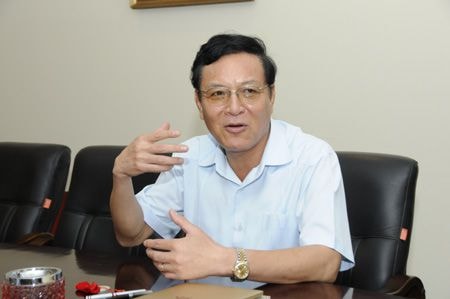 |
Mr. Luan gave an example: "Previously, people considered teaching Math, Physics, and Chemistry as core subjects, while singing and extracurricular activities were considered extracurricular. Teachers of Literature and Math were considered top-tier, while physical education teachers were considered inferior. In the new curriculum, those 'minor subjects' are also core subjects. Experiential activities are no longer considered extracurricular but are now considered core subjects."
“Previously, Math required many hours because it's a science, Literature required many hours because it's about people. History was also a subject of debate because without history there is no development, and Geography is also important because without it, the children wouldn't understand about the sea and islands... All of that is true, but those debates were based on the importance of science subjects, not on the students' interests.” Mr. Luan emphasized, “I use the children's best interests as the criterion for what to teach them, not the importance of science subjects.”
However, according to Mr. Luan, changes that serve the interests of students will follow a roadmap and a designed plan, rather than developing freely.
"Therefore, in the new school year, the entire education sector needs a more significant and noticeable change in teaching and learning methods," Mr. Luan expressed his wish.
According to Vietnamnet.vn


