
Minister of Health: Chickenpox vaccine will be available in another month.
Chickenpox is not yet included in the national immunization program, and it will be about another month before the chickenpox vaccine arrives in Vietnam.
This information was provided by Minister of Health Nguyen Thi Kim Tien in the program "People Ask - Minister Answers" broadcast on VTV on the evening of June 22nd.
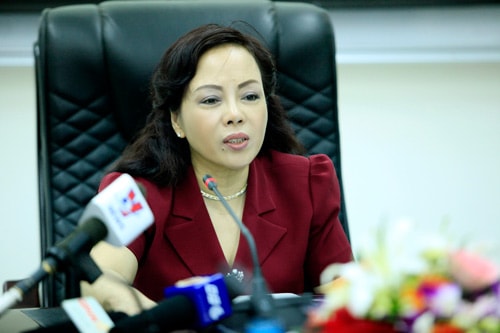 |
| Minister Nguyen Thi Kim Tien |
A local resident said:I have young children and often have to buy medicine when they are sick, but I find that the price of medicine in Vietnam is higher than in other countries in the region. Could the Minister please confirm if this assessment is correct? Furthermore, I've noticed that medicine prices have been rising significantly recently. Could the Minister please provide an update on the current situation regarding medicine prices and the pharmaceutical market?
Minister Nguyen Thi Kim Tien:Surveys conducted by an inter-ministerial team (including the Ministry of Health, the Ministry of Planning and Investment, the Ministry of Finance, and the National Assembly's Committee on Social Affairs) on 36 commonly used medicines found that our prices are 1.5-2 times lower than those in China and 2.5-3 times lower than those in Thailand.
The Institute of Health Strategy and Policy, together with business associations, surveyed approximately 3,000 items using the World Health Organization's methodology. They found that in recent years, the rate of price increases for domestically produced medicines has been very low, while the average increase for branded medicines imported from abroad has been moderate. For medicines covered by health insurance, we have implemented a very strict bidding process to minimize drug prices.
While medicines sold at independent pharmacies are subject to market regulations, the inter-ministerial committee (comprising the Ministry of Finance, the Ministry of Health, and the Ministry of Industry and Trade) has coordinated to establish maximum and minimum price frameworks for medicines.
Those pharmacies must publicly display their prices, and any that sell above the set price will be penalized. For drugs sold in hospital pharmacies that are not covered by health insurance, the maximum profit margin is limited to 5-15%.
Recently, the Ministries of Health and Finance have issued new regulations on drug bidding, which have helped reduce drug prices by 20-30%. However, there are many doubts about whether the quality of drugs can be guaranteed with such reduced winning bid prices. What is the Minister's opinion on this matter?
Minister Nguyen Thi Kim Tien: Two years ago, the inter-ministerial committee issued a Circular on bidding and tender documents, and subsequently adjusted Circulars 36 and 37 to address the issue of potential price increases during the bidding process and to prevent a decline in drug quality if low prices are offered in the bidding.
This circular has divided drugs into smaller groups, for example: the group meeting European GMP standards is further divided for developed countries such as the US, UK, France, Australia, Japan, etc.; the group meeting World Health Organization GMP standards is for other countries; traditional medicine and herbal medicines are divided into groups based on whether the factories meet GMP standards or not; and drugs are grouped according to their raw materials.
On the other hand, we have to rely on the hospital's drug selection committee. Drugs that don't necessarily need to be imported can be tendered according to such principles.
As a result, for the first time in many years since the Health Insurance Law was enacted, the portion of drug costs covered by health insurance decreased by 20-30%; the proportion of domestically produced drugs doubled, and people, including those in remote, impoverished areas, still have access to quality and affordable medicines.
Many argue that drug price bidding only applies to relatively common drugs that people frequently use, such as antibiotics, while many specialized and proprietary drugs are not included in the bidding list. Could the Minister please clarify this question?
Minister Nguyen Thi Kim Tien:Substandard drugs are certainly eliminated during the registration process. The process also excludes expensive, branded drugs from the list of drugs covered by health insurance, as the need for specific drugs is determined by the hospital's Drug Committee.
For example, intensive care units or departments dealing with severe infections require specialized medications, or drugs to treat cardiovascular diseases, cancer, etc. These items must be specialized drugs, and even if they are expensive, they must be imported and subject to the bidding process.
The chickenpox vaccine won't be available for another month.
A local resident asked:I've noticed that recently, the situation with diseases like measles and chickenpox has become complicated, which will inevitably lead to a surge in demand for vaccines. Many of my neighbors and I have young children, and we're very worried about whether there will be enough vaccines if our children are infected.
Minister Nguyen Thi Kim Tien:The government and the Ministry of Health facilitate completely free vaccinations for the public (for example, measles vaccination is extended to age 10 in cases of outbreaks). However, chickenpox has not been included in the expanded immunization program, and many countries in the region are also in the same situation.
Currently, the Ministry of Health has imported nearly 400,000 doses of chickenpox vaccine. However, this is still insufficient because manufacturers abroad no longer have the vaccine. Currently, outbreaks of measles, chickenpox, and other diseases are occurring in many countries worldwide, and those countries are also placing orders for the vaccine.
Therefore, people can get vaccinated through the expanded immunization program (for diseases such as measles and rubella), while the chickenpox vaccine will be available in about a month.
Minister Nguyen Thi Kim Tien: This revised Health Insurance Law has several key amendments and additions that benefit the people, especially the poor. The law stipulates that insurance is mandatory and based on households. Therefore, the more people in a family participate, the lower the contribution rate becomes. The payment rate for treatment will be reduced, including the elimination of co-payments for poor households; for near-poor households, the co-payment will be reduced from the previous 20% to 5%; and relatives of war veterans will not have to co-pay or will only have to pay 5%. Another new development is the integrated technical referral system for commune and district-level healthcare within the province, effective from January 1, 2016. In particular, poor households and those living in border and island areas have the right to access healthcare services through this integrated system, from the commune level up to the district, provincial, and central levels. The integration of provincial and central-level referrals will begin in 2021; more outpatient clinics will be opened with appointment slips and guidance staff... to reduce the average examination time by at least 40 minutes for a regular visit. We have also established hotlines at district, provincial, and central hospitals to receive public feedback on attitudes and procedures, and have taken disciplinary action, including warnings, transfers, dismissals, and bonus reductions, against staff who violated regulations. |
According to khampha.vn


