
A scarecrow or a man playing dead to catch crows?
(Baonghean) - Three small propeller-driven unmanned aerial vehicles (UAVs) were detected over South Korean territory near the border with North Korea in March and April, the South Korean Ministry of Defense announced on Friday, May 9, concluding that they were products of Pyongyang. The motives and purpose of this move remain unclear, but according to South Korea, it is a suspicious warning from North Korea.
These sky-blue-painted aircraft immediately aroused suspicion among Defense Ministry officials in Seoul that they were linked to Pyongyang. Along with the United States, South Korea established an investigation team in mid-April to analyze flight records and photographs taken by the three aircraft. Initial analysis indicated they were small, single-engine planes, very similar to the remote-controlled aircraft sold in toy stores. The only difference was that they were "militarized" and automated versions, with a "carrier pigeon" mechanism – meaning they would return to their point of origin to submit collected information. According to South Korean Defense Ministry spokesman Kim Min Soek, the three aircraft were programmed to return to North Korea, a conclusion reached by scientists.
However, even if the three aircraft had completed their planned routes, the information they collected would not have been particularly valuable. The digital cameras mounted on the aircraft were readily available on the market and were of Japanese origin, showing images of airspace near South Korea's border. All three aircraft were programmed to fly over military facilities; two of them collected images of key military targets: strategically important islands near the demilitarized zone and the Blue House – the residence and workplace of South Korean President Park Geun-hye. The images taken by the third aircraft were not utilized by South Korea for an unforeseen reason. A wild ginseng harvester stumbled upon the aircraft and erased the data from its memory card to use it, according to the Korea Times. Kim also added that the three aircraft were unable to transmit live images back to North Korea, and the image quality was only comparable to images downloaded via Google Earth.
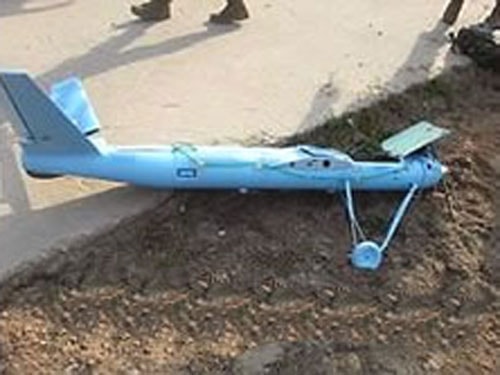 |
| North Korea's "toy" planes are causing alarm in South Korea. |
According to expert analysis, these aircraft are not capable of inflicting significant harm on South Korea. They are not designed for long-range missions; they are more suited to monitoring enemy activity beyond a hill or wall. "They have a relatively small range and lack endurance, only operating for a few hours at a time. They are more commonly used for battlefield surveillance," said James Hardy, editor of IHS Jane's Defense Weekly Asia-Pacific edition. Hardy added that these aircraft are far from being as advanced as those used by the United States in Yemen, Pakistan, and Afghanistan.
The South Korean side even considered the possibility that these drones were intended for offensive purposes. But Kim of the Ministry of Defense stated that even if explosives were loaded, they wouldn't have significant destructive power: "Even if they were used for future attacks, they could only carry 2-3 kg of explosives and wouldn't cause much damage." In fact, North Korea has publicly displayed similar, but larger, explosive-laden drones in recent years' show of force. Some videos show North Korea using them as missiles in some drills; however, according to Hardy, this is quite expensive to design a bomb, and they can only be carried on a single vehicle/warship.
If so, what makes these "toy" planes so suspicious to the Blue House? Because they managed to penetrate South Korea's air defense network. Constructed from polycarbonate, these planes are difficult to detect by radar. They fly at an average speed of 110 km/h (68 mph) at an altitude of 1.3 km (8 miles). They were launched from three different locations in North Korea, according to the South Korean Ministry of Defense: near Kaesong, 28 km southeast of Haeju, and 17 km from Pyonggak. For the South Korean Ministry of Defense, this constitutes a violation of the armistice agreement that ended the bloody conflict between the two Koreas in 1953. South Korea also announced it would send a warning to Pyongyang through the United Nations and tighten its air defense system in response to the aforementioned intrusive aircraft.
That being said, South Korea probably can't do anything to North Korea. There are two reasons: firstly, as usual, spring is a time when tensions between North Korea, South Korea, and the US are high. This is especially true after the US and South Korea concluded their annual joint military exercises in April. These exercises are a thorn in North Korea's side, seen as "rehearsals for an invasion." In response, North Korea launched two medium-range ballistic missiles from its east coast. A few days later, both sides simultaneously fired hundreds of shots across the Northern Limit Line – the disputed maritime border. However, both sides fired into the sea, not at any specific targets. Therefore, North Korea's incursion of South Korean airspace by aircraft was merely a typical intimidation tactic. Secondly, along with the threat of an impending nuclear weapons test, North Korea seems to be trying to create a diversion by making provocative but not excessive moves. Bypassing South Korea's air defense system will undoubtedly displease the Blue House, but what can they do when the uninvited guest is merely "going through the motions" without doing anything serious? Thus, South Korea, despite wanting to, has no justification for a concrete military response, and is left bewildered and anxious, wondering why its neighbor is sending these "unwanted guests." Let's wait and see what North Korea's next move is; only then will we know whether those "toy" planes are just feigning death or are truly just scarecrows.
Reishi Mushroom


