
A letter of credentials from a person from Nghe An.
(Baonghean) - In mid-April 2014, Japanese and Vietnamese newspapers reported that the National Museum of Japan had announced the discovery of the oldest letter from the Kingdom of Annam to Japan. However, to date, this matter has only been reported on the discovery. Therefore, we would like to provide readers with some documents to give a clearer understanding of the content and all issues related to this historical letter…
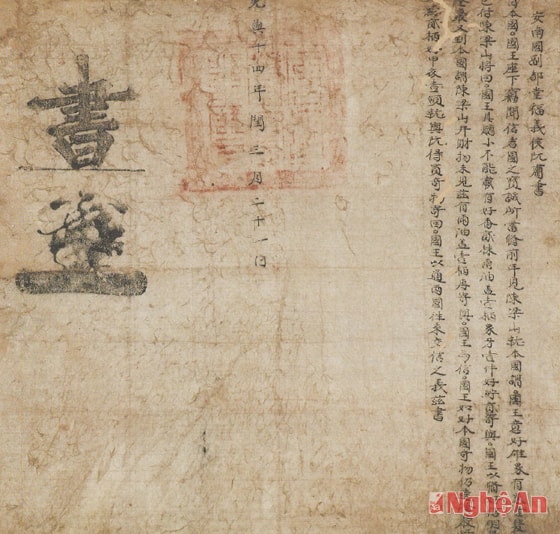 |
| Letter of credentials. |
Contents of the letter of credentials
According to reports, the letter measures 33.3 cm wide and 34.9 cm long, containing 180 Chinese characters written on traditional Vietnamese dó paper. Despite the passage of 423 years, the handwriting remains clear. First, we have translated this official letter into Vietnamese as follows:
"The Marquis of Phuc Nghia, Nguyen, holding the position of Deputy Governor of Annam, respectfully writes to His Majesty the King of Japan. I have heard that trustworthiness is a treasure of the nation, and it is truly worthy of cultivation. Last year, I met Tran Luong Son (a Japanese man) who came to our country and said that the King had a liking for war elephants. I had one elephant, so I entrusted it to Tran Luong Son to take back as a gift to the King, but because the ship was small, it could not be carried. So I immediately sent two fine agarwood trees, a rain umbrella, a bundle of ivory, and a bundle of hemp cloth to the King to cultivate my filial piety and trustworthiness. The following year, Long Nham (a Japanese man) came to our country again and said that the King had not yet seen Tran Luong Son and the aforementioned items. Therefore, I now have a rain umbrella, which I send to the King to maintain my trustworthiness. If the King likes the rare items of our country, please send Long Nham with two fine swords and a fine set of armor to the Nguyen man who acquired these rare items." He was in Japan to bring it back. That's how the King opened up a new chapter of diplomatic relations between the two countries. Now, this letter!
"The 21st day of the leap month of March, the 14th year of the Quang Hung era."
Previously, knowledgeable scholars considered the letter sent by Duke Nguyen Phuoc Nguyen to Tokugawa Ieyasu in 1601 to be the earliest diplomatic letter between Vietnam and Japan. This letter predates the Duke's letter by 10 years. Thus, it is the "First diplomatic letter between Vietnam and Japan" to date.
Author of the letter
From the very first line, the letter clearly states the sender's official title as "Deputy Governor." This is the "deputy" title of Governor or Grand Governor – a title that appears in letters from "Governor-General Li Hou" sent to Japan in 1610. The letter from Quang Phu Hou Nguyen Canh Ha to the Japanese Emperor in 1610 also mentions Grand Governor Thu Quan Cong rescuing and sheltering Japanese merchants after a shipwreck at Cua Hoi. This Governor title is equivalent to a Governor-General or Provincial Governor, the highest-ranking official in an administrative region. The fact that this letter was written by the Deputy Governor partly confirms that it was sent to Japan from the Le-Trinh government (later Dang Ngoai) and not from the Governor-General who also governed Thuan-Quang (later Dang Trong). In Dang Trong, correspondence had to be handled by the Nguyen Lords themselves, while in Dang Ngoai, many officials under the Trinh Lords were also permitted to exchange letters with Japan.
The letter clearly states: "...Phuc Nghia Marquis, surname Nguyen...", indicating that the sender of the letter to the Japanese Emperor was a member of the Nguyen family with the title of Phuc Nghia Marquis. The letter did not explicitly state the sender's name, only their title and surname. This makes it very difficult to identify the name and surname of this historical figure, not to mention the possibility of overlapping titles among different individuals. However, a distinguishing feature is that although they share the same title, their names and the eras they lived in are distinctly different. Therefore, the author of this letter must certainly have been a member of the Nguyen family. We have searched numerous national and regional chronicles and only found "Phuc Nghia Marquis" appearing in the genealogy of the Nguyen Canh family and in the episodic novel Hoan Chau Ky.
Therefore, we assert that the figure of Phúc Nghĩa Hầu Nguyễn mentioned in the diplomatic letter is indeed Phúc Nghĩa Hầu Nguyễn Cảnh Đoan. According to the Nguyễn Cảnh family genealogy, Tấn Quốc Công Nguyễn Cảnh Hoan had ten sons, of whom Phúc Nghĩa Hầu Nguyễn Cảnh Đoan was the eighth. According to the Nguyễn Cảnh clan management board, the descendants and place of worship of Phúc Nghĩa Hầu Nguyễn Cảnh Đoan are currently unknown. We will continue our research to learn more about this historical figure.
The diplomatic letter hints at Vietnam-Japan relations.
The very last sentence of the diplomatic letter affirms: "The King has opened the way for diplomatic relations between the two countries." This letter was written in 1591, and the following year, 1592, Japan entered the "Red Seal Ship" era – the period of its most prosperous diplomatic and commercial expansion with Vietnam and many other countries. The Japanese government at the time issued "Red Seal Ships" – documents bearing the red seal of the Shogunate – to merchant ships trading at the ports of Hoi An (Quang Nam), Pho Hien (Hung Yen), and especially Phuc Le (Hung Nguyen - Nghe An). At that time, Phuc Le was one of the busiest and most important international trading ports in Vietnam, with economic relations with many countries, most notably with Japanese merchant ships. Here, the Japanese established a trading district as well as several other cultural structures. For several decades, Japan and Vietnam built a friendly relationship not only in economics but also in diplomacy and culture. However, later, due to both objective and subjective reasons, this once-glorious trading port declined and completely disappeared. This is a lengthy issue, so we will address it in detail in a later article.
Although brief, this diplomatic letter truly reveals much about the historical relationship between Vietnam and Japan. Beyond their shared cultural ties, diplomatic relations were established very early on, playing a crucial role in strengthening trade relations between the two countries later on. This is invaluable original evidence for further research into the historical bilateral relationship between Vietnam and Japan.
Tu Quang


