
The transformation of a model district in cultural development.
(Baonghean)In 2001, implementing Resolution No. 5 of the 8th Central Committee Conference on "Building and developing an advanced Vietnamese culture imbued with national identity," Quy Hop district was selected by the Ministry of Culture and Information to be a model district for mountainous and ethnic minority culture. After 10 years of implementation, the district's appearance has undergone significant changes...
On every road, in every hamlet, in every village, the transformation of Quy Hop district is easily noticeable. In the middle of the town, Thung May Lake has been renovated and rebuilt, creating an interesting ecological highlight for those who set foot in this mountainous district. In Mo hamlet (Nghia Xuan), Hoa Thanh hamlet (Chau Quang commune), Vac hamlet (Tam Hop commune)... the cultural spaces of the Thai and Tho ethnic groups remain intact after many efforts by the local people to preserve them. Building and developing Quy Hop district to be both modern and traditional, rich in ethnic identity, is the main goal of Quy Hop district in its cultural model district project in recent years.

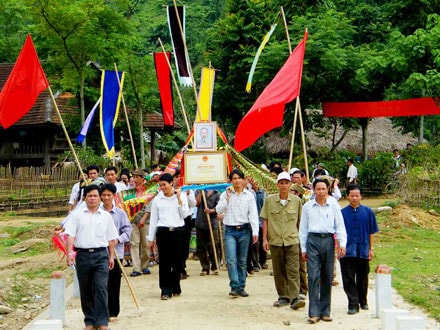
National Unity Day in Lien Hop commune, Quy Hop district.
To achieve these results, for the past 10 years, the movement for national unity in building a cultured way of life has been implemented in all villages and hamlets. The most prominent aspects include building exemplary individuals and good deeds, promoting advanced models; building cultured families, villages, hamlets, and organizations; and launching a nationwide movement for unity and emulation in developing production, eradicating poverty, and achieving legitimate wealth. As a result, the entire district has had 2,680 exemplary individuals and good deeds recognized, and 5,247 families and 67 villages and hamlets have been recognized as cultured. This movement has also led to increased attention and support from all levels and sectors in mobilizing social resources for the construction of facilities for sports and physical activities.
Over the past 10 years, the entire district has mobilized 2.6 billion VND from various funding sources to build playgrounds, training grounds, and equipment for training and competition. As a result, to date, 240 out of 277 hamlets and villages have community cultural centers, 260 hamlets have facilities for cultural activities, and 100% of hamlets and villages have cultural and sports teams organizing cultural activities. Economically, the movement to restructure crop production and apply scientific and technological advancements to production has been strongly embraced by the people. In many communes, many individuals have boldly invested in transforming their farming methods from semi-industrial to concentrated industrial farming. Hundreds of farms have emerged in the district, generating an average annual income of 50-100 million VND…
Ban Teo village in Chau Cuong commune has been awarded the title of Cultural Village.
Despite positive developments, the low starting point, uneven economic development across regions, and difficult transportation in the communes have resulted in many targets not being met during the project's implementation. For example, the entire district only has 8 cultural health stations (reaching 63.5% of the target), 8 communes and towns with cultural, information, and sports facilities meeting national standards (reaching 76.2% of the target), and 2 communes and towns with playgrounds for children (reaching 19% of the project target). Besides these objective reasons, the main cause remains the lack of experience among Party committees, government agencies, and relevant departments in leading and building cultural districts and communes. Many communes have very low local revenue, limiting investment in cultural, information, and sports activities and the construction of cultural facilities. Regarding guidance, there are still many obstacles from the central level down to the grassroots, so the content development remains general, lacking focus and key priorities.
Given the above situation, in the coming time, Quy Hop district needs to strengthen efforts to improve the quality and effectively implement the movement of "All people unite to build a cultured life at the grassroots level". This includes focusing on improving the quality of recognized cultural titles, and building a civilized lifestyle in weddings, funerals, and festivals; Establishing order in business operations, traffic safety, environmental sanitation, and a cultured lifestyle in public places, as well as organizing rehabilitation programs for drug addicts... In addition, activities to preserve and promote the traditional cultural identity of ethnic groups need to be continued and promoted, with effective social mobilization... Furthermore, the district has planned to build several key historical and cultural sites associated with tourism to create cultural and recreational areas for the people and attract tourists, such as Choong Temple, Ban Bia Waterfall (Chau Ly), Le Loi Training Ground Memorial (Tam Hop), Forest Stream (Dong Hop), Muong Dam Eco-tourism Area (Chau Thai), Khe Lanh (town)...
My Ha


