
A new turning point in the cooperative sector of Nghe An.
Over the years, the collective economy in Nghe An province has made positive progress, both in quantity and quality. Many new models have emerged and are operating effectively. After more than 10 years of implementing the Party's Central Resolution No. 5 (9th Congress); the 2003 Cooperative Law and Directive 20; the collective economic sector of the province has undergone many positive changes.
(Baonghean)Over the years, the collective economy in Nghe An province has made positive progress, both in quantity and quality. Many new models have emerged and are operating effectively. After more than 10 years of implementing the Party's Central Resolution No. 5 (9th Congress); the 2003 Cooperative Law and Directive 20; the collective economic sector of the province has undergone many positive changes.
To date, the province has nearly 2,800 cooperative groups, nearly 850 cooperatives and cooperative unions, 119 craft villages, and hundreds of villages with traditional crafts. The activities of cooperatives, cooperative groups, and craft villages are diverse and effective, actively supporting the development of the agricultural and rural economy and household economy. They have contributed significantly to shifting the proportion of the agricultural and rural economic structure in localities, most notably cooperatives in the non-agricultural sector and people's credit funds. The collective economy is increasingly contributing to rural infrastructure (concrete paving of canals, irrigation, internal field roads, rural roads, etc.), applying scientific and technological advancements: seeds, fertilizers in intensive production, and agricultural extension activities.
The collective economic sector and traditional craft villages have made a significant contribution to the province's revenue, averaging 700-900 billion VND annually; and 15-20 million USD in export value, contributing significantly to social security stability, poverty reduction, job creation, and ensuring the rights of member households. Agricultural cooperatives have both strengthened the quality of their service operations and expanded production and business; non-agricultural cooperatives have focused on investment, expanding their scale, and transforming their industries to suit the new situation and integration trends.
The trend of joint ventures and linkages between cooperatives and other organizations such as craft villages and businesses continues to expand and yield high efficiency. Typical examples include craft village cooperatives collaborating with vocational training centers in training in small-scale handicrafts; in product consumption; and in the application of scientific and technological advancements. Increasingly, new cooperative models are emerging, meeting the practical needs of life, such as market cooperatives, environmental cooperatives, craft village cooperatives, and forestry cooperatives.
A prime example is the Quyet Thanh Cooperative, whose main business is the production and trading of ultra-fine limestone powder and construction materials. Recently, the cooperative boldly invested in a multi-functional complex project including a supermarket, hotel, and restaurant in Ben Thuy ward with a total investment of 35 billion VND, which commenced operations at the end of 2011. Annual revenue reaches approximately 20 billion VND, creating regular employment for 70 workers with an average income of 2.5 million VND per person per month...
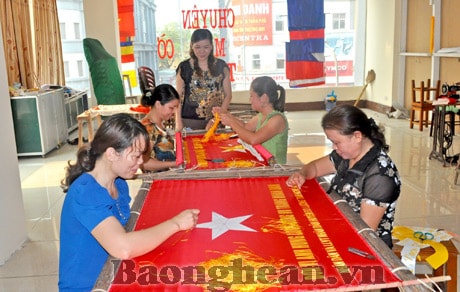
Traditional flag embroidery at Thong Nhat Cooperative (Vinh City).
Despite challenging conditions, the Thong Nhat Garment and Embroidery Cooperative has strived to maintain and stabilize its traditional garment and embroidery business. Although the scale and efficiency of production and business are not yet high, its operations, policies, and social activities comply well with the regulations of the 2003 Cooperative Law. Annual revenue exceeds 600 million VND. In 2010, the cooperative entered into a joint venture with Ca Vang Co., Ltd., admitted new members, and increased its business capital to build a commercial and service complex, which is currently under construction with a total investment of 15 billion VND. Ms. Nguyen Thi Thuy, the Chairwoman of the Thong Nhat Cooperative, stated: Currently, the cooperative is building a comprehensive commercial and service center at No. 4, Tran Phu Street, Vinh City. It is expected to be completed by the end of 2013, after which the cooperative will expand its business to include motorbike sales, photography, electronics repair, and garment manufacturing.
According to Mr. Luu Van Ngu, head of the Phu Hau Agricultural Cooperative (Dien Tan, Dien Chau), in recent years, the cooperative has focused on guiding farmers in rice production and providing services such as irrigation, electricity, fertilizers, plant protection products, and pesticides. Since 2011, the cooperative has boldly signed a contract with the Southern Seed Company to produce the purebred KN2 rice variety. In the first crop, they cultivated 3 hectares, harvesting nearly 16 tons of rice seeds, which they sold to the company at 6,700 VND/kg. In 2012, the cooperative continued to sign a contract with the Thai Binh Seed Corporation to cultivate 17 hectares of BC15 rice seeds, harvesting nearly 130 tons, which they sold to the company at 6,400 VND/kg of fresh rice. The favorable price has made the farmers very happy. In 2013, the cooperative continued to expand its rice seed production area to supply companies, aiming to bring higher income to its members.
Based on the practical results achieved by the collective economy in Nghe An province in recent years, it can be affirmed that the collective economy, with cooperatives as its core, has contributed to promoting the development of productive forces, liberating productive capacity, and ensuring that potential resources for production such as capital, land, labor, and technology are increasingly exploited and used rationally. It serves as a bridge for the development and exchange of goods between agriculture and industry, between urban and rural areas, and promotes the social division of labor. In reality, wherever the collective economy is given attention and developed, agriculture, farmers, and rural areas are closely intertwined; village security is ensured, and the lives of cooperative members and workers are improved.
In the overall development, the Provincial Cooperative Union has played a core and crucial role in promoting the development of the cooperative economy. The Provincial Cooperative Union has adopted dynamic, creative, and proactive approaches to effectively support the development of the cooperative sector; advising government agencies at all levels on timely measures to resolve difficulties and obstacles for cooperatives. Simultaneously, it has researched and learned from practical experiences to promote the establishment and replication of new cooperative models; protecting the rights and interests of members, and creating strong linkages between cooperatives.
However, despite the encouraging results, cooperative economics and cooperatives in Nghe An province still face certain difficulties and limitations. The most fundamental limitations include the scale of capital; the availability of equipment and production materials; the application of new technologies in production; the attraction of highly skilled human resources; the shrinking service sector, with cooperative members mainly relying on self-sufficiency or private sector services; and the uncertainty surrounding expanding production and business, and diversifying industries due to a lack of direction and conditions regarding capital, land, and technical expertise.
In the coming years, with the economic outlook remaining challenging, cooperative economic organizations, cooperatives, and traditional craft villages must strive to improve themselves, orienting their operations correctly and appropriately to their internal realities and the new demands of competition and integration. First and foremost, autonomous economic units in these sectors must determine the position and capabilities of their cooperatives, craft villages, and grassroots people's credit funds within the market chain to develop appropriate production, business, and service solutions and plans. While cooperatives do not aim for profit like businesses, all their activities must be geared towards the benefit of their members. To achieve this, it is necessary to maximize the participation of members in the development of cooperatives, and to foster linkages and cooperation to enhance their capacity and competitiveness in the increasingly fierce integration process.
Quynh Lan


