
A breakthrough in the education sector.
In the 2012-2013 academic year, the Ministry of Education and Training directed the pilot implementation of the new Vietnamese primary school model (VNEN) in 1,447 primary schools across 63 provinces and cities nationwide from June 2012 to June 2015. The VNEN model is part of the GPE-VNEN Project, funded by non-refundable grants from the Global Education Fund. In our province, this model was implemented in 73 primary schools across 20 districts, cities, and towns. After one pilot semester, initial positive changes have been observed in reforming teaching methods, focusing on student-centered learning, and changing the rote learning approach.
(Baonghean)In the 2012-2013 academic year, the Ministry of Education and Training directed the pilot implementation of the new Vietnamese primary school model (VNEN) in 1,447 primary schools across 63 provinces and cities nationwide from June 2012 to June 2015. The VNEN model is part of the GPE-VNEN Project, funded by non-refundable grants from the Global Education Fund. In our province, this model was implemented in 73 primary schools across 20 districts, cities, and towns. After one pilot semester, initial positive changes have been observed in reforming teaching methods, focusing on student-centered learning, and changing the rote learning approach.
Every day, after the bell signals the start of class, the student councils of Le Hong Son Primary School (Xuan Hoa commune, Nam Dan district) begin the new lesson with a group song or game, review previous lessons, and read out the lesson objectives before the homeroom teacher enters the classroom. Attending a math lesson with the 3A class at Le Hong Son Primary School, one can feel the lively atmosphere, the knowledge is conveyed gently, and students discuss and offer different solutions to problems involving three-digit numbers... Many groups, when their discussions become tense, raise a lifeline to ask the homeroom teacher for intervention. Ms. Nguyen Thi Hong, the homeroom teacher, said: “In this educational model, students play a central role, and the teacher is only a companion helping them to discover knowledge on their own. With this method, all students participate in contributing to the lesson and must work actively, instead of passively receiving knowledge as before.”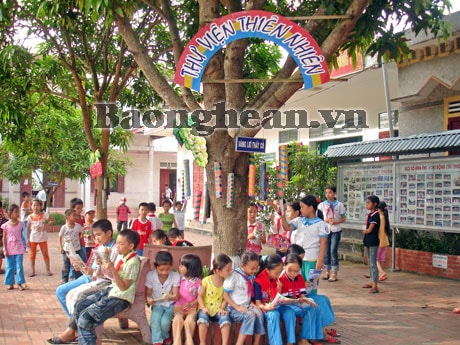
The Nature Library model at Nghi Phu 2 Primary School. Photo: KL
A new feature of the new school model is that students are arranged to sit in groups (6-8 students per group depending on the class size); classrooms are arranged like subject-specific classrooms, and the library is flexible with readily available and self-made teaching materials that students can access when needed. “Arranging students to sit in groups helps them develop new skills through collaborative learning, making it easier to participate in group activities, thereby fostering independence and creativity. Teachers can approach each student individually to answer questions instead of just standing at the podium delivering one-way instruction. The classroom decoration is very friendly and creates enthusiasm for students,” affirmed Mr. Hoang Xuan Quang, Principal of Le Hong Son Primary School.
Students are the central focus of the teaching and learning process, so the class self-governance council is elected by the students themselves instead of being appointed by the homeroom teacher as before. The criteria for electing the class self-governance council, which includes one president, two vice-presidents, and six members for various committees (including: academics, library, external relations, counseling, arts and sports, health and hygiene), require students to be academically strong, dynamic, proactive, and capable of public speaking. With this election method, the class will have a reputable and capable self-governance team to organize self-study and self-education activities according to the requirements of the new school model. Allowing students to elect their own self-governance council gradually fosters in them a sense of responsibility and a willingness to take action and accept consequences when making decisions. Previously, the class committee only followed the homeroom teacher's orders to manage activities. Now, the class self-governance council takes over all activities, only reporting to the teacher for support and assistance when absolutely necessary. Nguyen Nu Hoang Thuc, President of the class self-governance council of class 3C, Nguyen Trai Primary School (Vinh City), said: "As the president of the self-governance council, I feel more agile, flexible, confident in communication, and know how to mobilize all members of the group to participate in building the lesson."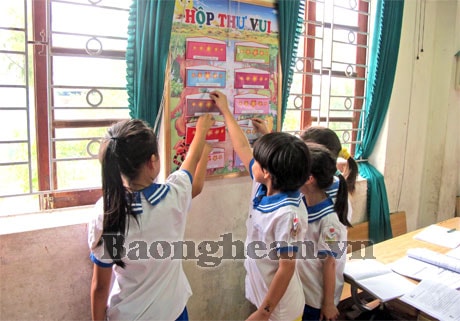
The "Fun Mailbox" model at Nguyen Trai Primary School (Vinh City). Photo: TP
The new teaching materials are in the form of "study guides" for the subjects of Vietnamese Language, Mathematics, and Social Studies (other subjects will be taught normally). These materials are built on the basis of maintaining the current curriculum, textbook content, and knowledge and skills standards. The materials have been revised, with each lesson containing three activities: a basic activity, a practical activity, and an application activity. Within each lesson, each activity is designed in various ways, depending on the subject and lesson, such as individual activities, team activities (groups of 3 or more), and whole-class activities. The best aspect of these materials is their "three-in-one" arrangement: textbooks, teacher's guides, and self-study guides are combined into a single document. Therefore, with just one book, students can self-study, complete assignments, receive guidance from teachers, and parents can also use it to guide their children without needing any other supporting materials. During the project period, this material will be distributed free of charge to all students. The material only compiles effective teaching and learning methods, so teachers must change their mindset about teaching while ensuring the knowledge and skills standards of the curriculum are met. “Initially, teachers faced considerable difficulties because previously they only stood at the podium, lecturing the whole class, but now they have to guide and mentor groups, explain questions and concerns to individual students. At the same time, they have to be creative in making teaching aids and read many materials… However, later on, as the class self-governance council became more organized, took control of the classroom, and systematically organized the 10 steps of the curriculum, the teacher's role became more of a guide and facilitator for the students…,” said Ms. Nguyen Thi Huong, Head of the Grade 2 Subject Department, Nguyen Trai Primary School (Vinh City).
Parents, initially hesitant, are now dedicating time and resources, along with the homeroom teacher, to decorating the classroom and study area for their children according to the regulations of the new primary school model, creating enthusiasm for learning. Mr. Vi Khang Chien (from Hoi 3 village), whose child is in grade 2 at Chau Hoi Primary School (Quy Chau), said: “This school year, the school is implementing teaching according to the new primary school model. I strongly support it. With this learning method, students, especially those from ethnic minorities, will develop communication skills and become more proactive and flexible. Since the beginning of the school year, parents in the class have been actively participating.”
"Activities to create display items for the community corner; cutting, pasting, and decorating classrooms."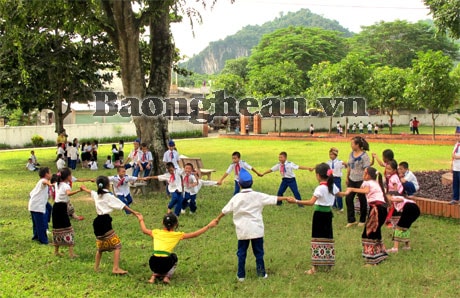
Students from Chau Hoi 1 Primary School (Quy Chau) participate in traditional folk games.
Photo: TP
The classroom of 2A at Chau Hoi 1 Primary School is filled with vibrant colors, featuring corners for community, math, Vietnamese, and a fun mailbox. Hand-embroidered scarves, Thai skirts, embroidered wallets, and belts made by mothers and grandmothers, along with handcrafted flutes, bamboo pipes, fish baskets, axes, and machetes made by fathers, have instilled in the children a sense of responsibility for productive labor and a pride in preserving their ethnic identity. Meanwhile, at Nguyen Trai Primary School (Vinh City), as an initial step to overcome the shortage of textbooks for the new model, parents have contributed their own money to photocopy materials, and the Quan Bau Ward People's Committee has invested in purchasing desks and chairs for students to facilitate group learning.
Mr. Tran The Son, Head of the Primary Education Department (Department of Education and Training), said: “This is a completely new model (from teaching methods for teachers, learning methods for students, materials, classroom organization methods, etc.), but all 73 primary schools under 20 Education Departments have embraced the model with enthusiasm and high determination. To overcome difficulties in the initial implementation of the model, at the end of July 2012, the Ministry of Education and Training organized a training conference on teaching according to the new school model for specialists in charge of primary education in the Education and Training Departments and key teachers of schools applying the new school model. The Department of Education and Training has directed schools to effectively carry out teacher training through self-study, self-improvement, self-making of teaching aids, and sharing and learning from colleagues' experiences through professional activities at the group, school, and cluster levels. It can be said that this is a breakthrough in educational thinking...”
However, when implementing this program, schools encountered many difficulties such as: having to equip themselves with the necessary facilities and furniture to organize activities as required, while the schools still faced difficulties; some parents were still hesitant to fully support their children because they feared the amount of knowledge in the materials would not be enough for them to pass entrance exams to specialized schools and classes; and the large number of students in each class made it difficult to design group activities that met the requirements...
This is an excellent educational model; if successfully implemented and scaled up, it will create a breakthrough in the holistic development of students.
Thanh Phuc



;)