
Tung Huong Fish
(Baonghean)Day after day, before dawn, the people of Tung Huong village, Tam Quang commune, Tuong Duong district, wake up and go to Khe Da to catch fish, only returning in the evening. They have found a rare and precious fish, a specialty of western Nghe An province, called "ca mat"...
 |
| Casting nets to catch cool-weather fish in Tung Huong. |
We followed a villager from Tung Huong as he went fishing in the streams flowing through Tam Quang commune (most concentrated in Khe Da and Nam San). His name is Lo Van Phuong (65 years old), from Tung Huong village. Mr. Phuong said: "The women choose shallow sections of the stream to catch fish with baskets, the men dive with nets, and we all get up very early every morning to go fishing!" He has been fishing for over 40 years, and Mr. Phuong's steps are still nimble; we followed him breathlessly. Mr. Phuong said: "The roads to the villages in the inner areas are all paved now, it's a hundred times easier than before." Mr. Phuong, now 65 years old, still looks healthy and agile, no less so than the young people in the village and commune. He can dive underwater for a long time and continuously without getting tired.
Fishing had become a habit for him. The villagers only started fishing later, mainly during their free time between farming seasons to catch fish for food, and if they caught a lot, they would sell it. He mainly sold his catch to restaurants outside the district. Back then, this road was deserted; sometimes he and his son would fish all day without seeing anyone. Now, there's a lot of traffic, all thanks to this new road! Mr. Phuong was a soldier in the Ho Chi Minh Army. After being discharged, he returned to his hometown and specialized in slash-and-burn agriculture, so his family owned the most farmland in Tung Huong village. They had more rice than they could eat, but he still chose fishing as his profession, because it had been a part of his life since childhood. When he was not yet 10 years old, he went fishing with his father, fishing both within and outside the commune. He and his father once took a bus to Ky Son and stayed there for a whole month to cast nets in the Nam Mo River.
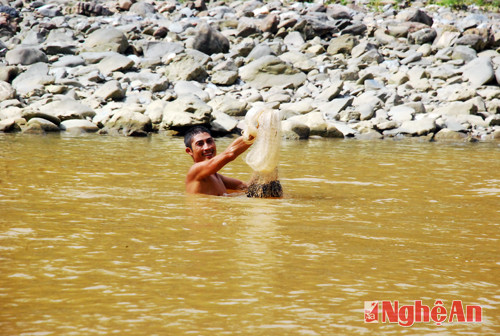 |
| Casting nets to catch cool-weather fish in Tung Huong. |
Reaching Khe Huong (Tung Huong village), he waded in, the water reaching his waist. He submerged himself completely for a moment, then surfaced and said, "This is just to see if there are many fish here." Having fished in Khe Huong for over 40 years, Mr. Phuong knew which sections of the stream had a lot of fish, whether they were big or small, and where there were many or few fish. He stretched out and cast his net. After a dozen casts without catching a single fish, he didn't find it strange, but I felt impatient because of the sweltering heat. He shouted, "There are fish! There are big fish!" He removed the fish and put them in a wicker basket, saying, "Fishing in the summer is much more enjoyable and easier than in the winter. In the summer, the water is cool and refreshing, while in the winter it's freezing cold and very tiring. But everyone likes fishing. Not for the money, but because of habit. Whoever catches fish will prepare dishes that the villagers usually eat, like grilled fish or sour fish soup. When one family gets fish, they invite others over; it's a lot of fun." In the past, due to difficult roads, we had to trade fish for rice with buyers from outside the district. They paid very low prices. Now, with improved transportation, people come directly to buy fish, or we can take the fish to the district or the commune center to sell. Freshwater fish now fetch a high price.
 |
| Casting nets to catch cool-weather fish in Tung Huong. |
Mr. Phuong caught nearly 2 kg of catfish. In a cheerful mood, he said, "There's a very skilled fisherman in the village, Mrs. Lo Thi Ha. When we get back, I'll take you to her house." After lunch, we followed Mr. Phuong to Mrs. Ha's house. The aroma of grilled fish filled the air from the gate. Mrs. Lo Thi Ha (63 years old), dressed in traditional Thai clothing, was carrying several baskets of fish and pouring them into a basin. She cleaned the fish and used two bamboo clamps to hold the large catfish before grilling them. "Today, the whole family caught this much. Several people asked to buy some, but I didn't sell them. I'll grill them until tomorrow and take them to the district market to finish buying some household items." Mrs. Ha and her two children caught nearly a kilogram of catfish in a single day. She said, "Catfish are scarce now; we used to catch more. Whether it's a lot or a little, people still like to go fishing. Even if we don't catch much, it's enough to eat for the day. If we don't eat it, we grill it and hang it in the kitchen attic to eat gradually. If anyone wants to buy it, we sell it. Dried catfish is fragrant, chewy, and very delicious."
Catfish can be prepared in many delicious ways, such as fish cakes, grilled catfish, catfish braised in soy sauce and turmeric, and catfish sour soup. However, the most special dishes are grilled catfish and steamed catfish with betel leaves. For steamed catfish with betel leaves, after washing and draining the fish, marinate it with seasoning powder, finely ground salt, MSG, a little fish sauce, and top with a layer of finely chopped betel leaves. Marinate for about 15 minutes, then bring to a boil. When the aroma of the fish rises, it's cooked. This dish is usually eaten in the summer, being refreshing and nutritious. For those who like soup, add cold water, bring to a boil, and add a handful of wild tamarind leaves. This dish is perfect for summer and unforgettable for anyone who has tried it. Then there's catfish sour soup; fresh, whole catfish cooked with pickled cucumbers, eggplant, and pickled bamboo shoots is incredibly appealing. The most popular choice remains grilled or deep-fried catfish, known for its sweet and savory flavor and firm texture, served with a dipping sauce of salt, chili, lime, MSG, and star anise. The combination of sweet and sour from the salt, sweetness from the MSG, and the pungent spiciness of the star anise is absolutely delicious.
The fresh, live fish are grilled by Mrs. Ha over glowing charcoal. When cooked, the fish skin turns a golden yellow, and the aroma is incredibly fragrant. Mrs. Ha explains that to make the fish delicious and not bitter, before grilling, you must cut open the fish's belly to remove the intestines, sprinkle a little white salt (the salt must be roasted until dry and then ground finely) along with wild chili peppers and dổi seeds, and then spread it evenly on both sides of the fish. You have to be skillful when spreading it so that there are no areas that are too bland or too salty. Once the fish is cooked, you just break it off and eat it.No need for dipping sauce anymore. I looked at the grilled fish on the glowing charcoal, their tails curled, the aroma of the fish and the dổi seeds wafting out. Aunt Ha told me to try some. It was delicious. Aunt Ha said, "Grilled catfish with sticky rice cooked in bamboo tubes is very tasty. It's a custom of the Thai people in Tung Huong village that whenever there are honored guests or during holidays and Tet (Lunar New Year), grilled catfish with sticky rice is indispensable. Making delicious fish requires a lot of effort. In the old days, every Tet, the villagers would organize a fish grilling competition. Everyone enthusiastically prepared the charcoal and bamboo to hold the fish, while the village chief, the women's association, and the youth union acted as judges. The women competed, and the men and boys stood and clapped, cheering them on. It was a lot of fun."
The people of Tung Huong village fish for freshwater fish throughout all four seasons, so there's always fish in the attic above their kitchens. During rainy and flood days, the fish in the attic are the main food source for the villagers. Many people ask to buy them, but the villagers refuse to sell, keeping them for themselves and sharing them with others – a beautiful tradition of the people of Tung Huong from ancient times to the present.
Thu Huong