
Over 30% of the country's export locations achieved export revenue of $1 billion or more.
The scale and growth rate of export turnover depend on many factors, including the export destinations.
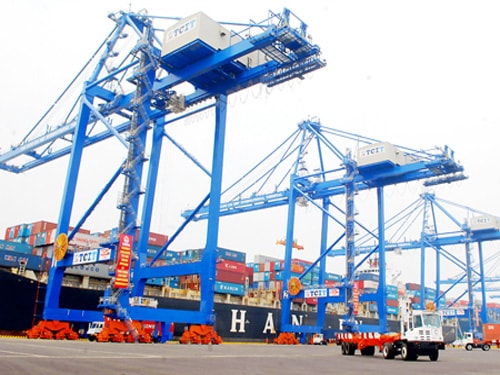 |
| The scale and growth rate of export turnover depend on many factors, including the export destinations. |
While it is necessary to expand and leverage the advantages of localities across the country to create a powerful impact, it is also important to honor localities that achieve export turnover of 1 billion USD or more.
According to the General Department of Customs' database, 19 provinces and cities have achieved export turnover of 1 billion USD or more.
Thus, nationwide, over 30%, or nearly one-third of the total number of localities, achieved a turnover of 1 billion USD or more; nearly 14.3% of localities achieved over 2 billion USD; 4 localities achieved over 10 billion USD, and notably, 2 localities achieved over 25 billion USD: Ho Chi Minh City and Bac Ninh.
Of Vietnam's six economic regions, five have members in the "club" of localities with export turnover reaching 1 billion USD or more (only one region, the Central Highlands, has no provinces, but Dak Lak has reached approximately that amount (982.7 million USD).
The three regions with the most members (5 members each) are the Red River Delta, the Southeast region, and the Mekong Delta. Two regions have only two members: the Northern mountainous and midland region and the Central coastal region.
The export turnover of the 19 members of the "club" reached over $115.7 billion, accounting for 87.6% of the country's total export turnover. From this perspective, due to this large proportion, the increase/decrease in the export turnover of the "club" is decisive in determining the scale and rate of increase/decrease of the country's total export turnover.
It is noteworthy that these are also the areas with the largest amount of foreign direct investment (FDI) in the country.
Ho Chi Minh City leads the country in FDI capital (US$33.35 billion) and is also the leading exporter. Bac Ninh, although only ranking 12th (with nearly US$4.58 billion), is the second largest exporter nationwide; and ranks first per capita. With additional FDI capital and the potential for market expansion, Bac Ninh will soon surpass Ho Chi Minh City to become the leading exporter nationwide.
Binh Duong, with nearly $18.7 billion in FDI, ranks 5th in terms of FDI, but ranks 3rd in exports. Dong Nai ranks 4th in FDI (with nearly $20.7 billion), and also ranks 4th in exports.
Hanoi ranks third nationwide in FDI capital (over $21.7 billion), and with its strengths in various export goods, it will quickly surpass the $10 billion mark in export turnover. Hai Duong, although an agricultural province, ranks tenth nationwide in FDI capital ($6 billion) but already has the sixth largest export turnover.
Hai Phong ranks 7th in FDI (with nearly $9.1 billion) and also 7th in exports. Long An ranks 16th in FDI (nearly $3.7 billion), but being located in a key region for rice and seafood, it ranks 8th in exports. Ba Ria-Vung Tau ranks 2nd in FDI ($23.4 billion) and 9th in exports.
Although Quang Ninh ranks 13th in FDI (with 4.2 billion USD), thanks to its strength in coal exports (this year, export volume decreased by 15.7%, export prices fell even more sharply by 37.7%, and coal export value decreased by 26.1%), its total export value ranks 10th nationwide.
Some localities have large amounts of FDI capital (such as Ha Tinh ranked 6th, Thanh Hoa ranked 8th, Phu Yen ranked 9th, Quang Nam ranked 11th, Quang Ngai ranked 14th, Thai Nguyen ranked 17th, Binh Thuan ranked 18th, Kien Giang ranked 19th, Thua Thien-Hue ranked 22nd, Nghe An ranked 25th), but because the projects are still primarily focused on export or the products are mainly consumed domestically, they do not yet have a significant position in exports.
Some areas within key agricultural regions have also achieved large export volumes. However, some areas within key agricultural regions, due to a decrease in export value of certain commodities this year, have not yet reached a high enough total export value to join the "club," especially some provinces in the Mekong Delta and some provinces in the Central Highlands.
Across the country, 42 provinces/cities have a trade surplus, with the largest being Bac Ninh (US$3.48 billion), Binh Duong (US$3.073 billion), Ca Mau (US$1.043 billion), An Giang (US$915 million), Can Tho (US$861 million), Ho Chi Minh City (US$859 million), Dak Lak (US$837 million), Long An (US$733 million), Tay Ninh (US$626 million), Khanh Hoa (US$593 million), Tien Giang (US$552 million), Kien Giang (US$527 million), etc.
Expectations for 2014 include more localities reaching $1 billion or more in FDI, as FDI projects are implemented, agricultural, forestry, and fisheries exports recover, businesses take advantage of the benefits of the global economic recovery, and Vietnam signs an FTA with Europe and joins the TPP...
According to Government.vn


